Australian Youth Orchestra National Music Camp: Orchestral Program
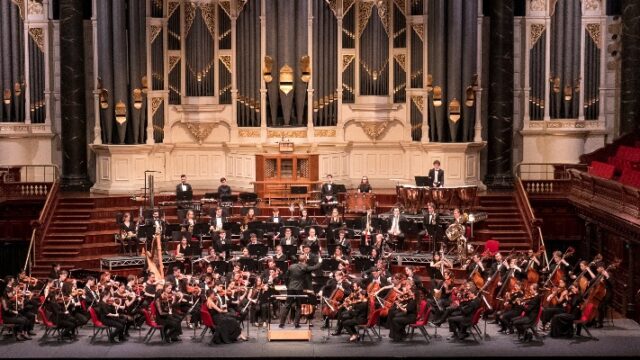
The Australian Youth Orchestra's National Music Camp brings young orchestral players to Adelaide for two weeks of living on site and playing in a symphony or chamber orchestra. Days are spent in full rehearsals, sectionals and tutorials with professional tutors, along with chamber music and professional development sessions. The camp ends with a series of public concerts at the AYO Summer Music Festival. Entry is by recorded audition of set orchestral excerpts and, for most instruments, a short piece of your choice.
At a glance
Official facts · checked 24 Nov 2026- 2027: 11 to 24 January
- Ages 14 to 22 inclusive as at 1 January 2027. Australian citizens or permanent residents, or students enrolled in full-time study in Australia during 2027
- 2027: $1,390
- In person, Adelaide, SA
- Length
- 2 weeks
- Included / budget separately
- Included: accommodation, meals (All meals). Separately: application fee $75 (non-refundable, waived for First Nations applicants), Own transport to and from the program, Instrument freight to and from the program
- Deposit and refunds
- Withdrawing from the program may carry financial penalties depending on how close to the start you withdraw
- Financial aid
- Means-tested scholarships open to all successful applicants, to help offset program fees and travel costs
- Apply by
- 2028: Not announced yet. 2027: 3 August 2026 (Registration and application fee), 11 August 2026 (String auditions), 13 August 2026 (All other auditions and portfolios)
- Cohort and selectivity
- Places are offered by recorded audition, ranked by instrument panels, with offers depending on the instruments each program's repertoire needs. More than 200 participants (2027)
- Credit or certificate
- Not published
- Official page
- ayo.com.au/program/ayo-national-music-camp
Get the key facts by email
The dates, costs and how to apply, all in one place.
Should you apply?
SucceedWhy it's worth it
The $1,390 fee covers two weeks of rehearsals, tutorials and chamber music plus your room, meals and transfers, and the 2027 tutors include principal players from the Adelaide and Melbourne symphony orchestras and the Gewandhaus Orchestra. You also finish with a run of public concerts at Elder Hall, which is real performing experience under international conductors.
What it asks of you
The work starts months before camp. You have to prepare a recorded audition of set excerpts and, unless you play percussion or timpani, a short unaccompanied piece, and for the 2027 camp those videos were due in mid-August 2026.
Who should skip it
Students who'd rather sleep at home or miss a day or two. Evening activities are part of camp, so AYO encourages everyone to stay on site, even if you live in Adelaide, and you have to arrive and leave on the scheduled days.
What do the two weeks actually involve?
Your days revolve around full rehearsals in a symphony or chamber orchestra, sectionals and tutorials with your instrument's tutor, professional development sessions and rehearsals with a small chamber ensemble. The daily schedules come in a Participant Handbook that AYO sends about a week before camp, and your parts arrive at least a month ahead, so you can learn the music over the holidays.
Your schedule may also include free time and staff-run activities such as yoga and trivia, and AYO says activities often run into the evening. The AYO Summer Music Festival at Elder Hall runs from 16 to 23 January 2027, with the camp giving four orchestral concerts, a brass and percussion concert, a chamber music concert and a composition showcase. The announced lineup, which AYO says may change, includes Debussy's La Mer, Brahms's Symphony No. 2 and Bernstein's West Side Story Symphonic Dances.
Who will be teaching and conducting?
Your tutors are working orchestral musicians and conservatory teachers. For 2027, AYO has named 26 tutors and course leaders for more than 200 participants across the whole camp, which works out to roughly one for every eight. Just over half of the tutors are AYO alumni. Creative Director Lachlan Bramble is Associate Principal 2nd Violin of the Adelaide Symphony Orchestra.
The conductors are Alexandre Bloch, Music Director of the Orchestre National de Lille, and Emilia Hoving, Associate Conductor of the Royal Philharmonic Orchestra, while Aiko Goto of the Australian Chamber Orchestra directs strings. Composer-in-residence Maria Grenfell has pieces on several of the concert programs.
Strings
Violin: Jos Jonker (Melbourne Symphony Orchestra), Elizabeth Layton (Elder Conservatorium), Riley Skevington (West Australian Symphony Orchestra) and Kate Suthers (Adelaide Symphony Orchestra Concertmaster). Viola: Merewyn Bramble and Stephen King. Cello: Sharon Grigoryan and Howard Penny. Double bass: Damien Eckersley (New Zealand Symphony Orchestra) and Robert Nairn.
Woodwinds
Julia Grenfell (flute), Celia Craig (oboe), Dean Newcomb (clarinet) and Jack Schiller (bassoon, Melbourne Symphony Orchestra Principal).
Brass
Gill Williams (horn, Beethoven Orchester Bonn), Timothy Francis (trumpet), Amanda Tillett (trombone) and David Cribb (tuba, Gewandhaus Orchestra Principal).
Percussion, harp and piano
François Combémorel and Fraser Descovich (timpani and percussion), Will Nichols (harp) and Louisa Breen (piano).
Who gets in, and what's in the audition?
Entry is by recorded audition, and you need to be an Australian citizen or permanent resident, or enrolled in full-time study in Australia during 2027. Every orchestral instrument is eligible, including harp and piano, while saxophone (doubling alto and tenor) is offered for Week 2 only, from 17 to 24 January 2027. AYO recommends a standard equivalent to Grade 8 from the Australian Music Examinations Board (AMEB) as a general guideline, though it says the expected level varies a lot by instrument.
The audition is the year's Set A orchestral excerpts plus an unaccompanied piece of your choice lasting no more than five minutes, and percussion and timpani players skip the own-choice piece. Set B is only for students also trying for AYO's main orchestra or its Professional Immersion program. You can audition on more than one instrument, and wind players are encouraged to add their doubling instrument. One panel hears every audition on the same instrument and marks accuracy, musicality and tone quality, and AYO says differences in recording quality aren't held against you.
Offers depend on which instruments the year's repertoire needs. Every applicant gets a result of Successful, Reserve or Not Successful, and reserves can be offered a place right up until camp starts if someone withdraws. AYO doesn't publish acceptance rates and gives no individual feedback on auditions.
Separate videos
Record your excerpts in order in one video and your own-choice piece in another.
One take, no edits
Each video must be one continuous take with no cuts, titles or cropping, though you can record as many attempts as you like.
Format
Landscape, at least 720p, MP4 or MOV and no bigger than 1GB, with you visible from head to toe where possible.
A fresh recording
AYO won't accept a video you made for another purpose.
What does the $1,390 fee cover?
The program fee is $1,390 in Australian dollars, and it covers your accommodation, meals and transfers for the two weeks. On top of that, you pay a $75 non-refundable application fee when you register, and that single fee covers every AYO program you apply for that year. It's waived for First Nations applicants, and AYO asks anyone who can't cover it to get in touch. You also pay for your own travel to and from Adelaide and for freighting your instrument, and AYO staff contact families eight to ten weeks before camp to plan travel, including for large instruments. AYO lists only the one program fee, so saxophonists, who attend Week 2 only, should check with AYO what they'll pay.
The camp fee is due one month before the program starts. AYO offers monthly payment plans, and every successful applicant can apply for its means-tested scholarships, which go toward program fees and travel. If you apply for one, AYO waits for the outcome before asking you to pay. If you withdraw, AYO says there may be financial penalties depending on the timing, but it doesn't say how large they are, so ask before you accept a place.
How are students looked after on camp?
Every AYO residential program has at least two residential coordinators, known as "Ressies", who help with homesickness, fatigue and health and make a point of being around at meals and downtime. Students wear a lanyard with contact numbers for residential and AYO staff, who can be reached 24/7. Under-18s sign in at their accommodation every evening, and there's a curfew set around the camp's evening rehearsals and activities. Drinking and smoking aren't allowed.
AYO staff meet flights at the airport and take students to their accommodation by bus. Rooms are in university accommodation or similar, sometimes shared and sometimes single, and you can make a rooming request if you're sharing. Parents don't visit during camp, and a parent collecting a child at the end has to sign them out. AYO's Child Safety Policy commits it to screening staff, including Working with Children Checks, and to risk assessments covering supervision and adult-to-child ratios.
What should you do next?
Frequently asked questions
Sources
- AYO National Music Camp
ayo.com.au · Official page
- 2027 AYO Media and Communication Information
ayo.com.au
- My AYO Experience: What is life like on an AYO program?
ayo.com.au
- AYO Summer Music Festival
ayo.com.au
- From campers to mentors: AYO alumni return to National Music Camp in…
ayo.com.au
- Audition Requirements
ayo.com.au
- My AYO Experience – Social Story (PDF)
ayo.com.au
- 2027 AYO Audition Information for Instrumental Applicants (PDF)
ayo.com.au