
Engineering: A Project Based Introduction
Applications open
In person in Cambridge, ages 14 to 18, from $3,298.
21 Feb 2027 · From $3,298 · 14-18 · Cambridge · In-person
In this two-week Northwestern seminar on the Evanston campus, you design an autonomous mobile robot in CAD, build it from 3D-printed and laser-cut parts, solder its circuits and program its microcontroller in C and Python. Each robot goes head to head with another to finish a set task first, and the course ends in a bracket-style competition between classmates. Classes run in the afternoons, and you can either live in a residence hall or commute.
Get the key facts by email
The dates, costs and how to apply, then 2 reminders: 18 Mar (2 weeks before) and 29 Mar (3 days before).
Why it's worth it
You take one robot all the way from a CAD drawing through 3D-printed and laser-cut parts, soldered circuits and C and Python code, then test it against your classmates' robots in a bracket competition. That's the whole engineering loop in two weeks, taught by someone who teaches mechatronics at Northwestern.
What it asks of you
Class fills only the afternoons for nine days, so a good share of what the $5,235 residential price buys is campus life rather than lab time. Northwestern lists no prerequisites but says earlier programming experience will help, which makes some Python practice before July worthwhile.
Who should skip it
Students who mainly want college credit on their record, because Northwestern runs its credit courses as a separate program for rising juniors and seniors, and you can only be active in one program at a time.
Nick Marchuk, a senior lecturer in Mechanical Engineering at Northwestern, teaches the seminar. He runs the university's Mechatronics Design Lab, teaches classes in electronics, programming, mechatronics and design, and co-created the nScope, a portable electronics lab tool built for hands-on learning.
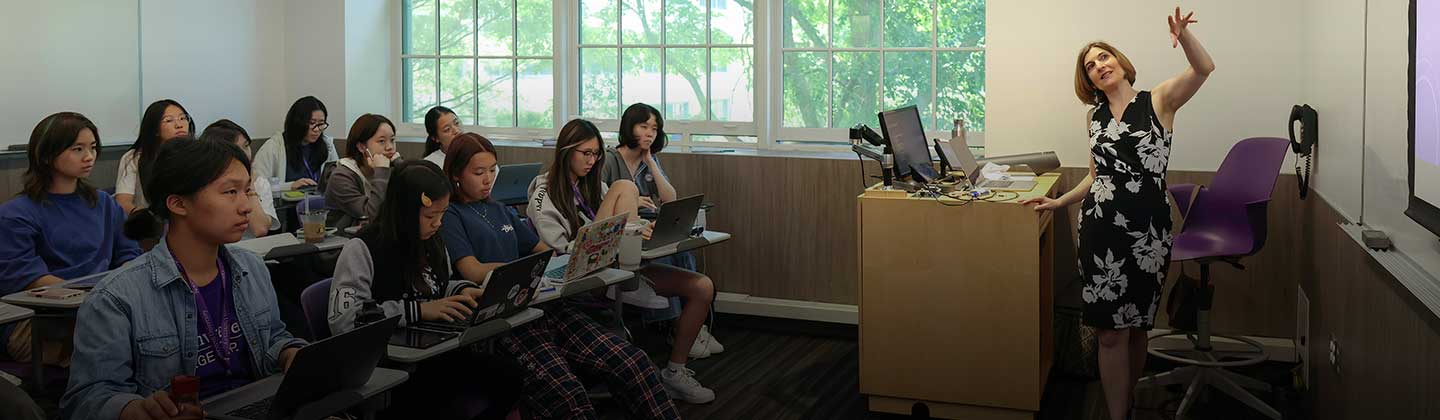
Classes mix brief lectures, readings, tutorials and discussions with plenty of lab work, based on Northwestern's "Lab in a Backpack" approach. You'll design parts in CAD and produce them on 3D printers and laser cutters, breadboard circuits that read sensors and drive actuators before soldering them, and program a microcontroller in C and Python while tracking your code with git. Northwestern doesn't publish a class size for the seminar.
Class meets from 2:00 to 5:30 PM Central Time, Tuesday to Friday in the first week (6 to 9 July 2027) and Monday to Friday in the second (12 to 16 July), so your mornings are free. IN FOCUS seminars also come with the Wildcat Connect: Get Ready Series, interactive workshops on preparing for college, and Northwestern runs program activities every day of the week.
In the residence halls, RAs host movie nights, theme parties and cooking classes. Weekend outings, which commuters can join too, have included the Blue Man Group, Navy Pier and a Cubs game at Wrigley Field. You can use the libraries, computer labs, athletic facilities and lakefront beaches, although the gym is only for students 16 and over, and some extra recreation is at your own cost.
You leave with an official Northwestern University transcript and a certificate, provided you earn a Satisfactory (S) grade. That means attending every class, taking part and completing all the assignments. Missing even one session can cost you the S grade, and simply not turning up doesn't count as withdrawing, so it leaves an Unsatisfactory (U) on your transcript. Other summer plans need to fit around the two weeks.
You also come away having designed, wired and programmed a robot yourself, with practice in documenting a complex engineering project, which Northwestern lists among the course outcomes. Northwestern says taking part in its College Preparation Program doesn't on its own guarantee admission to the university.
You can apply if you'll have finished freshman, sophomore or junior year of high school by the summer and have a cumulative GPA of at least 3.0 on a 4.0 scale. If English isn't your first language, or your secondary schooling wasn't in English, you also send a TOEFL, IELTS or DET (Duolingo English Test) score, although Northwestern sets no minimum.
Along with the $60 application fee, you send a personal statement of about 500 words answering two questions, one on your most rewarding recent academic project and one on why you chose this program and what you hope to gain. You add a list of extracurricular activities with dates and your role, and at least a year of recent transcripts, which can be unofficial copies. Northwestern judges the statement on the quality of the writing, its thoughtfulness and its originality, so the second answer is the place to explain what draws you to building robots in particular.
Admission is limited and rolling, with decisions about four to six weeks after a complete application. Being admitted doesn't guarantee a seat in this seminar, which you only secure by paying the deposit, and Northwestern warns that spaces fill as other admitted students pay theirs.
Living on campus costs $5,235 for the two weeks, made up of $2,730 tuition, an $895 program fee and $1,610 for room and board, which covers your residence hall room and dining hall meals. Commuting costs $3,625, the same tuition and program fee without housing. Northwestern asks for a $1,000 non-refundable deposit three weeks after you're accepted, and it counts toward the total.
On top of that comes the $60 application fee, and Northwestern notes that tuition doesn't cover a DL tech fee, textbooks if any are required, or health insurance. International students without US-based medical insurance pay $67 a week, about $134 for the two weeks, and need a visitor visa, whose cost is separate. Commuters buy their own parking permits.
Domestic rising seniors with financial need and a strong academic and extracurricular record can apply for a tuition scholarship by 1 March 2027, and the full program application, transcripts included, has to be in by then too. Northwestern also has an application fee waiver form, and past College Prep students qualify for a waiver.
Residential students are looked after by Resident Directors and Residential Advisors (RAs). The RAs are undergraduate or graduate students who are selected for the role and complete intensive training. You can explore on and off campus without staff, but you have to check out of the residence hall first and be back for check-in by the set time. Staying overnight anywhere else needs a form and approval from the residential team.
Commuters must live with a responsible adult over 18 for the whole program and can be dismissed if they can't arrange this. Every student and a parent sign a Standards of Conduct Contract that bans alcohol, drugs and weapons, and a student dismissed for breaking the rules gets no refund. A dietitian helps students with special diets, and blue-light emergency phones around campus alert Northwestern police.

Sean
Talk it through with Sean
“I can help you compare the programs you're considering, think through the practicalities and work out what makes sense for you.”
In person in Cambridge, ages 14 to 18, from $3,298.
21 Feb 2027 · From $3,298 · 14-18 · Cambridge · In-person
Two weeks in Parma, 27 June to 10 July 2027, from €5,500.
Deadline: Not announced yet · From €5,500 · 15-18 · Parma · In-person
London site visits and simulations, ages 15 to 18, from £2,290.
Deadline: Not announced yet · From £2,290 · 15-18 · London · In-person
Save this program in Succeed to compare it with similar programs, dates, costs and formats in one place.
Compare with other programssps.northwestern.edu · Official page
sps.northwestern.edu
sps.northwestern.edu
sps.northwestern.edu
sps.northwestern.edu
sps.northwestern.edu
sps.northwestern.edu
sps.northwestern.edu
Facts checked against the official page on 11 Nov 2026
Editor: Ben Stacy
Succeed has no commercial relationship with Northwestern College Prep.
Spot an error? Report it