An economics summer course in Cambridge
Deadline: Not announced yet · From £5,795 · 13-24 · Cambridge · In-person
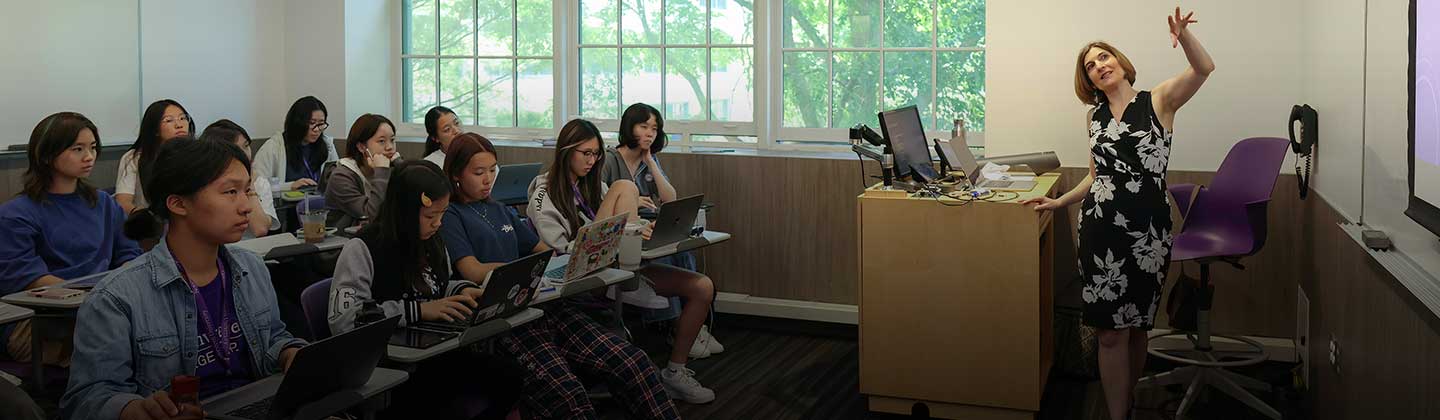
Game Theory and Practice is a two-week certificate seminar on Northwestern's Evanston campus where you play and pick apart classic strategy games such as the Prisoner's Dilemma, the Stag Hunt and the Ultimatum Game. Over nine mornings from 19 to 29 July 2027, economist Scott Ogawa shows you how to find a Nash equilibrium with a bit of math and how the same logic explains airline schedules, politicians' campaign moves and even traffic jams. You solve and present problem sets, analyze data from games played in class and design a game of your own, either living on campus or commuting from home.
 Sean Stevens · Sources
Get the key facts by email
The dates, costs and how to apply, then 2 reminders: 18 Mar (2 weeks before) and 29 Mar (3 days before).
Why it's worth it
You learn game theory by actually playing the games with classmates, working out the equilibrium yourself and designing a game of your own. Your teacher is a Northwestern economics professor whose research studies real decisions through experiments, which suits a course that keeps checking theory against how people really play.
What it asks of you
It's nine 3.5-hour mornings from 19 to 29 July 2027, with problem sets to solve and present, and you have to attend every class to earn the pass grade. Living on campus costs $5,235, while the cheaper $3,625 commuter option only works if you can live with a responsible adult within commuting distance of campus.
Who should skip it
Anyone who wants transferable college credit or a letter grade. The seminar is graded Satisfactory or Unsatisfactory, and Northwestern's credit courses are a separate program that you can't take while you're enrolled in an IN FOCUS seminar.
Scott Ogawa, a Professor of Instruction in Northwestern's Department of Economics, teaches it. His research applies experimental economics to the choices students and teachers make, such as whether students who pay more for their education put in more effort. Before graduate school he taught high school math and economics at Lakeside School in Seattle, and he sits on the AP Microeconomics Development Committee.
The classroom is meant to be as technology-free as possible, with notes taken by hand and plenty of discussion, and only a brief look at whether AI can now think strategically. It isn't a chess or poker class, although Northwestern says fans of those games will probably enjoy it. Northwestern doesn't publish a class size, but your classmates will all be high school students in the College Prep Program, and Northwestern lists Game Theory among the program's most popular recent courses.
You leave with an official Northwestern University transcript and a certificate, as long as you attend and take part in every class and finish all the assignments, which earns a Satisfactory (S) grade. A missed class can cost you that grade, so Northwestern asks you to schedule other summer commitments before or after the program.
Northwestern is clear that taking part in College Prep doesn't on its own guarantee admission to Northwestern.
You can apply if you'll have finished freshman, sophomore or junior year of high school by summer 2027 and have a cumulative GPA of at least 3.0 on a 4.0 scale. If English isn't your first language, or your secondary schooling wasn't in English, you also send a TOEFL, IELTS or Duolingo English Test (DET) score. Northwestern sets no minimum but says competitive applicants often score in the high range.
Northwestern calls its admissions selective, with limited places reviewed on a rolling basis, but it publishes no acceptance rate or cohort size. Your personal statement is judged on the quality of your writing, its thoughtfulness and its originality, and one of its two questions asks why you chose this specific seminar, so that answer is where your interest in strategy and economics should come through.
You apply through Northwestern's College Prep admission page, which links to the online application.
The summer 2027 application launches in early December 2026.
Submit it with the $60 non-refundable fee (or an approved fee-waiver form), a personal statement answering two questions in about 500 words total, a list of your extracurricular activities and at least one year of recent transcripts in English, which can be unofficial.
If you want a tuition scholarship, send the scholarship form and your complete application, transcripts included, by 1 March 2027.
Northwestern starts reviewing complete applications in January 2027 and emails a decision about four to six weeks after your file is complete.
If you're admitted, pay the $1,000 deposit within three weeks. Admission alone doesn't guarantee you a seat in the class, and the deposit is what holds your place.
The final deadline is 1 April 2027, and Northwestern won't accept late applications.
The seminar costs $3,625 if you commute and $5,235 if you live on campus, plus a $60 non-refundable application fee. Both prices include $2,730 in tuition and an $895 program fee, and the residential price adds $1,610 for room and board in a Northwestern residence hall with dining-hall meals. Commuters can buy meals at the Norris University Center, but meals aren't included in their price.
A $1,000 deposit is due three weeks after you're accepted. It counts toward the total but is non-refundable. Northwestern's price list also notes that a DL tech fee, any required textbooks and health insurance aren't included, without giving amounts for them. International students without US-based medical insurance pay $67 a week, which comes to about $134 for the two weeks. They also need a US visitor visa, so check its fee with the US embassy. Travel to Evanston and any off-campus outings you choose are also extra.
Need-based tuition scholarships exist, but only for US students who will be rising seniors with strong academic and extracurricular records, and they're due by 1 March 2027.
Residential students live in a Northwestern residence hall overseen by Resident Directors and Residential Advisors (RAs). The RAs are trained undergraduate or graduate students who also host movie nights, theme parties and cooking classes. You can explore on and off campus without staff, but you have to check out of the hall first and be back for check-in by a set time. Staying anywhere else overnight needs a form and approval from the residential team.
Every student and a parent sign a Standards of Conduct contract that bans alcohol, drugs and weapons, and breaking it can mean dismissal with no refund. Commuters must live with a responsible adult over 18 for the whole program and can't drive other participants. On campus, blue-light emergency phones connect straight to Northwestern police, who add patrols at night, and a dietitian helps students with special dietary needs.

Sean
Talk it through with Sean
“I can help you compare the programs you're considering, think through the practicalities and work out what makes sense for you.”
An economics summer course in Cambridge
Deadline: Not announced yet · From £5,795 · 13-24 · Cambridge · In-person
Philosophy, politics and economics study in Cambridge
Deadline: Not announced yet · Cost not listed · 16-18 · Cambridge · In-person
Business, economics and entrepreneurship study in Cambridge
Deadline: Not announced yet · From £6,550 · 16-19 · Cambridge · In-person
Save this program in Succeed to compare it with similar programs, dates, costs and formats in one place.
Compare with other programssps.northwestern.edu · Official page
sps.northwestern.edu
sps.northwestern.edu
sps.northwestern.edu
sps.northwestern.edu
sps.northwestern.edu
sps.northwestern.edu
sps.northwestern.edu
Facts checked against the official page on 11 Nov 2026
Editor: Sean Stevens
Succeed has no commercial relationship with Northwestern College Prep.
Spot an error? Report it