
In person in Cambridge, ages 13 to 18, from £5,995.
Deadline: Not announced yet · From £5,995 · 13-18 · Cambridge · In-person
Introduction to Microeconomics (ECON 202-0) is a Northwestern University undergraduate course that high school students can take for college credit through the College Preparation Program on the Evanston campus. It covers how people and firms set prices and divide up scarce resources, including consumer preferences, production costs, equilibrium, market types, market failures and government policy. In summer 2026 it ran for five weeks with classes three afternoons a week, and you could either commute or live in a residence hall.
Get the key facts by email
The dates, costs and how to apply, then 2 reminders: 18 Mar (2 weeks before) and 29 Mar (3 days before).
Why it's worth it
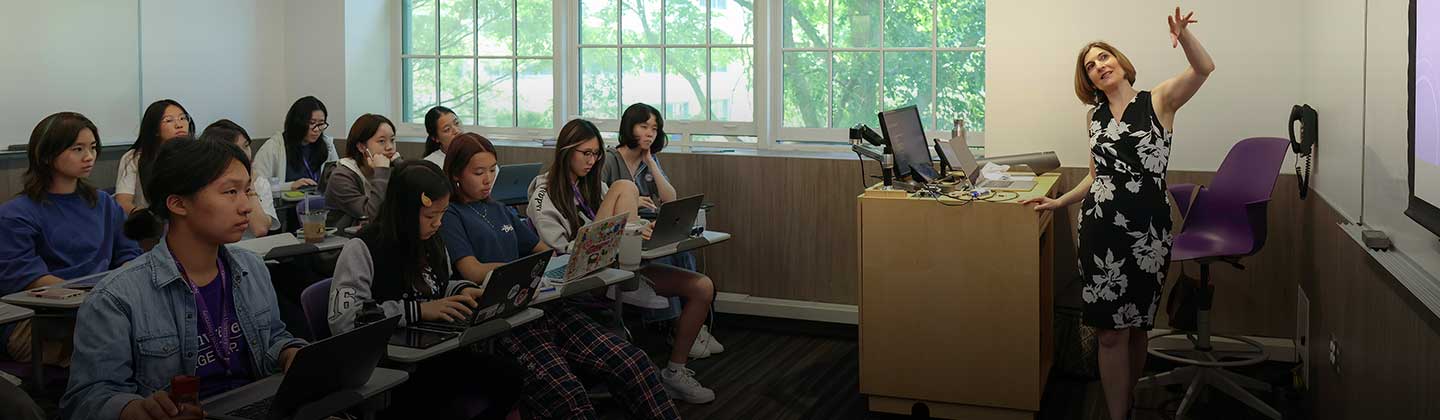
You take the actual undergraduate course, ECON 202-0, in the same room as Northwestern and visiting college students rather than in a class built for teenagers, and you leave with one Northwestern credit unit and a letter grade.
What it asks of you
In 2026 the class met three afternoons a week for five weeks, and Northwestern warns that missing even one meeting can hurt your grade, so the rest of your summer has to fit around it. You're also paying university tuition for a single class, and more again if you live on campus.
Who should skip it
Students who want to explore economics without a grade that stays on a university record, since a weak result here is permanent. The Economics Summer Course run by Atlas Summer Courses is one in-person option to compare, with fees from £5,795.
The course is open to students who've finished sophomore or junior year of high school, so rising juniors and seniors, with a cumulative GPA of 3.0 on a 4.0 scale. For this course you also need either ECON 201-0 (Introduction to Macroeconomics) or basic algebra and graphing courses behind you. Rising sophomores can't take credit courses, although Northwestern's IN FOCUS seminars are open to them.
The application asks for a personal statement of about 500 words in total, answering two questions: your most rewarding recent academic project or experience, and why you chose this program and what you hope to gain from it. Northwestern judges it on the quality of your writing, its thoughtfulness and its originality. You also send a list of activities with your dates, role and a short description, plus official transcripts in English covering at least your most recent year. If English isn't your first language or your schooling wasn't in English, you'll need a TOEFL, IELTS or DET (Duolingo English Test) score, although Northwestern sets no minimum.
In summer 2026 the class met on Tuesdays, Wednesdays and Thursdays from 1 to 3:15 pm in the Global Hub building on the Evanston campus, taught by Scott Ogawa, which leaves mornings, Mondays and Fridays for reading and coursework. Your classmates are Northwestern undergraduates and visiting college students, and Northwestern says its instructors expect the same commitment from you as from them.
Outside class, there's something on most days of the week, from lunchtime entertainment on Lake Michigan and an outdoor film festival to movie nights, theme parties and cooking classes run by the residential advisors. Weekend outings in past years have included Wrigley Field, Navy Pier and the Blue Man Group, and you can use the university's libraries, athletic facilities and beaches. Most activities are optional, and some recreation on and off campus is at your own cost.
At 2027 prices, taking this one class as a commuter costs $7,139, which is $5,984 in tuition plus Northwestern's $1,155 program fee. Living on campus adds room and board at $805 a week, covering a residence hall room and dining hall meals, so a five-week course like the 2026 one comes to about $11,164. The 2027 course list isn't out until late January 2027, so check the course length before you budget.
On top of that there's a $60 application fee, and Northwestern suggests setting aside at least $100 per class for textbooks. Commuters pay for their own parking permits and any meals on campus, and international students without US health insurance pay $67 a week. International students living on campus must take two credit classes to hold F-1 visa status, which means paying tuition twice, and the visa itself is an extra cost to check with the US government. A $1,000 deposit, due three weeks after acceptance, holds your place and counts toward the total, but it isn't refunded.
Northwestern offers a need-based tuition scholarship, but only to US students who will be rising seniors, and both the scholarship application and your full program application, transcripts included, have to arrive by 1 March 2027. There's also a waiver form for the application fee, and past College Prep students qualify for it.
You leave with one Northwestern University credit unit and a letter grade on the university's four-point scale, which you can see in CAESAR, Northwestern's registration system, with an official transcript available from the registrar on request. Northwestern says one credit unit is typically equal to four quarter hours or 2⅔ semester hours at other colleges, which helps if you later try to transfer it, but whether your future college accepts it is that college's decision.
The grade counts both ways. Under the 2025 student handbook, D is the lowest grade that earns credit, skipping class without a written drop earns a failing grade, and dropping once 60% of the course has passed leaves a W on your transcript.
Residential students live in a Northwestern residence hall run by Resident Directors and Residential Advisors, who are undergraduate or graduate students chosen for the role and put through intensive training. You're free to explore on and off campus without staff, but you have to check out of the hall first and be back for check-in by a set time, and a dietitian is on hand in the dining hall for special dietary needs.
Commuters must live with a responsible adult over 18 for the whole program or risk dismissal, and they can't drive other participants. Across campus, blue-light emergency phones alert Northwestern police, who step up patrols at night. Every student and a parent sign a Standards of Conduct contract, and under the 2025 handbook a student dismissed for breaking the rules has to leave within 24 hours with no refund.
Applications go through Northwestern's College Preparation Program admission page.
Start your application when the summer 2027 portal opens in early December 2026, paying the $60 fee or sending the fee waiver form first.
Send your personal statement, activities list, official transcripts and any English test score you need, because Northwestern won't review an application until it's complete.
Check the 2027 course list when it appears in late January 2027 to confirm ECON 202-0 runs again and when it meets.
Expect an email decision about four to six weeks after your application is complete, with review starting in January 2027 and places offered on a rolling basis.
If you're admitted, pay the deposit within three weeks and finish the registration forms, because admission alone doesn't guarantee a seat and classes fill first come, first served.
Submit everything by 1 April 2027, the final deadline, after which Northwestern accepts no applications.

Sean
Talk it through with Sean
“I can help you compare the programs you're considering, think through the practicalities and work out what makes sense for you.”
In person in Cambridge, ages 13 to 18, from £5,995.
Deadline: Not announced yet · From £5,995 · 13-18 · Cambridge · In-person
In person in Cambridge, ages 13 to 24, from £5,795.
Deadline: Not announced yet · From £5,795 · 13-24 · Cambridge · In-person
In person in Toronto, ages 15 to 18, from CAD 6,625.
Deadline: Not announced yet · From CAD 6,625 · 15-18 · Toronto · In-person
Save this program in Succeed to compare it with similar programs, dates, costs and formats in one place.
Compare with other programssps.northwestern.edu · Official page
sps.northwestern.edu
sps.northwestern.edu
sps.northwestern.edu
sps.northwestern.edu
sps.northwestern.edu
sps.northwestern.edu
Facts checked against the official page on 17 Nov 2026
Editor: Ben Stacy
Succeed has no commercial relationship with Northwestern College Prep.
Spot an error? Report it