
In person in Cambridge, ages 13 to 18, from £5,995.
Deadline: Not announced yet · From £5,995 · 13-18 · Cambridge · In-person
A two-week, in-person seminar on Northwestern University's Evanston campus. It traces how relativity and quantum mechanics overturned everyday ideas about time and cause and effect, and why the two theories still don't fit together. You meet on weekday mornings for readings, discussion and debate about open puzzles such as entanglement and the measurement paradox. It's part of Northwestern's College Preparation Program, so you can live in a residence hall or commute, and if you complete the seminar you get a Northwestern transcript and certificate.
Get the key facts by email
The dates, costs and how to apply, then 2 reminders: 18 Mar (2 weeks before) and 29 Mar (3 days before).
Why it's worth it
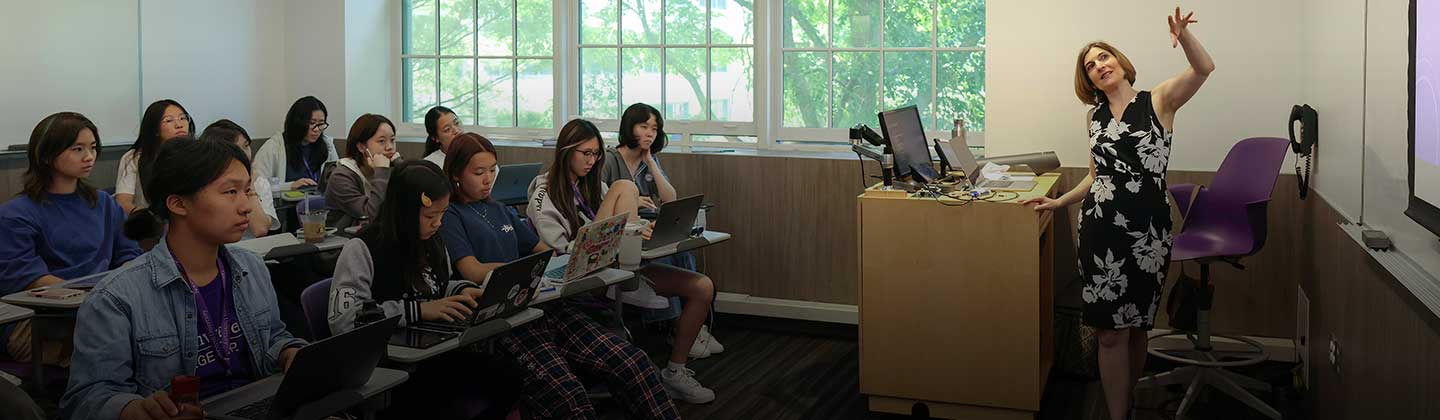
Andrew Rivers joined Northwestern in 1999 and teaches its introductory physics sequence and its Modern Cosmology course. Here he leads you through questions physicists still argue about, such as entanglement, the measurement paradox and why relativity and quantum mechanics don't fit together. That pairing of a frontier topic with an experienced university teacher is the main reason to go.
What it asks of you
There are nine mornings of class, about 31.5 hours in total, and you have to attend every session and finish every assignment to pass, so other summer plans need to fit around 21 June to 1 July 2027. For families outside the Chicago area, the residential fee plus travel makes this an expensive two weeks for the amount of class time.
Who should skip it
Students who want to practice solving physics problems. Northwestern's description of this seminar covers ideas, paradoxes and debate, and it never mentions problem sets or math.
Dr. Andrew Rivers, a Professor of Instruction in Northwestern's Department of Physics and Astronomy, teaches it. He joined the department in 1999 and has taught the introductory physics sequence along with courses such as Modern Cosmology and Highlights of Astronomy. He won the Weinberg College Distinguished Teaching Award in 2008 and has been named to the Associated Student Government faculty honor roll several times.
His research background is in astronomy. For his PhD from the University of New Mexico, he worked on a large radio survey of the so-called Zone of Avoidance, which revealed 20 previously unknown nearby galaxies. Northwestern doesn't publish a class size for its IN FOCUS seminars.
Class runs from 9:15 AM to 12:45 PM Central Time, Monday to Friday in the first week and Monday to Thursday in the second. That's nine mornings and about 31.5 hours of seminar time. Every IN FOCUS seminar also includes the Wildcat Connect: Get Ready Series, a set of interactive workshops outside class that prepare you for college.
Summer Session runs activities through the week, including lunchtime entertainment on Lake Michigan and an evening outdoor film festival, and residential advisers host movie nights, theme parties and cooking classes. Weekend outings have included the Blue Man Group, Navy Pier and Wrigley Field, and you can go stargazing at the campus Dearborn Observatory, which suits this subject well. Attendance isn't required at most of these. Residential students can explore on and off campus without staff, but they have to check out of the residence hall first and be back for check-in by a set time.
You leave with an official Northwestern University transcript and a certificate, as long as you earn a Satisfactory grade. That means attending and taking part in every class and completing all the assignments. The seminar is graded only Satisfactory or Unsatisfactory, and the course description doesn't mention a final project or paper.
Northwestern awards college credit through its separate Courses for Credit, which are open only to rising juniors and seniors, and you can't be active in both programs at once. Northwestern also says that taking part in its College Prep Program doesn't by itself guarantee admission to Northwestern.
IN FOCUS seminars are open to students who have finished their freshman, sophomore or junior year of high school, which means rising sophomores, juniors and seniors. You also need a cumulative GPA of at least 3.0 on a 4.0 scale. Admission is limited and decided on a rolling basis. Northwestern calls its admissions selective but publishes no acceptance rate or cohort size.
International students attend on a US visitor visa. If you commute, you must live with a responsible adult over 18 for the whole program.
Personal statement
About 500 words in total, answering two questions: your most rewarding recent academic project or experience, and why you chose this program and what you hope to gain. Northwestern judges the quality of the writing, its thoughtfulness and its originality.
Activities list
Your clubs, sports, volunteering, jobs or other commitments, each with dates, a short description and your role.
Transcript
An unofficial transcript is accepted for IN FOCUS, but it must be in English and cover at least your most recent year.
English test
You need a TOEFL, IELTS or Duolingo English Test (DET) score if English isn't your first language or your schooling wasn't in English. There's no minimum score, though Northwestern says competitive applicants usually score in the high range.
For summer 2027, a residential place costs $5,235 and a commuter place $3,625. The difference is room and board in a university residence hall, where you eat in the dining hall. Commuters can buy meals on campus at their own cost and pay for their own parking. On top of the fee come a $60 non-refundable application fee and your travel. Northwestern also lists a DL tech fee, any required textbooks and health insurance as outside tuition. International students without US-based medical insurance pay $67 a week, about $134 for the two weeks. Where a visa fee applies, check it with the US embassy.
The $1,000 deposit you pay after acceptance is non-refundable, but it counts toward the total. Tuition scholarships exist, but only for domestic US students finishing their junior year who show financial need and strong achievement, and the scholarship deadline comes a month before the main one. Northwestern also has an application fee waiver form, and former College Prep students can have the fee waived.
| Option | Tuition | Program fee | Room and board | Total |
|---|---|---|---|---|
| Residential | $2,730 | $895 | $1,610 | $5,235 |
| Commuter | $2,730 | $895 | None | $3,625 |
You apply through Northwestern's College Prep admission page.
Applications for summer 2027 open in early December 2026, and you either pay the application fee online or get a fee waiver approved first.
Submit your personal statement, activities list and transcript by 1 April 2027, because Northwestern accepts no late applications, or by 1 March 2027 if you're also applying for a tuition scholarship.
Northwestern starts reviewing complete applications in January 2027 and emails a decision about four to six weeks after everything arrives.
Within three weeks of acceptance, activate your Northwestern NetID and pay the deposit, since admission alone doesn't guarantee a seat and spaces fill as deposits come in.
Once the deposit is in, a parent or guardian completes and signs the program forms, including a Standards of Conduct contract, and then you sign them.

Sean
Talk it through with Sean
“I can help you compare the programs you're considering, think through the practicalities and work out what makes sense for you.”
In person in Cambridge, ages 13 to 18, from £5,995.
Deadline: Not announced yet · From £5,995 · 13-18 · Cambridge · In-person
Physics and astronomy in person in Cambridge, ages 14 to 18, from £6,995.
Deadline: Not announced yet · From £6,995 · 14-18 · Cambridge · In-person
In person in London, ages 14 to 18, from £719.10.
Deadline: Not announced yet · From $1,080.14 · 14-18 · London · In-person
Save this program in Succeed to compare it with similar programs, dates, costs and formats in one place.
Compare with other programssps.northwestern.edu · Official page
sps.northwestern.edu
sps.northwestern.edu
sps.northwestern.edu
sps.northwestern.edu
sps.northwestern.edu
sps.northwestern.edu
sps.northwestern.edu
Facts checked against the official page on 11 Nov 2026
Editor: Ben Stacy
Succeed has no commercial relationship with Northwestern College Prep.
Spot an error? Report it