
NYU Tisch Special Programs Dramatic Writing Summer High School Program
- 2027 program
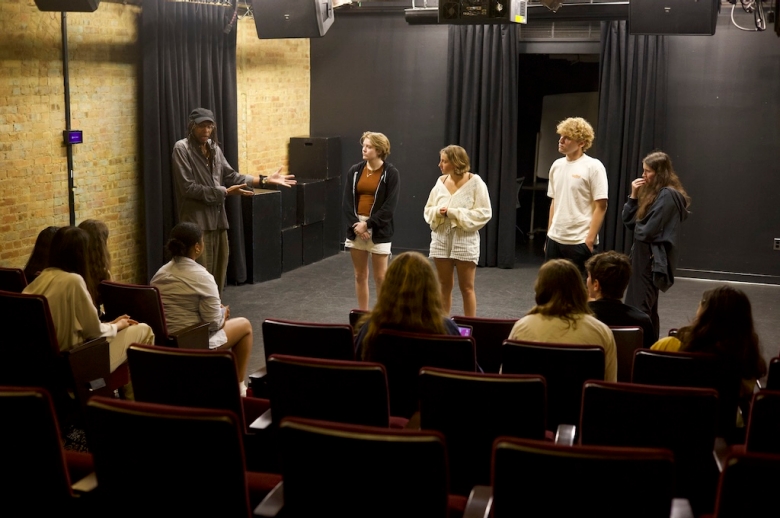
For four weeks at NYU's Tisch School of the Arts in Manhattan, you take two college courses side by side, one in screenwriting and one in playwriting, while living in NYU housing. Your screenwriting work becomes an outline and part of a full-length screenplay. In playwriting you write a ten-minute play, rehearse and rewrite it with classmates, and perform it on the last day of classes. Readings, screenings and evening trips to the theater fill out the rest of the program.

At a glance
Official facts · checked 12 Nov 2026- DatesOfficial
- 2027: 11 July to 7 August
- Who can applyOfficial
- Current high school sophomores and juniors at the time of application. At least 15 years old. Preference given to current high school juniors. Non-US citizens and residents need a US student visa. English proficiency evidence required if English is not the native language, unless exempt after three or more years of English-only instruction
- Total costOfficial
- 2027: $12,552
- Format and placeOfficial
- In person, New York City (Manhattan)
- Length
- 4 weeks
- Included / budget separately
- Included: meals (Required 10-meals-a-week plan with optional upgrades). Separately: materials and admin fee $200, accommodation $1,876, application fee $75 (non-refundable), Dramatic Writing ticket fee $361
- Deposit and refunds
- Deposit $1,500. Cancel after confirming: the $1,500 deposit is never refunded, and dropping no later than four days after classes start gets a full refund of tuition and fees apart from the deposit
- Financial aid
- Limited number of need-based scholarships, given to students who demonstrate the most financial need
- Apply by
- 2027: 1 December 2026 (Application), 11 December 2026 (Scholarship application), 19 February (Confirmation deposit)
- Cohort and selectivity
- Tisch receives over 800 applications to its Summer High School Program across all tracks and admits about 24 students to Dramatic Writing. Over 800 applications across all Tisch Summer High School tracks. About 24 students accepted to Dramatic Writing
- Credit or certificate
- NYU academic transcript for Summer Screenwriting (DWPG-UT 15, 3 units) and Summer Playwriting (DWPG-UT 16, 3 units), available on request
Get the key facts by email
The dates, costs and how to apply, then 2 reminders: 5 Feb (2 weeks before) and 16 Feb (3 days before).
Succeed's assessment
Should you apply?
SucceedIn short
Why it's worth it
Your ten-minute play is rehearsed, rewritten and performed with classmates, and professional actors and directors stage your monologues, so you hear your work out loud while you're also drafting part of a full-length screenplay.
What it asks of you
Four weeks living in NYU housing with no option to commute, in a program Tisch is clear isn't a leisure camp. Evenings and weekends go to theater trips, writing and rehearsals.
Who should skip it
Families looking for a low-cost first taste of screenwriting, because tuition, housing, meals and fees add up to more than $15,800 and Tisch's scholarships are limited to students with the most financial need.
Who gets in, and what does the application ask for?
Tisch takes current high school sophomores and juniors who are at least 15 when they apply and have at least a 3.0 cumulative GPA on a 4.0 unweighted scale, and it gives preference to juniors. Freshmen and seniors can't apply. If your school doesn't calculate a GPA, you estimate your own on a 4.0 scale and Tisch checks it against your transcript. Homeschooled students have the parent in charge of their schooling email a record of their coursework instead.
Places are tight. Tisch receives more than 800 applications across all its summer high school tracks and admits about 24 students to Dramatic Writing. The tracks offer about 313 places between them, so fewer than 2 in 5 applicants get in overall, although Tisch doesn't publish odds for each track. It says the most competitive applications include every component, and it strongly recommends against using AI tools in your answers.
Written responses
Three answers of up to 250 words each, plus any prompts specific to Dramatic Writing.
Creative résumé
Your training, awards, projects, community service and work, with links to your writing or other work if you have them.
Transcript
Grades for every year of high school as a PDF, including fall 2026 grades if they're available.
Two recommendations
At least one has to come from a high school representative, and Tisch suggests giving recommenders one to two weeks.
English proficiency
A test score if English isn't your native language, unless you've had three or more consecutive full-time years of schooling taught only in English.
What does a typical day look like?
Classes run Monday to Friday, 9:30 a.m. to 5:30 p.m., in two three-hour blocks, one of playwriting and one of screenwriting, with a lunch break in between. The group is split into two sections that swap subjects between morning and afternoon, and the screenwriting course also brings in guest lecturers in TV writing and holds several film story analysis sessions.
On Tuesdays and Thursdays you have dinner at 5:00 p.m., meet the program assistants at 6:00 and head out for a theater night from 7:00 to 10:00 p.m. in weeks one to three. In week four those evenings become rehearsals for the final showcase on the last Friday. Monday, Wednesday and Friday evenings are free, and everyone is back by the 11 p.m. curfew. Weekends are set aside for assignments and writing, and Tisch warns that evenings and weekends are often as busy as class time. This timetable is a sample from previous summers, and admitted students get their actual schedule at orientation.
Who teaches it?
Both courses are taught by working writers from the Rita and Burton Goldberg Department of Dramatic Writing. Summer Screenwriting is led by Joe Vinciguerra, an associate arts professor and the department's chair, who wrote the films Mall (2014) and Machine, Learning (2023), co-wrote Don't Go In The Woods (2011) and is a member of the Writers Guild of America.
Summer Playwriting is led by William Electric Black, also known as Ian Ellis James, who won seven Emmy Awards writing for Sesame Street between 1992 and 2002 and writes and directs for the stage, including recent productions at La MaMa in New York. He has taught in the department and the Summer High School Program for some 20 years.
What do you leave with?
You leave with 6 NYU units, 3 for Summer Screenwriting (DWPG-UT 15) and 3 for Summer Playwriting (DWPG-UT 16), each graded A to F. Within NYU they count as elective credit in the Department of Dramatic Writing, and if you later enroll at NYU as an undergraduate they're applied to your degree automatically, with the grade counted in your GPA. Any other college decides for itself whether to accept them, and whether they can replace a required class depends on its own rules.
Grades are posted by September, but NYU doesn't send a transcript automatically, so you'll need to request one from the Registrar if a college asks for it. You also take home the writing itself: an outline and partial draft of a full-length screenplay, and a ten-minute play you've rehearsed, rewritten and performed.
What does it really cost?
Tisch's 2027 charges for tuition, the program fee, housing, the meal plan and the Dramatic Writing ticket fee come to $15,841 for the four weeks. Housing and the 10-meals-a-week plan aren't optional, because every student lives in NYU housing, though you can pay more for a bigger meal plan. On top of that comes the $75 nonrefundable application fee, and you can ask Tisch to waive it by emailing an explanation of financial hardship.
To accept a place you pay a $1,500 deposit, which counts toward the total but is never refunded. Tisch doesn't take credit cards for the final payment, and NYU says payment plans aren't available for most of its high school programs. If you drop no later than four days after classes start, you get tuition and fees back apart from the deposit, although NYU Housing may charge its own cancellation fees.
Travel to New York, laundry and personal spending are extra, and domestic students need their own health insurance. International students also pay a $115 international student fee and are automatically enrolled in NYU health insurance, which cost $392 for the month in 2026. US visa fees come on top of that, so check them with the official sources.
Tisch's need-based scholarships generally cover tuition, fees, housing and meals, but there are only a limited number and they're open only to students who depend on a parent or guardian who files US federal tax returns.
| Charge | Cost |
|---|---|
| Tuition (6 units) | $12,552 |
| Program fee (residential activities) | $200 |
| Housing, 4 weeks | $1,876 |
| Meal plan, 10 meals a week for 4 weeks | $852 |
| Dramatic Writing ticket fee | $361 |
| Total | $15,841 |
How are students looked after?
Every residence hall floor has its own program assistant, an NYU college student who's your main point of contact, and professional staff run the building and supervise them. You must be back in the hall by 11 p.m. every night, hand your NYUCard in at the front desk and be in your room for quiet hours by 1 a.m., and you can't leave before 7 a.m. Breaking curfew can lead to anything from a warning to parental notification or dismissal.
You share a double room in a four-person suite with one bathroom, and NYU assigns roommates at random. Guests, family included, can't go past the lobby, and nights or weekends away are allowed only in extenuating circumstances, when your emergency contact requests it in advance. NYU's campus isn't enclosed, so while staff go with you on program events, you're free to leave campus on your own in your free time. NYU asks families to agree on expectations for getting around the city before you arrive.
The Student Health Center deals with urgent concerns but has no pediatricians, so some under-18s are referred to outside care. Students are also expected to manage their own medication. There's zero tolerance for alcohol and drugs, which means dismissal without a refund. The full rules are in the NYU High School Programs Handbook.

Sean
Founder, Succeed
Talk it through with Sean
Want to talk it through?
“I can help you compare the programs you're considering, think through the practicalities and work out what makes sense for you.”
20 minutes · No obligation to enroll
What should you do next?
Frequently asked questions
Sources
- Tisch Summer High School Dramatic Writing Program
tisch.nyu.edu · Official page
- High School Programs Handbook
nyu.edu
- Tisch Summer High School Program Admitted Student Information
tisch.nyu.edu
- Cancellation Policy
tisch.nyu.edu
- Admissions Calendar
tisch.nyu.edu
- Tisch Summer High School Application FAQ
tisch.nyu.edu
- Summer High School Application Requirements
tisch.nyu.edu
- Tuition and Scholarships
tisch.nyu.edu
Not ready to decide yet? Keep it for later.