
NYU Tisch Special Programs Recorded Music Summer High School Program
- 2027 program
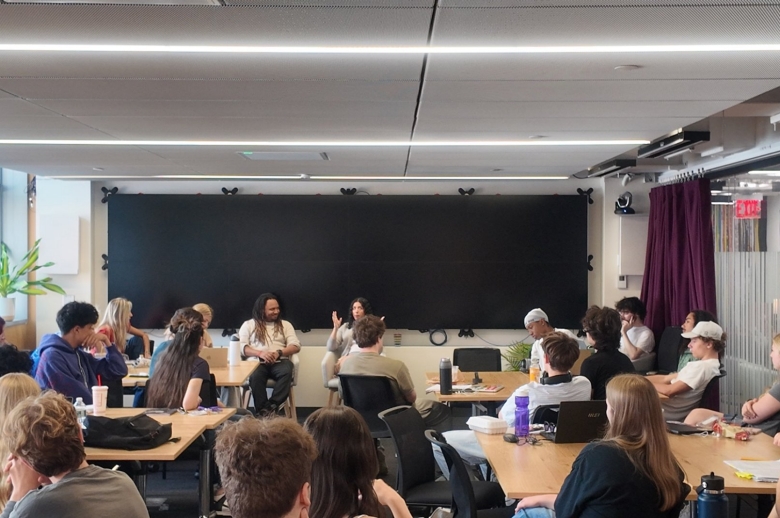
Over four weeks in New York, you study how music is recorded, produced and distributed, and how music companies are started and run, through three NYU courses worth 6 college credits in total. Weekdays are split between music business classes, production labs in Pro Tools and Logic Pro, and an arts and culture course with field trips and talks from industry professionals. Weekends go to group studio sessions on final projects, and you live in NYU housing with a nightly curfew.
 Sean Stevens · Sources
At a glance
Official facts · checked 12 Nov 2026- DatesOfficial
- 2027: 11 July to 7 August
- Who can applyOfficial
- At least 15 years old at the time of application. Current high school sophomore or junior (rising junior or senior), with preference given to juniors. Non-US citizens need a valid passport and a US student (F-1) visa. English language proficiency required if English is not your native language, unless exempt
- Total costOfficial
- 2027: $12,552
- Format and placeOfficial
- In person, New York City
- Length
- 4 weeks
- Included / budget separately
- Included: meals (10 meals a week plan with $30 Dining Dollars, larger plans optional). Separately: materials and admin fee $335, accommodation $1,356, application fee $75, Program fee $200
- Deposit and refunds
- Deposit $1,500. The $1,500 confirmation deposit is never refunded or transferred once you confirm your place
- Financial aid
- Limited need-based scholarships go to students who demonstrate the most financial need
- Apply by
- 2027: 1 December 2026 (Application and Supplemental Profile Form), 11 December 2026 (Scholarship application), 19 February (Confirmation deposit)
- Cohort and selectivity
- Tisch accepts about 36 students to the Recorded Music track, from more than 800 applications across all its summer high school tracks. Over 800 applications across all Tisch Summer High School tracks, about 36 accepted to Recorded Music
- Credit or certificate
- NYU transcript credit for 6 units, graded A to F
Get the key facts by email
The dates, costs and how to apply, then 2 reminders: 5 Feb (2 weeks before) and 16 Feb (3 days before).
Succeed's assessment
Should you apply?
SucceedIn short
Why it's worth it
You earn 6 NYU credits from courses based on Tisch's undergraduate curriculum and taught by people working in the industry, and you cover how a record gets made and how it gets sold in the same four weeks.
What it asks of you
You spend four weeks in NYU housing, with classes every weekday, regular evening events and studio sessions every weekend. Tisch is clear that it isn't a leisure camp. On top of the required charges, you'll need to pay for travel and have spending money in an expensive city.
Who should skip it
Students mainly after a taste of college life, because the schedule centers on coursework graded A to F, and that grade counts toward your GPA if you later enroll at NYU.
Who gets a place, and what does the application ask for?
Tisch takes about 36 students into the Recorded Music track, from more than 800 applications across all its summer high school tracks. You need to be at least 15, a current sophomore or junior, and have a GPA of at least 3.0 on an unweighted 4.0 scale, and Tisch gives preference to juniors. There's no audition or portfolio, so your written answers, résumé, grades and recommendations are what Tisch has to go on.
The $75 application fee isn't refundable, but you can ask for a need-based waiver by emailing Tisch to explain your financial hardship. Tisch also strongly recommends against using AI tools on your answers.
Written responses
Three questions, each answered in 250 words or fewer, plus any program-specific prompts.
Creative résumé
Your training, awards, projects, community service and work, with links to your music if you have any.
Transcript
A PDF with your grades for every year of high school. Homeschooled applicants instead have the parent in charge of their schooling email a summary of their coursework.
Two recommendations
At least one has to come from a high school representative, and the other can come from a community group leader, mentor or coach.
Extras for some applicants
An English proficiency test if English isn't your native language, unless you've had three or more full years of English-only schooling, and a passport copy for non-US citizens.
What does a week in the program look like?
Classes run Monday to Friday, and weekends go to studio and lab time for final projects. In Tisch's sample week from earlier summers, Monday, Wednesday and Friday start with music business from 10:30 a.m. to 12:15 p.m., then arts and culture from 1:40 to 4:00 p.m. On Tuesday and Thursday the group splits in two, and each half has a music production class plus either a three-hour songwriting workshop or a morning field trip.
Evenings are busy too, with jam time from 6:00 to 9:00 p.m. on Monday and Thursday, a concert or Broadway show on Wednesday and a free evening on Friday. Saturday and Sunday each have two group studio sessions, from 1:45 to 5:00 p.m. and from 6:30 to 9:45 p.m. In 2026 students lived in NYU housing in Manhattan and took classes at the institute in Brooklyn. Your actual schedule is handed out on orientation day.
Who teaches the courses?
Tisch says its summer high school courses are taught by working industry leaders and mentors, and the instructors it lists for Recorded Music are active in production, artist work and label business. Alongside them, the program includes master-class lectures on topics such as touring, artist management and digital media, given only to students in this program. Tisch doesn't publish a class size, although production classes are split into two groups.
Devon Baran (Von), music production
Owner of Vondom Labs, who has music-directed a New York Fashion Week show and specializes in alternative production methods and live events.
Halima Edozie-Akinlade, music production
A London- and Lagos-raised producer, artist and songwriter whose singles have passed 10 million cumulative streams.
Andre Howard, music business
Started in A&R at Def Jam and is now VP, Digital + Commerce at ADA/WMG.
Amir A. Oliver, arts and culture
An actor, recording artist and filmmaker who graduated from the Clive Davis Institute in 2020.
What do you leave with?
You leave with 6 NYU credits from three 2-unit courses, Fundamentals of Music Production, Foundations of Music Business and Arts & Culture of New York City, each graded A to F. Inside NYU they count as elective credit in the Clive Davis Institute, and if you later enroll at NYU as an undergraduate they're applied to your degree automatically, with the grade going into your GPA. Other colleges set their own rules, so whether the credits transfer or replace a required class is up to the college you attend. Grades are posted by September, and transcripts aren't sent automatically, so you request one from the NYU Registrar. You also come away with the final projects you work on in the weekend studio sessions.
What does it really cost?
Required charges for summer 2027 come to $15,656. That's $12,552 tuition for 6 units, $1,356 for four weeks of housing, $852 for the 10-meals-a-week plan, a $200 program fee for residential life activities, a $335 lab fee and a $361 ticket fee. Housing and the meal plan aren't optional, because every student lives in NYU housing, although you can pay for a bigger meal plan. The $75 application fee, travel to and from New York, laundry and spending money come on top.
International students also pay a $115 international student fee and are automatically enrolled in NYU's comprehensive health insurance, which cost $392 for one month in 2026. They pay US visa fees as well, including the SEVIS fee. Domestic students need their own health insurance.
To accept a place you pay a $1,500 deposit, which counts toward the total but is never refunded. If you cancel by email no later than four days after classes start, you get the rest of your tuition and fees back, but housing cancellations can carry their own fees and a student dismissed for conduct gets no refund. NYU doesn't take credit cards for the final payment.
Scholarships are limited and go to students with the most financial need, and they generally cover tuition, fees, housing and meals. You're only eligible if a parent or guardian files US federal tax returns, and the scholarship application is due 11 December 2026.
How are students looked after?
Every residence hall floor has its own program assistant, an NYU college student, and a team of professional staff runs each building. Students have to be back in the hall by 11:00 p.m. every night, hand in their NYU ID at the front desk, and be in their rooms for quiet hours from 1:00 a.m. Rooms are doubles in four-person suites sharing one bathroom, assigned at random.
No guests are allowed past the lobby, family included, and nights or weekends away are only for emergencies, requested in advance by the emergency contact. NYU is an open campus, so outside program events students can go out on their own in their free time, and NYU asks families to agree on boundaries beforehand. The Student Health Center handles urgent problems but has no pediatricians, so it refers some students to outside clinics or hospitals. Alcohol and drugs mean immediate dismissal without a refund. The full rules are in the NYU High School Programs Handbook.

Sean
Founder, Succeed
Talk it through with Sean
Want to talk it through?
“I can help you compare the programs you're considering, think through the practicalities and work out what makes sense for you.”
20 minutes · No obligation to enroll
What should you do next?
Frequently asked questions
Sources
- Tisch Summer High School Clive Davis Institute of Recorded Music
tisch.nyu.edu · Official page
- Tisch Summer High School Program Admitted Student Information
tisch.nyu.edu
- Cancellation Policy
tisch.nyu.edu
- Tisch Summer High School Application FAQ
tisch.nyu.edu
- Summer High School Application Requirements
tisch.nyu.edu
- Admissions Calendar
tisch.nyu.edu
- Tuition and Scholarships
tisch.nyu.edu
- NYU’s Visual Guide
tisch.nyu.edu
Not ready to decide yet? Keep it for later.