
Politics of Law & Economics
Applications open
06 Jan 2027 · From $7,500 · 16-18 · New Haven · In-person
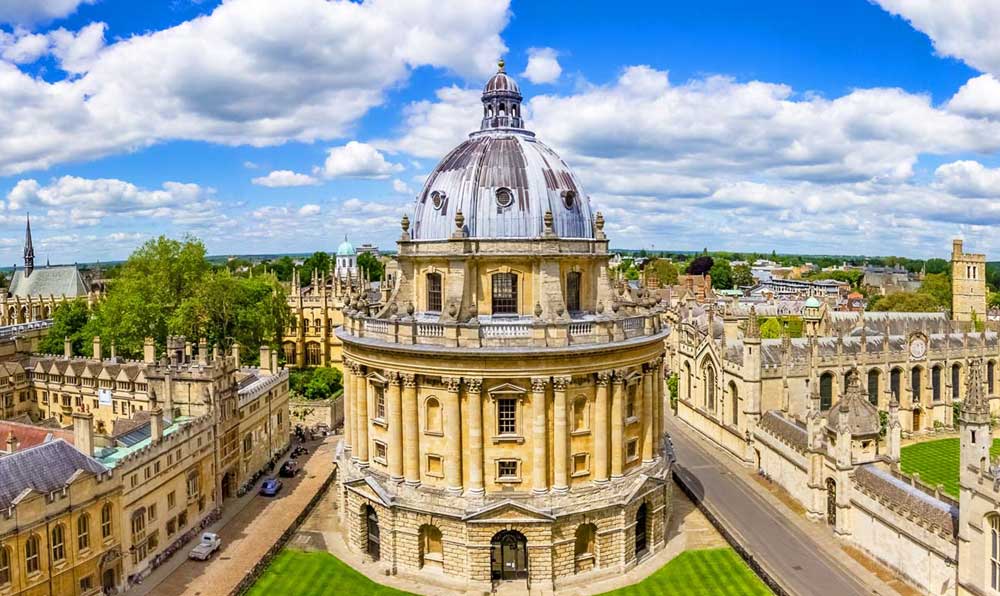
The Oxford Tradition is a residential summer program at Pembroke College, Oxford, run by Oxbridge Academic Programs for students in grades 10 to 12. You take one course per two-week session, in subjects such as Medicine, Law, Creative Writing or Speech and Debate, and learn through small-group classes, visits around Oxford and a final project. You can come for one session or stay for both, living in undergraduate rooms and eating breakfast and dinner in hall.
Why it's worth it
The courses use Oxford itself as the classroom, with Law students visiting a court and Speech and Debate ending in a formal debate in the Oxford Union's historic chamber. There are no tests, so the work builds toward a final project or performance rather than an exam.
What it asks of you
Mostly money and the trip to England, since flights and lunches come on top of tuition. The workload is light, which leaves plenty of time to explore Oxford.
Who should skip it
Students hoping the program will make their college application stand out by itself. Oxbridge says it rarely turns applicants down, the University of Oxford doesn't run it, and what you take home is a teacher's report rather than course credit.
You take one course per session, and it meets every morning and again for two hours on three afternoons a week. In Oxbridge's sample Medicine day, class runs from 9 a.m. to noon, starting with a suturing session at the John Radcliffe Hospital overseen by a surgeon, then talks from guest doctors and a workshop on diagnostic techniques, before students head out in groups for lunch.
Afternoons without class are free, and so is 4 to 6 p.m. on class days, when you can join optional tours of Christ Church, the Bodleian or the Pitt Rivers Museum, go punting, or try sports from rowing and cricket to tennis. Dinner is in hall at 6 p.m., and evenings until 11 p.m. bring optional Shakespeare plays, concerts, talent nights and movie nights, or time for project work. Homework takes at most an hour a night and is mostly project work, often done in teams. Every student also goes on a trip to London.
Oxbridge staffs its courses with academics, including university teachers and Rhodes Scholars, while creative courses go to working professionals, so Creative Writing is led by a published writer and Theater Masterclass by actors and directors. Its 2027 brochure profiles two Oxford Tradition teachers: Dr. Cosima Gillhammer, a Junior Research Fellow in English Literature at Christ Church, Oxford, and Dr. Douglas Brand OBE, a former Assistant Chief Constable who spent 20 years with London's Metropolitan Police.
Oxbridge doesn't say who will teach which course in 2027, though, and asks families to email info@oxbridgeprograms.com to find out. Classes run in small groups, but no class size is published, so that's worth asking about at the same time.
You leave with a finished final project and a written report on your work. Each course ends in something you've made or performed, such as a moot court for Law, a mock Parliament for Politics and Economics, a Shark Tank-style pitch of a mock company for Global Business, a literary magazine for Creative Writing or a class performance for Theater Masterclass.
Shortly after the program, you and your parents receive a grade report with your course syllabus and your teacher's notes on your contributions and achievements, along with a congratulatory letter from Oxbridge's executive director. Oxbridge says most alumni send copies with their college applications, but how much weight a college gives them is up to that college, and the report isn't course credit.
The program is for students in grades 10 to 12, and you don't need any background in the subject you pick. Courses in Oxford are taught only in English, so if English is your second language, Oxbridge asks for a TOEFL (Test of English as a Foreign Language) score or a short letter from your English teacher confirming your fluency, and it's happy to have a short conversation to check you can follow the classes.
Getting in is more a check than a competition. Oxbridge reviews applications on a rolling basis and says turning someone down is rare, happening when a student's academic or behavioral record suggests they won't meet its standards. Places and courses can fill up quickly, though. Reviews typically take three to five days, and Oxbridge promises a decision within three weeks of a complete application.
Course preferences
Your choice of course for each session you're applying to.
A teacher contact
The name and contact details of a teacher or counselor who knows you well.
Personal statement
About 500 words on why you want to attend, what draws you to your courses and what you'll bring to the program.
Recent grade report
Your latest school grades.
Payment
Full tuition or a deposit, and the statement and grade report can follow once the deposit is paid.
One two-week session costs $7,850 if you enroll by 31 December 2026 and $8,495 from 1 January 2027, and both sessions together cost $12,995 or $13,595 on the same dates. That covers your room, breakfast and dinner, classes, books and materials, field trips, activity tickets and airport transfers.
Flights, lunch and spending money are extra, and Oxbridge suggests $15 to $30 a day for lunch, incidentals and souvenirs, which comes to roughly $195 to $390 over a 13-day session. Engineering and Design, Journalism and Theater Masterclass add a $100 materials fee per session, and a private bathroom costs extra if one is available. Credit card payments carry a 2% fee, which you can avoid by paying by bank transfer (ACH). The Paris Connection, six days in Paris after session two, costs $2,750 if you enroll by 31 December 2026 and $2,850 after, and you book your own flight home from Paris.
To hold a place, you pay in full, put down $500 and start a monthly plan, or pay $1,000 and settle the balance in March or April 2027. Deposits come back if you aren't accepted but not if you cancel, and the refund shrinks fast as the start date nears.
Oxbridge also offers a small number of need- and merit-based scholarships toward part of tuition, open to students currently in grades 8 to 11 who haven't done an Oxbridge program before. They need a separate application by 9 February 2027, you can't file a regular application at the same time, and decisions arrive within a month of that deadline, which is after the 1 January price rise.
| When you cancel (in writing) | What you get back |
|---|---|
| 75 or more days before your session starts | Tuition minus a $500 fee and non-refundable fees such as deposits and insurance |
| 45 to 74 days before | Tuition minus the $500 fee and 40% of tuition (and 40% of any Paris Connection cost) |
| 44 days or fewer before | Nothing |
Adults live alongside you. The Program Director, the Deans, who are professional educators from schools around the world, and some faculty all live in the residence, and the program office is staffed from 8 a.m. until past midnight. You check in with the Dean on duty between 10 and 11 p.m., can't leave the college after that, and must be in your own room by midnight.
Hallways or floors are separated by gender, and college porters, campus security and CCTV cover the entrances around the clock. Every venue has a Medical Officer, and through WorldStrides, Oxbridge's parent company, students have 24-hour phone access to a U.S.-based doctor. Staff meet students at the airport and see them off at the end, and during the day Oxbridge generally lets students explore Oxford in groups without an adult.
Oxbridge's health and safety rules include a zero-tolerance contract on alcohol and drugs that applies even to students of legal drinking age, and breaking it means being sent home at your family's expense. Oxbridge also strongly urges full medical insurance for students traveling from abroad, since you may have to pay for treatment up front.

Sean
Talk it through with Sean
“I can help you compare the programs you're considering, think through the practicalities and work out what makes sense for you.”
06 Jan 2027 · From $7,500 · 16-18 · New Haven · In-person
Deadline: Not announced yet · From £6,995 · 14-18 · Cambridge · In-person
Deadline: Not announced yet · From $1,999 · 14-18 · Los Angeles · In-person
Save this program in Succeed to compare it with similar programs, dates, costs and formats in one place.
Compare with other programsOfficial page
oxbridgeprograms.com
oxbridgeprograms.com
oxbridgeprograms.com
oxbridgeprograms.com
oxbridgeprograms.com
oxbridgeprograms.com
oxbridgeprograms.com
Facts checked against the official page on 3 Nov 2026
Editor: Ben Stacy
Succeed has no commercial relationship with Oxbridge Academic Programs.
Spot an error? Report it