
Succeed has a commercial partnership with this provider.
Science
Deadline: Not announced yet
From £5,995
16-18
Cambridge
In-person
by Penn Arts and Sciences High School Programs
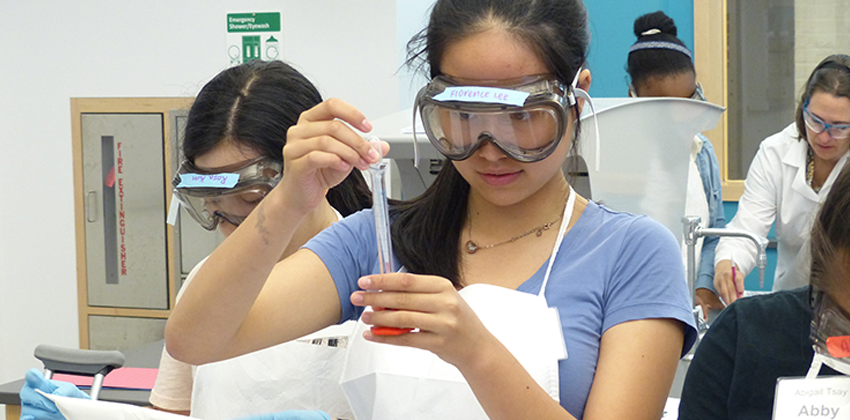
The Chemistry Research Academy is a three-week residential summer program at the University of Pennsylvania in Philadelphia for high school students who've already taken a year of chemistry. About half the teaching time is spent in Penn's general chemistry lab, learning to use instruments for techniques such as spectroscopy and chromatography and running open-ended investigations. The rest goes on classroom work, talks by Penn chemistry professors and journal clubs with research students, and over the three weeks you plan your own independent research project to carry out after you go home.
 Sean Stevens · Sources
Get the key facts by email
The dates, costs and how to apply, all in one place.
Succeed's assessment
In short
Why it's worth it
About half the teaching time is hands-on in a university lab with real instruments, and you hear Penn chemistry professors explain their own research and take your questions.
What it asks of you
You live on campus for the full three weeks with no commuter or online option, and you're in class six hours a day, Monday to Friday, with homework averaging no more than an hour a night. The 2026 price was $10,050 before travel and the $100 application fee. That's a lot for three weeks, and the only scholarships are a limited number for Philadelphia students at School District of Philadelphia schools.
Who should skip it
Students who want finished research to show colleges by the end of the summer, because you leave with a certificate and a project plan that you still have to carry out yourself.
In 2025, classes ran Monday to Friday from 9 am to 4 pm with an hour for lunch, and labs sometimes ran a little later for some groups. Roughly half that time is in the general chemistry lab, where you start with introductory labs on how each instrument works and then move on to guided and open-inquiry experiments. The classroom half is mostly active learning with little lecturing. It's built around small-group discussions, chemistry demonstrations and pre-lab work, along with research talks with time for questions, journal clubs with graduate and undergraduate researchers, and tours of labs around campus. The 2025 program also took students to the Science History Institute and the Penn Museum.
Homework averages no more than an hour a night. Outside class you can use the residence hall lounges, dining halls, libraries and, if you're 15 or older, the gym. Residential staff plan evening activities such as trivia or arts and crafts nights, plus weekend trips off campus, such as a day at the beach or a Phillies game.
The academy is led by Dr. Jenine Maeyer, a senior lecturer at Penn who has directed its general chemistry laboratories since 2009 and has also run the department's middle and high school outreach programs. She holds a PhD in chemistry from the University of Arizona with a research focus in chemistry education, and in 2025 she worked with a team of instructors and a lab manager. Penn doesn't publish a class size or a student-to-instructor ratio for the academy.
Hearing from working researchers is a big part of the program. The talks planned for 2025 included Penn chemistry faculty such as Dr. Eric Schelter on rare earth elements, Dr. Ivan Dmochowski on how to capture an atom, Dr. Karen Goldberg on energy and materials chemistry, and Dr. Daniel Mindiola on metal complexes and catalysis. Each talk had time for questions and the chance to follow up one to one.
You need to be in 10th or 11th grade when you apply, have finished at least one year of high school chemistry before the program starts and have a high school GPA of at least 3.5. To show you've met the chemistry prerequisite, you upload the course syllabus with its title, a short description and the topics covered, and if you're still taking the course you also add a transcript showing at least one marking period.
Penn reviews completed applications in the order they arrive and offers places on a rolling basis until the academy is full, which happened for summer 2026. After that it keeps a waitlist. Decisions can take up to six weeks, and Penn doesn't publish a cohort size or acceptance rate. You have to submit the application yourself, not through a parent, counselor or agent.
Essays
Two essays of up to 400 words each, one on why you want this program and how it fits your goals, and one on how two extracurricular activities have added to your academic or personal growth. Students whose first language isn't English write a third on their English background.
Transcript
Your full transcript for the previous school year, official or unofficial, in English or with an official translation.
Recommendation
One letter from an adult who knows your work well, written on their organization's letterhead and naming this specific program.
English test
Non-native speakers need at least 100 on the TOEFL iBT, 7 on the IELTS or 130 on the Duolingo English Test. If you'll have attended an English-medium school for at least two years by the time the program starts, you may be eligible for a waiver.
You leave with a Certificate of Completion from Penn and a plan for your own independent research project, which Penn says you can use to enter a science fair or to meet your high school's independent research requirement. You build the plan over the three weeks using Penn's online library resources, but the experiments happen after you go home, and the academy doesn't place you in a research group.
Because the academy is non-credit, there's no Penn transcript or college credit. Once you've completed it, you can ask your Penn instructors for a letter of recommendation. Penn is also clear that attending its high school programs doesn't guarantee admission to Penn as an undergraduate.
In summer 2026 the academy cost $10,050, and Penn hasn't published the 2027 price yet. That price covered classes, on-campus housing, a meal plan, linens, gym access, evening activities and trips, and supervision, and Penn says academy students don't need to buy any course materials. On top of that come the nonrefundable $100 application fee, travel to and from Philadelphia, meals eaten off campus, medical costs, laundry supplies and spending money. ESF Pre-College, which runs the residential side, charges $75 each way for airport pick-ups and drop-offs, and international students pay ESF a $175 registration fee that includes medical insurance.
To hold a place you pay a $1,500 deposit, which counts toward the total but is never refunded. Bills typically arrive in early May and are due by June, with a 1.5% penalty on any amount paid late. Everything except the deposit is refundable until 15 May if you withdraw in writing by email, and nothing comes back for arriving late or leaving early.
Penn offers a limited number of scholarships to Philadelphia residents at School District of Philadelphia public or charter high schools. They cover the program and residential costs but not travel or the other extras, and a student can receive one for only one program. There's no other financial aid, although families can pay with a 529 college savings plan.
Penn hands residential life to ESF Pre-College, which hires and supervises the residential staff, runs the evening and weekend activities and helps look after students' health and safety. ESF lists 1:10 staffing for the Penn programs. Under ESF's policies, which apply to all its programs, residence halls are split by gender by building or floor, and there's a curfew and quiet hours. Students leave campus only with ESF staff or an adult the parent has authorized, and on campus they walk in groups of three or more and sign out and back in with the residential director. Every student needs a working cell phone with a US data plan.
ESF requires a health form, a medical exam within 18 months of the start, immunization records and proof of health insurance, and if a parent asks in writing, its nursing staff can remind students to take their medication. After hours, emergency and urgent care is at the nearby Children's Hospital of Philadelphia, and Penn's Division of Public Safety offers 24/7 walking escorts. In the lab, goggles stay on the whole time, closed shoes and long pants are required, and phones stay in lockers outside. Students must be at least 13 to live in the residence halls.

Sean
Founder, Succeed
Talk it through with Sean
“I can help you compare the programs you're considering, think through the practicalities and work out what makes sense for you.”
20 minutes · No obligation to enroll
Succeed has a commercial partnership with this provider.
Save this program in Succeed to compare it with similar programs, dates, costs and formats in one place.
Compare with other programshs.sas.upenn.edu · Official page
esfprecollege.com
hs.sas.upenn.edu
hs.sas.upenn.edu
hs.sas.upenn.edu
hs.sas.upenn.edu
hs.sas.upenn.edu
hs.sas.upenn.edu
Not ready to decide yet? Keep it for later.