
Neuroscience Summer Course
Applications open
Biology
31 Dec 2026
From £5,795
13-17
Cambridge
In-person
by Penn Arts and Sciences High School Programs
The Neuroscience Research Academy is a three-week residential summer program at the University of Pennsylvania that works through the brain from the single neuron to the senses and then to memory, emotion and morality. A typical weekday pairs lectures from Penn's neuroscience faculty with a journal club on published research papers, an afternoon lab and a neuroethics club that debates current dilemmas in the field.
 Sean Stevens · Sources
Get the key facts by email
The dates, costs and how to apply, all in one place.
Succeed's assessment
In short
Why it's worth it
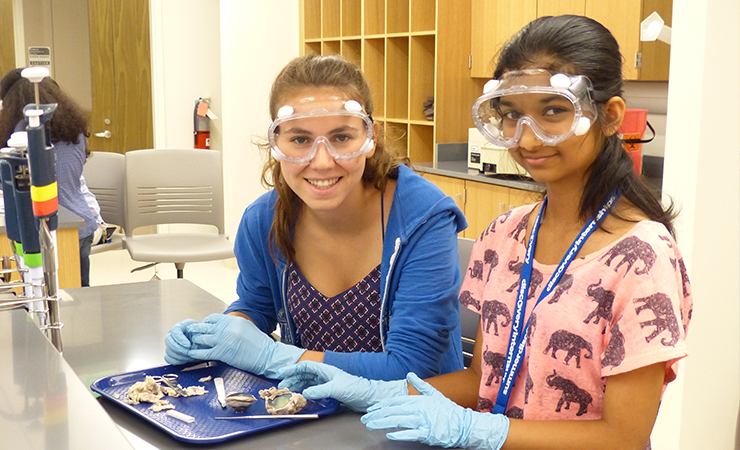
You don't just hear about the brain, you handle it. The 2025 syllabus had sheep brain and cow eye dissections, a fly lab and three afternoons recording from crickets, and the journal club builds up to you presenting a published paper yourself. The teaching comes from members of Penn's own undergraduate neuroscience program.
What it asks of you
You'll spend three weeks living on campus with full weekdays of classes, and Penn doesn't let residential students hold a job or join another program at the same time. It's also a big expense, with no financial aid outside the Philadelphia school scholarship.
Who should skip it
Anyone who needs college credit, since the academy ends in a certificate, and anyone hoping to design and run their own experiment, because the 2025 syllabus is built around lectures and set lab sessions rather than an individual research project.
In the 2025 syllabus, weekdays ran from 9:00 am to 4:30 pm. A 75-minute morning lecture was followed by an hour of journal club, then lunch at 11:30 and a shorter lecture at 12:30. After that came a two-hour lab from 1:30, and the day finished with an hour of neuroethics club. A few days broke the pattern. The Wednesday of week two was given over to a trip to the Mütter Museum, and on the final Friday students gave their journal club presentations, followed by a student panel on college and grad school and a talk on studying neuroscience at Penn.
Evenings and weekends are planned by the residential staff. Penn mentions trivia or arts and crafts nights during the week and weekend trips to places like the beach or a Phillies game. ESF Pre-College, which runs the residential side, says it offers a trip every Saturday and leaves Sundays for relaxing and exploring Philadelphia. Penn says you'll also spend some of that free time studying or working on assignments.
The academy is directed by Dr. Mary Ellen Kelly, a lecturer and neuroscience program coordinator in Penn's undergraduate Neuroscience Program. She has worked in undergraduate neuroscience education for more than 10 years at Haverford College and Penn. She also spent several years researching temporal lobe epilepsy as a Stokes Research Fellow at the Children's Hospital of Philadelphia, and her teaching centers on the neural mechanisms behind brain disorders.
In 2025 she shared the teaching with several other lecturers. They included Dr. McLean on the senses and neuroanatomy, Dr. Kane on drugs and fruit-fly models, Dr. Hipolit on learning, memory and moral decision-making, Dr. Wengert on the cricket recordings and Dr. Flanagan-Cato on sex and hormones. Penn says its academies also have graduate and undergraduate teaching assistants, though it doesn't publish a class size.
Penn takes current 9th to 11th graders who will have completed a year of high school biology and a year of high school chemistry before the program begins. If you're still taking one of them, send a report card or unofficial transcript showing at least one marking period. If your biology course was Living Earth or Living Environment, include its course description so the admissions committee can check it. Penn also asks for a minimum 3.5 GPA, and graduating seniors can't apply.
The application has two essays of up to 400 words each, one on why you want this program and one on two of your extracurricular activities. You'll also send a full transcript, a syllabus for your prerequisite courses and one letter of recommendation, which has to name this program and be written on the recommender's letterhead. Non-native English speakers write a third essay and need a TOEFL of 100 (iBT), an IELTS of 7 or a Duolingo score of 130, unless they've attended an English-medium school for at least two years. Penn reviews complete applications in the order they arrive until the academy is full, which happened in 2026, and it doesn't publish how many students it takes.
The 2026 fee was $10,050 for the three weeks. It covered teaching, an on-campus room, the meal plan, linens, gym access (for students 15 and older), activities and trips, and supervision. Penn says you don't need to buy any materials before the academy starts, although you do need your own laptop or tablet with administrator access. On top of the fee came the $100 nonrefundable application fee, travel to Philadelphia, meals off campus, laundry supplies, medical costs and spending money. ESF Pre-College offers airport pick-up or drop-off at $75 each way. International students also pay a mandatory registration fee, which ESF lists as $175 including medical insurance, as well as the cost of a tourist or B-2 visa.
A $1,500 nonrefundable deposit holds your place and counts toward the total. In 2026, bills arrived around the start of May with payment due by June, and Penn added a 1.5% penalty on anything overdue. A written withdrawal by 15 May got everything back except the deposit.
Penn doesn't offer financial aid, but it does award a limited number of scholarships to Philadelphia residents at School District of Philadelphia public or charter high schools. These cover the program, housing and meals but not travel or class materials, and those students don't pay the application fee.
ESF Pre-College, Penn's residential partner, runs life in the dorms and lists 1:10 staffing among what tuition includes. Its pre-college policies set curfew and quiet hours and keep residence halls gender specific. Students can walk around campus only in groups of three or more after signing out, and they can leave campus only with ESF staff or with an adult the family authorizes, who has to carry official ID.
Medical care
ESF nursing staff can give over-the-counter medication, and after-hours emergency or urgent care is at the nearby Children's Hospital of Philadelphia.
Health forms
Before arrival ESF needs a health form, a physical from within 18 months, immunization records and proof of health insurance, and incomplete forms can mean removal without a refund.
Phones
Every student needs a working cell phone with a US data plan and WhatsApp, which staff use to reach students.
Campus security
Penn's Division of Public Safety offers 24/7 walking escorts, and students must be at least 13 to live in the residence halls.
You leave with a certificate of completion, and you can ask your Penn instructors for letters of recommendation. The academy carries no college credit and no official Penn transcript. Along the way you'll have presented a peer-reviewed paper at journal club and, going by the 2025 syllabus, made an infographic on a neuroscience public health topic.

Sean
Founder, Succeed
Talk it through with Sean
“I can help you compare the programs you're considering, think through the practicalities and work out what makes sense for you.”
20 minutes · No obligation to enroll
Succeed has a commercial partnership with this provider.
Save this program in Succeed to compare it with similar programs, dates, costs and formats in one place.
Compare with other programshs.sas.upenn.edu · Official page
esfprecollege.com
hs.sas.upenn.edu
hs.sas.upenn.edu
hs.sas.upenn.edu
hs.sas.upenn.edu
hs.sas.upenn.edu
hs.sas.upenn.edu
Not ready to decide yet? Keep it for later.