
Biology
15 Jan 2027
Free
14-18
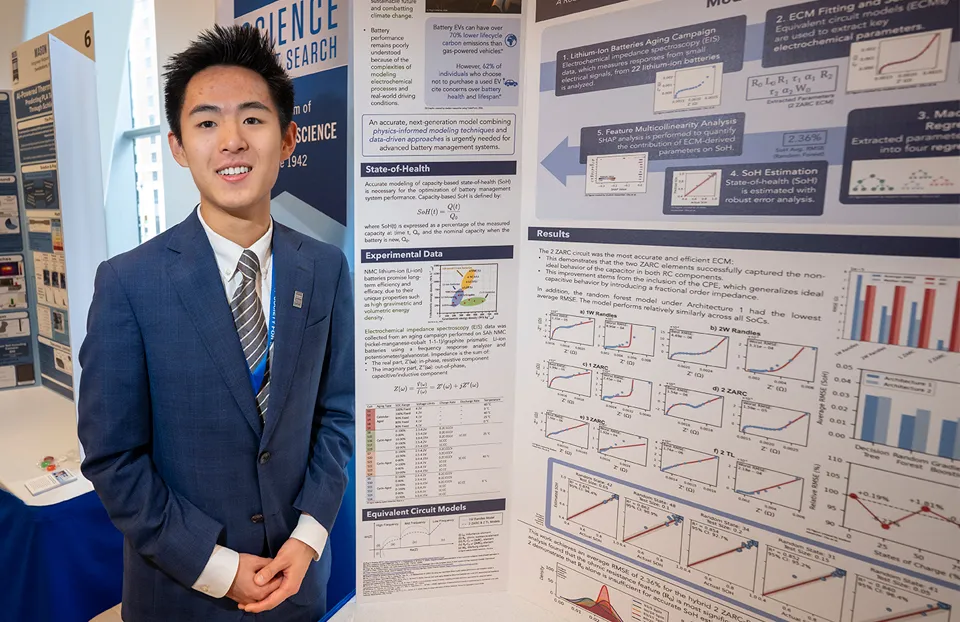
Regeneron STS is the Society for Science's research competition for high school seniors, and you enter with a project you've already finished: original science, math or engineering research written up as a paper of up to 20 pages. The online application adds essays, questions about how you spend your time, three kinds of recommendations, your transcript and a full account of everyone who helped. PhD scientists pick 300 scholars from the entries, and 40 of them travel to Washington, DC, in March for judging interviews and a public exhibition.
 Sean Stevens · Sources
Succeed's assessment
In short
Why it's worth it
Every eligible entry is read in full by at least three PhD scientists in its own field, and the recognition reaches well past the winners, since 300 scholars and their schools all receive awards.
What it asks of you
The application assumes the research is already done, which the Society says frequently means a year or more of work. The write-up, essays, disclosures and three types of recommendation then add a serious second job on top.
Who should skip it
Students who want to know how their work was rated, because the Society shares no rubrics or judges' comments and entrants waive the right to see them.
One shot only
You can enter only in your final year of high school, and anyone who has entered a previous STS is ineligible, so there's no practice run as a junior.
You submit one finished project, entered alone, through an online application of 13 tasks. At its center is a research report of up to 20 pages, uploaded as a PDF of 4MB or less. The title page, abstract and bibliography don't count toward the limit, but appendices do, and anything past page 20 isn't read. Around it sit essay questions about you and your goals, a 200-word plain-language summary of the project, an account of how you got the idea and how long the research took, your previous research, up to seven activities, optional test scores and a disclosures section covering family connections, mentors, payments and any AI use.
Three types of recommendation complete it: an Educator Recommendation from a teacher, a Project Recommendation from the adult closest to your research (you need one even if you worked without a mentor), and a High School Report, where your counselor uploads your transcript. These are question-by-question online forms rather than letters, so your recommenders need real time too.
The research is the big commitment. The Society says projects frequently span a year or more, though some students have finished in as little as six weeks, and you need data and results before you apply. It reckons the basic personal and school tasks take about an hour and make up a fifth of the application. In our estimate, the essays, disclosures and final polish of the paper take several weeks of evenings beyond that.
The Society publishes its own list of common reasons projects fail to qualify, and several of its rules carry disqualification outright.
Individual work only
Research done with another high school student counts as team research even if you each did different parts, and you can't split a team project or merge your entry into a team one for another competition before June 2027.
No AI-written text
You can use AI tools in the research itself if you disclose them, but not to write your answers, draft the report or generate citations, and a fake reference in your bibliography means disqualification.
Cite every image
Every graph, table and picture in the report needs a citation in the Society's format, including ones you made yourself, and leaving one out could get the project disqualified.
Approvals come first
Research involving people (surveys included), vertebrate animals, cell lines or tissue, or potentially hazardous biological agents likely needs approval before you begin, and Task 7 of the application tells you which paperwork applies.
Disclose every kind of help
Paid programs, coaching, relatives who work in science and personal links to your mentor all have to be declared, and an undisclosed paid relationship gets the entry disqualified.
Recommendations share your deadline
Recommenders must submit by 8pm ET on 5 November 2026 with no exceptions. A missing one doesn't remove your application, but the Society says it's hard to judge an entry without it.
Your whole application is judged, not just the science. Each eligible entry is read by three or more PhD scientists, mathematicians or engineers in its field, who give the research report the most weight but also look at your grades, recommendations, essays and how you spend your time. The Society says it has no quotas or cut-offs for test scores, grades, region, school or category, that it weighs your access to labs and other circumstances, and that grammar isn't scored. Your category only decides who reviews you, because prizes aren't given by category.
Research Report and Scientific Merit
Student Contribution to the Research
Academic Aptitude and Achievement
Overall Potential as a Future Leader of the Scientific Community
In practice that rewards being exact about what you did yourself and what your lab or mentor did, since student contribution is one of the four areas. A 2026 finalist's advice was not to hide the confusion, pivots or failed ideas, because they show how you think. At Finals Week, judges interview all 40 finalists about their projects and run panel interviews testing the breadth and depth of their STEM knowledge, creativity and problem-solving.
Around 2,600 seniors enter each year, and in 2026 the 40 finalists came from 300 scholars and more than 2,600 applicants. That makes roughly 1 in 9 entrants a scholar and about 1 in 65 a finalist, from 300 and 40 out of 2,600. The 2026 scholars came from 206 high schools in 35 states, Washington, DC, and China.
Selection runs in stages. The 300 scholars are announced on 7 January 2027, a second panel of judges picks the 40 finalists from them for announcement on 21 January 2027, and the top 10 are named at the awards ceremony on 16 March 2027.
Money is paid at every stage, though most of it goes to the 40 finalists. Each of the 300 scholars gets $2,000, mailed in late spring once they upload a W9 taxpayer form, and their school gets another $2,000 per scholar for science, math or engineering teaching. For homeschoolers, that school award goes to a public school district in their home state or a nonprofit science organization they choose, with the director's approval. Scholars are also invited to apply to Regeneron's summer internship program, which is an invitation to apply rather than a place.
| Place | Award |
|---|---|
| 1st | $250,000 |
| 2nd | $175,000 |
| 3rd | $150,000 |
| 4th | $100,000 |
| 5th | $90,000 |
| 6th | $80,000 |
| 7th | $70,000 |
| 8th | $60,000 |
| 9th | $50,000 |
| 10th | $40,000 |
| Remaining 30 finalists | $25,000each |
| Top 300 scholars | $2,000each, plus $2,000 to their school |
| All entrants who submit | T-shirt, laptop sticker, one-year Science News subscription |
All 40 finalists get at least $25,000 and an all-expenses-paid trip to Washington, DC, for Finals Week, so getting there costs the family nothing. The top 10 receive between $40,000 and $250,000, and the Society calls its $250,000 first prize the largest scientific prize open to a high school student in the United States. Finalists do take on paperwork, since they must complete the Society's forms through the spring before Finals Week. Every entrant who submits gets a t-shirt, a laptop sticker and a one-year subscription to Science News.
Start with the 2027 Rules Book, because the Society adds new rules each year. Check eligibility on page 6, then the common reasons projects fail to qualify on page 49, which also comes as a separate list. Read your draft paper against the Research Report Guidelines for spacing, fonts and page rules, and use the Citation Guide for every image.
The 2027 Application Questions let you draft every answer offline, which the Society recommends anyway because the system can lose unsaved text and rejects emoji and some special characters. The application tour videos walk through each task. The Society's own advice is to request recommendations the day you open your application, since recommender trouble is its top support request, and to register with a personal email rather than a school one, without Google sign-in. Recorded webinars such as Top Ten Tips for Regeneron STS Entrants are collected on the resource page.
Save this competition in Succeed to compare it with other essay prizes, deadlines and entry formats in one place.
Compare with other competitionssocietyforscience.org · Official page
sciencetalentsearch.smapply.org
sciencetalentsearch.smapply.org
sspcdn.blob.core.windows.net
sspcdn.blob.core.windows.net
societyforscience.org
societyforscience.org
societyforscience.org
Facts checked against the official page on 3 Nov 2026
Editor: Sean Stevens
Succeed has no commercial relationship with Society for Science.
Spot an error? Report it
Not ready to enter yet? Keep it for later.