
Summer Springboard Architecture Design & Restoration High School Course
- 2027 program
May qualify for the £300 Succeed Program Award.
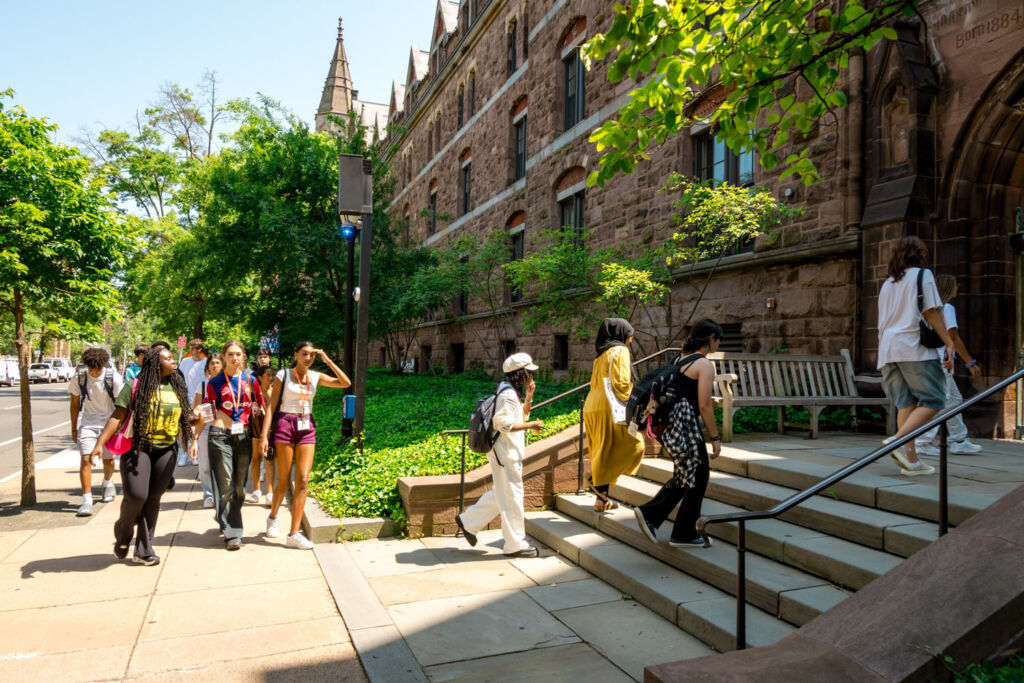
Over one week on Yale's campus in New Haven, you sketch and measure landmarks such as Harkness Tower and the Beinecke Rare Book & Manuscript Library, tour buildings by Louis Kahn, Eero Saarinen and Paul Rudolph, and learn how preservation experts judge an old building's materials and condition. You finish with measured drawings, a scale model and your own restoration or adaptive reuse concept, which you present in a final studio critique. Summer Springboard runs the course, which is new for 2027, and you can either live on campus or commute.

At a glance
Official facts · checked 11 Nov 2026- DatesOfficial
- 2027: 27 June to 3 July (Session 2), 18 to 24 July (Session 5)
- Who can applyOfficial
- Students in grades 9 to 12, including students starting high school in the fall and seniors who graduated in the spring. International students show English proficiency by telephone interview or minimum scores: TOEFL 490 paper or 60 iBT, Cambridge PET-Distinction or FCE-C, or SAT 450 Reading/Writing
- Total costOfficial
- 2027: $4,298 residential, $2,498 non-residential
- Format and placeOfficial
- In person, New Haven, Connecticut
- Length
- 1 week
- Included / budget separately
- Included: accommodation, meals (breakfast, lunch and dinner for residential students, lunch for commuter students). Separately: Course supplement $250 (mandatory), application fee from $99 (non-refundable), airport shuttle $95 each way, Yale gym access $27 per week (optional)
- Deposit and refunds
- Deposit $600. Cancel before 1 March: 100% of tuition is refunded, except the $99 application fee, which is never refunded
- Financial aid
- Need-based scholarships cover up to 30% of residential tuition or up to 60% of commuter tuition
- Apply by
- 2027: 21 February (1st Wave), 18 April (2nd Wave), 16 May (Final General Admission)
- Cohort and selectivity
- Summer Springboard admits students who meet its 3.0 GPA minimum and Essential Eligibility Criteria, and assigns course places first come, first served
- Credit or certificate
- Completion certificate and letter of recommendation from the instructor
Get the key facts by email
The dates, costs and how to apply, then 2 reminders: 2 May (2 weeks before) and 13 May (3 days before).
Succeed's assessment
Should you apply?
SucceedIn short
Why it's worth it
The campus is the subject as well as the venue. You study its landmarks and modern buildings at first hand and meet architects and preservation professionals who care for historic buildings, so the design skills you learn connect to real decisions about real places.
What it asks of you
No prior experience, about four hours of class each weekday morning and an afternoon excursion or lab. The bigger ask is the price, which is high for five days of class once the mandatory course supplement is added.
Who should skip it
Anyone who needs college credit, since this course carries none. A completion certificate and an instructor's letter are a modest return for the price.
Good to know
The course is new for 2027, so there are no past students to ask, and Summer Springboard still lists the instructors and the course infosheet as coming soon.
What does a day at Yale look like?
Class runs from 9am to 1:15pm with a 15-minute break at 11am, which gives you about four hours of architecture each morning. After lunch and some free time, the 3pm slot is for academic excursions or labs, and this course's site visits show how preservation decisions play out in buildings people still live, study and work in every day.
Commuters leave at 5pm, while residential students get free time, then dinner at 6pm, an evening activity at 7pm and more free time before dorm checks at 9:30pm. Weekend trips to Boston and New York City are only for students who stay more than one week, so a single week doesn't include them.
Who can enroll?
Any student who has finished 8th grade by the start date and holds a 3.0 GPA or local equivalent can apply, and Summer Springboard also accepts seniors who graduated that spring. International students show their English either in a phone interview or with a minimum score: 490 on the paper TOEFL (Test of English as a Foreign Language) or 60 on the internet-based test, Cambridge PET with Distinction or FCE at grade C, or 450 in SAT Reading and Writing.
Every application is screened against Summer Springboard's Essential Eligibility Criteria, which cover things like managing your own medication, walking more than a mile and following instructions in English, and a student who doesn't meet them is turned down. Summer Springboard gives no acceptance rate or class size, but it assigns course places first come, first served, so applying early is the surest way to get the session you want.
What does a week really cost?
For applications made by 30 November 2026, a residential week costs $4,298 and a commuter week $2,498. This course adds a mandatory $250 supplement, which brings the totals to $4,548 and $2,748, plus an application fee that starts at $99. Summer Springboard raises tuition on 1 December 2026 and hasn't listed the new price yet. The residential price covers lodging, all meals, excursions and the course, while commuters get the course, lunch, excursions and programming from 9am to 5pm on weekdays.
Flights and health insurance, which every student must have, are extra, and so are the airport shuttle at $95 each way and the Yale gym at $27 a week if you want it. Each extra one-week Yale course you add costs $3,298 residential or $1,998 commuter. The $600 deposit is due with the application. Need-based scholarships can cover up to 30% of residential or 60% of commuter tuition, but never the deposit or the application fee.
The application fee is never refunded. Cancel before 1 March 2027 and you get all the tuition back, and from 2 March to 1 April 2027 you get it all back except the $600 deposit. From 2 April to 1 May 2027 you get 75% of tuition back and after 1 May 25%, in both cases less the deposit. After 1 June nothing is refunded.
What do you leave with?
You leave with your own restoration or adaptive reuse proposal, measured drawings and a scale model of a campus detail or small space, plus a completion certificate and a letter of recommendation from your instructor. Summer Springboard says the certificate and letter are earned rather than automatic and can be withheld for poor participation or conduct breaches. The course carries no college credit, and because Summer Springboard runs independently of Yale, neither document is a Yale credential.
How are students looked after at Yale?
Summer Springboard staff live on every dorm floor, and the campus director and other senior staff also live in the dorms and are on hand 24 hours a day. All staff go through background checks. The dorms need individual key cards, Yale Security patrols around the clock, and students have to be in their rooms after 10pm. A doctor is on call 24/7 and Summer Springboard works with Yale New Haven Hospital for medical care, while students keep and take their own medication.
In free time, students can move around within set campus boundaries in groups of at least three. Rooms are on gender-separated floors with shared bathrooms, and because Yale's residential colleges have no air conditioning, Summer Springboard gives every student a fan. The rules are set out in its Code of Conduct.
How do you enroll?
Applications go through Summer Springboard's enrollment page.
Check that your session is still listed as available, then create an account and confirm the verification email.
Click Create New Application and choose Yale, your session, this course and residential or commuter tuition.
Complete the application with the student present, which takes about 30 minutes and includes the short-answer essay questions.
Pay the $600 deposit and the application fee to hold your place. The fee is $99 until 21 February 2027, $149 after that and $199 after 18 April 2027, and some programs close or go to a waitlist after each of those dates. Enrollment closes on 16 May 2027.
Expect a decision by email within 5 to 7 business days, after which the remaining enrollment forms open.
If you apply before 10 March 2027 and don't pay in full, the balance is split into thirds, due on 10 March, 10 April and 10 May.

Sean
Founder, Succeed
Talk it through with Sean
Want to talk it through?
“I can help you compare the programs you're considering, think through the practicalities and work out what makes sense for you.”
20 minutes · No obligation to enroll
What should you do next?
Frequently asked questions
Sources
- Architecture Design & Restoration
summerspringboard.com · Official page
- Application and Enrollment FAQ
summerspringboard.com
- Need-Based Scholarships
summerspringboard.com
- Terms & Conditions
summerspringboard.com
- General Information FAQ
summerspringboard.com
- Main FAQ | Knowledge Base
summerspringboard.com
- summerspringboard.com/apply
- summerspringboard.com/knowledge-base/campus-specific-faq-knowledge-base-summer-springboard
Not ready to decide yet? Keep it for later.