
Accounting: The Language of Business
Applications open
In-person accounting course for ages 16 to 18, from $5,200.
17 Feb 2027 · From $5,200 · 16-18 · In-person
May qualify for the £300 Succeed Program Award.
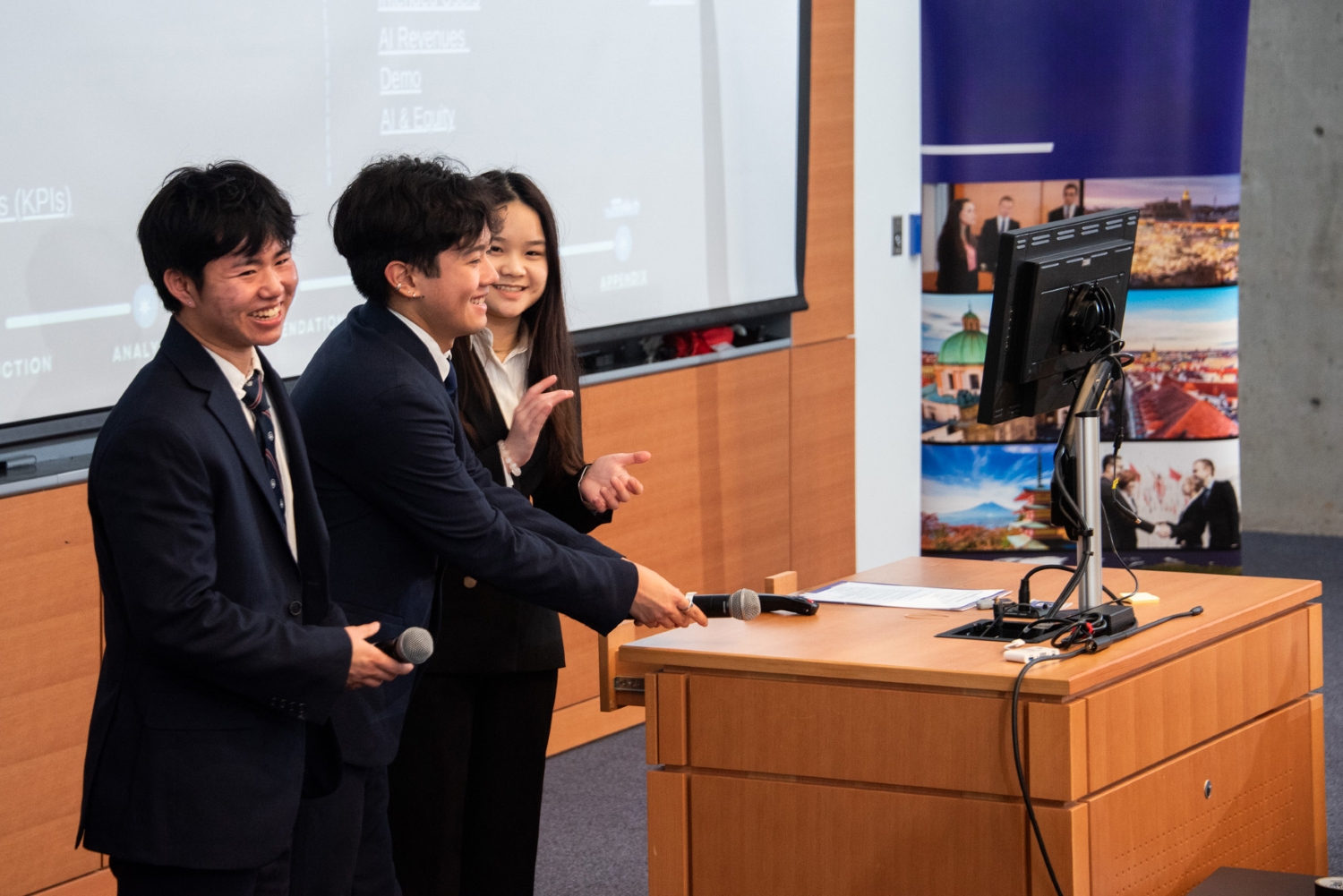
Business & Leadership is a two-week summer course at the University of Washington's Foster School of Business in Seattle. Summer Springboard runs it in partnership with Foster, and Foster faculty teach the classes. Mornings are given to classes on strategy, marketing, finance, teamwork and presenting, and afternoons bring workshops and visits to Seattle-area companies. The course ends with a team case competition, where you pitch a solution to a real company's problem to a panel of experts, and you can either live in a campus dorm or commute to the day program.
Get the key facts by email
The dates, costs and how to apply, then 2 reminders: 2 May (2 weeks before) and 13 May (3 days before).
Why it's worth it
Foster School faculty teach the classes, and the two weeks build toward one concrete piece of work, a team solution to a real company's problem, with company visits around Seattle tied to it. That gives you something specific to talk about afterward, not just a summer on campus.
What it asks of you
The bigger commitment is money rather than time. Living on campus costs $7,898 and commuting costs $4,498, before the application fee and any flights. You'll also need a 3.0 GPA, a short application with essay questions and, if you live on campus, the energy for long days that run into evening activities.
Who should skip it
Students who want a demanding course load, because the course comes to nine three-hour morning classes in total, and the afternoons mix workshops and excursions with project time and recreation.
Class runs from 9:00 am to noon, Monday to Friday in the first week and Monday to Thursday in the second, which comes to nine three-hour sessions. Wednesday afternoons are kept for extra academic time such as excursions and speakers. On other days, 1:30 pm brings Academics in Action or a UW faculty workshop, and 3:30 pm is for project work, the True You personal-growth sessions or a recreational activity. Along the way you'll also take college readiness workshops on admissions, finance and public speaking.
Commuters leave at 5:00 pm. Residential students have dinner at 6:00 pm, clubs or evening activities from 7:00 pm and night checks at 10:30 pm. The weekend in the middle brings trips to Pike Place Market, the Museum of Pop Culture and a Seattle ferry tour. In 2026, the company visits included Nike headquarters and AI House.
Foster School faculty lead it. Leta Beard, an associate teaching professor of marketing and international business at Foster, is the main instructor, and she holds a bachelor's degree and an MBA from the University of Washington. Jean Choy, an associate teaching professor of management and associate dean of executive education and international initiatives, covers teamwork, communication and presentation skills. Helen Andrews holds a Foster MBA and the CFA designation and has taught personal finance at UW Bothell, and she covers behavioral economics and personal financial planning. Summer Springboard also lists Elijah Wee, an assistant professor of management at Foster, to teach management strategy.
You leave with a Letter of Participation from your instructor, a UW Foster professor, a certificate of completion from Summer Springboard and the case solution your team presented. The course doesn't carry college credit, which Summer Springboard offers only at its Cal Poly and NYSID campuses.
Summer Springboard says the project gives students a competitive edge on college applications, but that's its own claim, not a college's. The certificate and letter aren't automatic either. Staff can withhold them if a student breaks the code of conduct or doesn't take part.
Summer Springboard takes rising 10th, 11th and 12th graders and students graduating from high school in 2027, with a 3.0 GPA or the equivalent. International students show their English in a telephone interview or with a minimum score: 490 on the paper TOEFL or 60 on the iBT, PET with Distinction or FCE grade C from Cambridge, or 450 in SAT Reading and Writing.
The online application takes about 30 minutes, and the student has to be there to complete it. It includes short-answer essay questions and signed agreement forms. Summer Springboard reviews each application against its Essential Eligibility Criteria, which expect students to manage their own medication and daily care and may call for medical documentation, and it sends a decision within 5 to 7 business days. Places can run out, though, so the wave dates matter.
21 February 2027
First-wave deadline. After it the application fee rises to $149 and some programs close to a waitlist.
18 April 2027
Second-wave deadline. The fee rises to $199 and more programs may close.
16 May 2027
Final deadline, when enrollment closes.
Living on campus costs $7,898 and commuting costs $4,498 for the full two weeks. Summer Springboard lists these prices for applications made by 30 November 2026 and says tuition goes up on 1 December, but it doesn't publish the new figure. The residential price covers your dorm room, all meals, the course, company visits and the weekend trips. The commuter price covers the course, lunch, excursions and the 9:00 am to 5:00 pm weekday program, and weekend trips cost $125 a day on top.
Either way, there's a nonrefundable application fee starting at $99, and tuition doesn't cover flights or health insurance. The airport shuttle is optional and costs $95 each way, plus $50 each way for students flying as unaccompanied minors, which Summer Springboard says students aged 14 and under must do. You pay a $600 deposit with your application, and if you apply before 10 March, the balance is due in three installments on 10 March, 10 April and 10 May 2027. Any payment received after 10 May carries a $150 late fee.
Need-based scholarships from a limited pool cover up to 30% of residential tuition or 60% of commuter tuition, but never the deposit or application fee, and families hear back within 7 business days. The optional $699 Tuition Protection Plan lets you cancel for any reason up to the start date. You can only buy it with your application, no later than 10 May, and the $699 itself isn't refunded. Without it, refunds shrink through the spring.
| If you cancel | What you get back |
|---|---|
| Before 1 March 2027 | All tuition, minus the application fee |
| 2 March to 1 April 2027 | All tuition minus the $600 deposit and application fee, or everything paid as credit for a future year |
| 2 April to 1 May 2027 | 75% of tuition minus the deposit and application fee, or everything paid as future credit |
| After 1 May 2027 | 25% of tuition minus the deposit and application fee, or 75% of what you paid as future credit |
| After 1 June 2027 | Nothing, and no credit |
Summer Springboard staff live on the dorm floor, which the program has to itself. They run clubs and evening activities and do night checks at 10:30 pm. Students live in Spratlen Hall or a similar dorm, in double or triple rooms with a private bathroom, and are housed by gender in separate wings. The rooms have no air conditioning, but fans are provided. The dorms have 24-hour security with electronic keys for every building and room, and university security patrols around the clock.
Staff supervise classes and excursions. In free time, students can go anywhere within set campus boundaries in groups of three or more. All program staff go through background checks and training. If a student is ill or injured, staff take them to the nearest medical facility and contact parents, and the family pays any costs. Students keep and take their own medication and must show proof of health insurance. Serious breaches of the code of conduct, such as alcohol, drugs or leaving the group without permission, can get a student sent home at the family's expense, with no refund.

Sean
Talk it through with Sean
“I can help you compare the programs you're considering, think through the practicalities and work out what makes sense for you.”
In-person accounting course for ages 16 to 18, from $5,200.
17 Feb 2027 · From $5,200 · 16-18 · In-person
Banking and finance career course in London for ages 15 to 18, from £3,745.
Deadline: Not announced yet · From £3,745 · 15-18 · London · In-person
Finance and investing program in Winston-Salem for ages 14 to 18, from $3,500.
Deadline: Not announced yet · From $3,500 · 14-18 · Winston-Salem · In-person
Save this program in Succeed to compare it with similar programs, dates, costs and formats in one place.
Compare with other programsOfficial page
summerspringboard.com
summerspringboard.com
summerspringboard.com
summerspringboard.com
summerspringboard.com
summerspringboard.com
summerspringboard.com