
Summer Springboard Entrepreneurship Essentials
- 2027 program
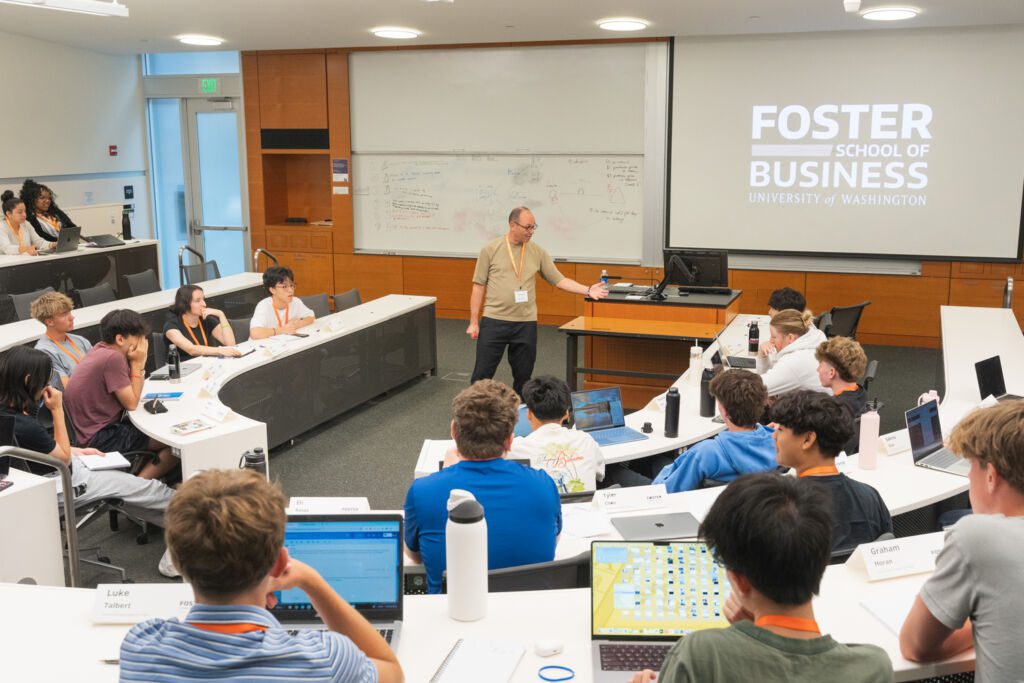
Entrepreneurship Essentials is a one-week startup bootcamp at the University of Washington's Foster School of Business in Seattle, run by Summer Springboard in partnership with UW Foster. You work in a small team to come up with a product idea, test it with market research, build a prototype and plan the business, then pitch it to a panel of judges at the end of the week. Students can either live in a campus dorm or commute in for the 9am to 5pm day.
 Sean Stevens · SourcesSucceed has a commercial partnership with this provider.
At a glance
Official facts · checked 11 Nov 2026- DatesOfficial
- 2027: 25 to 31 July
- Who can applyOfficial
- Rising 10th, 11th and 12th graders and graduating seniors. 3.0 grade point average (or equivalent). Must have completed 8th grade by the program start date. International students show English proficiency by telephone interview or a minimum score: TOEFL 490 paper or 60 iBT, Cambridge PET-Distinction or FCE-C, or SAT 450 Reading/Writing
- Total costOfficial
- 2027: $4,498 residential, $3,198 non-residential
- Format and placeOfficial
- In person, University residence hall, Seattle
- Length
- One week
- Included / budget separately
- Included: accommodation, meals (All meals for residential students). Separately: application fee from $99 (non-refundable), rising to $149 after 21 February 2027 and $199 after 18 April 2027, Group airport transfer $95 each way, Unaccompanied minor transportation $145 each way, tuition Protection Plan $699 (optional)
- Deposit and refunds
- Deposit $600. Cancel before 1 March: 100% of tuition is refunded, and only the $99 application fee, which is never refundable, is kept
- Financial aid
- Need-based scholarships cover up to 30% of residential tuition or up to 60% of commuter tuition
- Apply by
- 2027: 21 February (1st wave), 18 April (2nd wave), 16 May (Final)
- Cohort and selectivity
- Applicants who meet the GPA and eligibility criteria are reviewed holistically, and places are filled while the session has room
- Credit or certificate
- Certificate of completion from Summer Springboard, plus a letter of participation from a UW Foster professor
Get the key facts by email
The dates, costs and how to apply, then 2 reminders: 2 May (2 weeks before) and 13 May (3 days before).
Succeed's assessment
Should you apply?
SucceedIn short
Why it's worth it
In seven days your team takes an untested idea to a prototype and a pitch in front of judges. The course is led by Valerie Trask, who teaches entrepreneurship at the University of Washington and has founded companies herself, so you learn the full startup cycle from someone who has been through it.
What it asks of you
Mostly money. At the prices listed for applications made by 30 November 2026, the week costs $4,498 if you live on campus or $3,198 if you commute, and families from outside Seattle also pay for travel. You'll also need to bring a laptop for class.
Who should skip it
Students who want something for a transcript, because the course ends with a certificate and a professor's letter rather than credit. It's also a poor fit if you'd rather work alone, since the startup is built as a team from start to finish.
Who teaches the startup bootcamp?
Valerie Trask leads the course. According to Summer Springboard, she has taught entrepreneurship at the University of Washington for the past eight years, guiding students through launching real, profitable ventures, and she has founded and advised several early-stage companies in consumer and innovation fields. UW Foster faculty with startup experience and Seattle entrepreneurs also teach, and visiting professionals talk about their own careers and hear the team pitches.
Summer Springboard doesn't publish a class size or staff ratio for this course.
What does a day on the UW campus look like?
Class runs from 9am to noon. At 1:30pm there's an excursion or a recreational activity, and at 3pm a college readiness workshop or a session of True You, Summer Springboard's self-discovery curriculum. Commuters leave at 5pm. Residential students have dinner at 6pm, clubs or evening activities at 7pm and a dorm check at 10:30pm.
Everyone, commuters included, checks in on Sunday 25 July 2027 for orientation, icebreakers and dinner. The course has no weekend break, and the week ends with the pitch competition and an awards and certificate ceremony. Academic excursions go to businesses around Seattle, and the course includes visits to UW's makerspaces.
What do you need to get a place?
Besides being in the right grades, you need a 3.0 GPA or the equivalent. International students without one of the minimum English test scores can prove their English in a telephone interview instead. The application also includes short-answer essay questions.
Summer Springboard reviews each application against its Essential Eligibility Criteria, which expect you to manage your own medication and self-care, walk more than a mile between buildings and follow staff instructions in English. Students with some medical or mental health conditions may be asked for a doctor's clearance and to show 12 months of stability first, and Summer Springboard says its programs aren't designed to provide clinical or mental health support. It publishes no acceptance rate, and if the session fills you go on a waitlist.
What does the week really cost?
Living on campus costs $4,498, which covers the course, a dorm room, all meals and excursions. Commuting costs $3,198, which covers the course, lunch, excursions and the 9am to 5pm weekday program. Summer Springboard lists these prices for applications made by 30 November 2026 and raises tuition on 1 December 2026, so check the current price if you apply after that.
When you apply, you pay a $600 deposit and a non-refundable application fee, which starts at $99, rises to $149 after 21 February 2027 and reaches $199 after 18 April 2027. If you don't pay in full, you go on a payment plan with the balance due by 10 May 2027. Group airport transfers cost $95 each way, and Summer Springboard suggests bringing about $100 a week for spending money. Students must also show proof of health insurance. Summer Springboard has a limited pool of need-based scholarships worth up to 30% of residential or 60% of commuter tuition. They can't go toward the deposit or application fee, and you should hear back within 7 business days of applying for one.
How much you get back if you cancel depends on the date. An optional $699 Tuition Protection Plan, which has to be bought with the application, lets you cancel for any reason up to the program's start date and get a refund of the fees you've paid, apart from the $699 for the plan itself.
| If you cancel | What you get back |
|---|---|
| Before 1 March 2027 | All tuition, minus the application fee |
| 2 March to 1 April 2027 | All tuition minus the $600 deposit and fee, or full credit for a future year |
| 2 April to 1 May 2027 | 75% of tuition minus the deposit and fee, or full credit for a future year |
| 2 May to 1 June 2027 | 25% of tuition minus the deposit and fee, or 75% of what you've paid as future credit |
| After 1 June 2027 | Nothing, and no credit for a future year |
How are students looked after on campus?
Summer Springboard staff live on the dorm floor, which the program has to itself, with students housed by gender in separate wings. Staff run a dorm check at 10:30pm, and after that students must stay in their rooms. The dorms have 24-hour security and electronic keys for every building and room, and university security patrols around the clock. Rooms in Spratlen Hall or a similar dorm are doubles or triples with a private bathroom. There's no air conditioning, but fans are provided.
In free time, students can move around within set campus boundaries in groups of three or more. Every staff member goes through background checks and training. If a student is sick or hurt, staff take them to the nearest medical facility and call home, and the family covers the cost. Breaking the code of conduct can get a student sent home on the next available flight at the family's expense, with no refund.
How do you apply for a place?
Applications go through Summer Springboard's enrollment page.
Check that Session 2 (25 to 31 July 2027) is still listed as available, then create an account on the application portal and confirm the verification email.
Start a new application and choose the UW Foster campus, Session 2, Entrepreneurship Essentials and residential or commuter tuition. The full application takes about 30 minutes, and the student has to be present.
Answer the short-answer essay questions and pay the $600 deposit and application fee to hold the place.
Expect a decision within 5 to 7 business days. More forms open after acceptance, and the team won't review any of them until every required form is in.
Apply before the first-wave deadline of 21 February 2027 if you can. Some programs close or move to a waitlist after that date and again after 18 April 2027, and enrollment closes on 16 May 2027.

Sean
Founder, Succeed
Talk it through with Sean
Want to talk it through?
“I can help you compare the programs you're considering, think through the practicalities and work out what makes sense for you.”
20 minutes · No obligation to enroll
What should you do next?
Frequently asked questions
Sources
- summerspringboard.com/teen-programs/business-startup-bootcamp-course-summer-springboard
Official page
- Application and Enrollment FAQ
summerspringboard.com
- Main FAQ | Knowledge Base
summerspringboard.com
- Campus Life FAQ
summerspringboard.com
- Staff and Safety FAQ
summerspringboard.com
- General Information FAQ
summerspringboard.com
- summerspringboard.com/knowledge-base/tuition-faq
- Terms & Conditions
summerspringboard.com
Not ready to decide yet? Keep it for later.