
Summer Springboard Foundational Robotics High School Course
- 2027 program
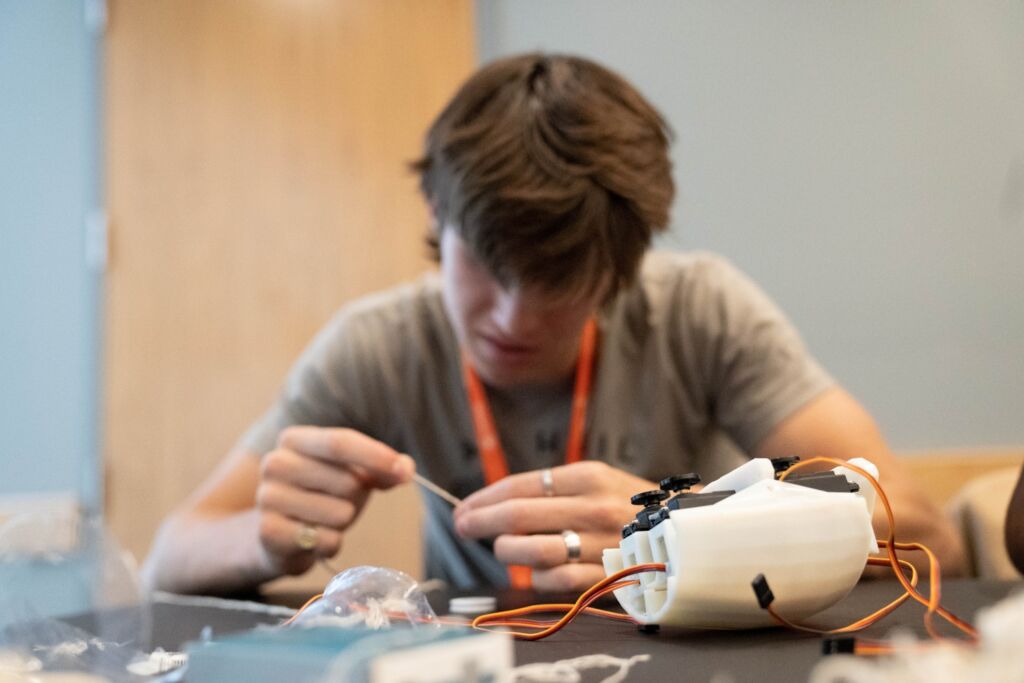
Foundational Robotics is a two-week summer course on the UC San Diego campus where high school students build and program their own robot from scratch. Mornings cover microcontrollers, sensors, 3D design and an introduction to machine learning. Afternoons mix visits with robotics professionals, college readiness workshops and trips around San Diego. You can live in the campus dorms or come as a weekday commuter.
 Sean Stevens · SourcesSucceed has a commercial partnership with this provider.
At a glance
Official facts · checked 11 Nov 2026- DatesOfficial
- 2027: 27 June to 9 July
- Who can applyOfficial
- Open to students in Grades 9 to 12. Students starting high school in the fall or who graduated in the spring are also eligible. International students show English proficiency by telephone interview or a minimum score: TOEFL 490 paper or 60 iBT, Cambridge PET-Distinction or FCE-C, or SAT 450 Reading/Writing
- Total costOfficial
- 2027: $5,998 residential, $3,298 non-residential
- Format and placeOfficial
- In person, UC San Diego, San Diego
- Length
- 2 weeks
- Included / budget separately
- Included: accommodation, meals (Three meals a day for residential students, lunch for commuters). Separately: Course tuition supplement $250 (mandatory), application fee from $99 (non-refundable), application fee $149 after 21 February 2027, application fee $199 after 18 April 2027
- Deposit and refunds
- Deposit $600. Cancel before 1 March: all payments are refunded, including the $600 deposit, except the $99 application fee, which is never refunded
- Financial aid
- Need-based scholarships cover up to 30% of residential tuition or up to 60% of commuter tuition
- Apply by
- 2027: 21 February (1st Wave Application), 18 April (2nd Wave Application), 16 May (Final General Admission)
- Cohort and selectivity
- Places go to applicants who meet the stated eligibility criteria while space lasts, and courses are assigned first come, first served
- Credit or certificate
- Completion certificate and letter of recommendation from the instructor, issued by Summer Springboard
Get the key facts by email
The dates, costs and how to apply, then 2 reminders: 2 May (2 weeks before) and 13 May (3 days before).
Succeed's assessment
Should you apply?
SucceedIn short
Why it's worth it
You build a robot yourself, working from basic electronics through sensors, microcontrollers and programming to an introduction to machine learning, and Summer Springboard adds visits with robotics professionals in San Diego. That makes it a practical first taste of the field for someone who hasn't had a robotics lab or team to work in.
What it asks of you
Mostly money and two weeks of your summer. The residential option comes to at least $6,347 before flights, and you'll need a 3.0 GPA and your own laptop, although Summer Springboard lists no robotics prerequisite for this course.
Who should skip it
Students who already code or build robots, because a foundational course taught in mornings only leaves little room to go deeper, and anyone who needs a credential that counts toward a degree, since you finish with a certificate and a letter.
How much of each day is spent building robots?
Robotics takes up the mornings, and the rest of the day is a mix of trips, workshops and campus life. Summer Springboard's course outline has nine three-hour classes, from 9am to noon Monday to Friday in the first week and Monday to Thursday in the second, which adds up to 27 hours of robotics teaching.
A typical day starts with breakfast at 8am and class at 9am. After lunch, the afternoon goes to Academics in Action, which covers course excursions, guest speakers and project work, or to a recreational outing, followed at 3:30pm by College Readiness Workshops or the True You personal development sessions. Commuters leave around 5pm, while residential students have dinner at 6pm, clubs or evening activities from 7pm and night checks at 10:30pm.
Weekends are for group trips. Summer Springboard lists Old Town San Diego, Little Italy's farmers market and Coronado Beach for Saturday, and the San Diego Zoo and Belmont Park for Sunday, all included for residential students.
What do you leave with after the two weeks?
On paper, you leave with a completion certificate and a letter of recommendation from your instructor, which Summer Springboard gives to students who finish the program. Both are earned rather than automatic, and the organizer can withhold them for breaking the code of conduct or not taking part.
There's no college credit, since Summer Springboard awards credit only at its Cal Poly and New York School of Interior Design programs. The robot you design and build is the course's main project, although the organizer doesn't say whether students take it home.
What does it take to get a place?
Getting in depends on meeting Summer Springboard's requirements and on space in the course, which it fills first come, first served. You need to have finished 8th grade by the time the program starts, which means students starting high school in fall 2027 qualify, and so do seniors graduating in spring 2027. You'll also need a 3.0 GPA or your school's equivalent. International students show their English either in a phone interview or with a minimum score: 490 on the paper TOEFL or 60 on the iBT, PET with Distinction or FCE grade C on Cambridge exams, or 450 in SAT Reading and Writing.
Summer Springboard also screens every applicant against its Essential Eligibility Criteria, which expect students to manage their own medication and personal care, walk more than a mile, follow instructions in English and cope with shared rooms and long structured days. Students with certain health conditions may be asked for medical documentation and at least 12 months of stability, and applicants who don't meet the criteria are turned down.
What does it really cost, residential or commuter?
Residential students pay at least $6,347 and commuters at least $3,647, each made up of tuition, the $250 robotics course supplement and the application fee, which starts at $99. The tuition in those totals ($5,998 residential, $3,298 commuter) is Summer Springboard's price for applications made by 30 November 2026, and tuition goes up on 1 December 2026, so confirm the figure when you apply.
Residential tuition covers your room, all meals, the course, course excursions and weekend trips. Commuter tuition covers lunch, the course, excursions and programming from 9am to 5pm on weekdays, and weekend trips cost $125 a day on top. The application fee rises to $149 after 21 February 2027 and $199 after 18 April 2027.
Flights and health insurance are extra, and so is the airport shuttle at $95 each way. Students 14 or younger must fly as unaccompanied minors, which adds another $50 each way on top of whatever the airline charges. Summer Springboard suggests about $100 a week in spending money. Its need-based scholarships, from a limited pool, cover up to 30% of residential tuition or 60% of commuter tuition, but never the $600 deposit or the application fee.
If you apply before 10 March 2027, the balance is split into three payments due on 10 March, 10 April and 10 May. Cancel before 1 March and you get everything back except the application fee. From 2 March, the deposit and application fee are no longer refundable, and you get back the rest of your tuition until 1 April, 75% of it from 2 April to 1 May and 25% after 1 May. After 1 June nothing is refunded.
How are students looked after in the dorms and around campus?
Staff live alongside students and the dorms are locked. Summer Springboard mentors live in the suites, the Campus Director and Assistant Campus Director live on site and are available for emergencies around the clock, and students need key cards for the building and their suite plus a key for their room. UCSD Police also patrol the campus and residence halls 24/7.
Students share a room with one other student in suites separated by gender, must be in their rooms after 10pm and have dorm checks at 10:30pm. Staff supervise classes and excursions directly, while in free time students can move around within set campus boundaries in groups of three or more. All program staff have background checks and training.
If a student is ill or injured, staff take them for treatment, most likely at the UC San Diego Health Emergency Department about 2 miles away, and parents are told. Families pay any medical costs, and every student must show proof of medical insurance. The rooms have no air conditioning, although the windows open.
How does the application process work?
Applications go through Summer Springboard's online enrollment page, and admissions are rolling, so places go as students apply.
Create an account with basic contact details and confirm the verification email to reach the application dashboard.
Start a new application and choose UC San Diego, Session 2 (27 June to 9 July 2027), Foundational Robotics and either residential or commuter tuition.
Complete the full application with the student present, which takes about 30 minutes and includes short-answer essay questions and signed agreement forms.
Pay the $600 deposit and the application fee to hold the place.
Expect a decision within 5 to 7 business days, after which further enrollment forms open up.
Apply by 21 February 2027 to avoid the higher application fee and the first round of course closures, and no later than 16 May 2027, when general admission ends.

Sean
Founder, Succeed
Talk it through with Sean
Want to talk it through?
“I can help you compare the programs you're considering, think through the practicalities and work out what makes sense for you.”
20 minutes · No obligation to enroll
What should you do next?
Frequently asked questions
Sources
- Foundational Robotics
summerspringboard.com · Official page
- Foundational Robotics Infosheet 2027_V2
link.summerspringboard.com
- Need-Based Scholarships
summerspringboard.com
- Campus Life FAQ
summerspringboard.com
- Staff and Safety FAQ
summerspringboard.com
- Terms & Conditions
summerspringboard.com
- General Information FAQ
summerspringboard.com
- Application and Enrollment FAQ
summerspringboard.com
Not ready to decide yet? Keep it for later.