
Summer Springboard Occupational Therapy High School Course
- 2027 program
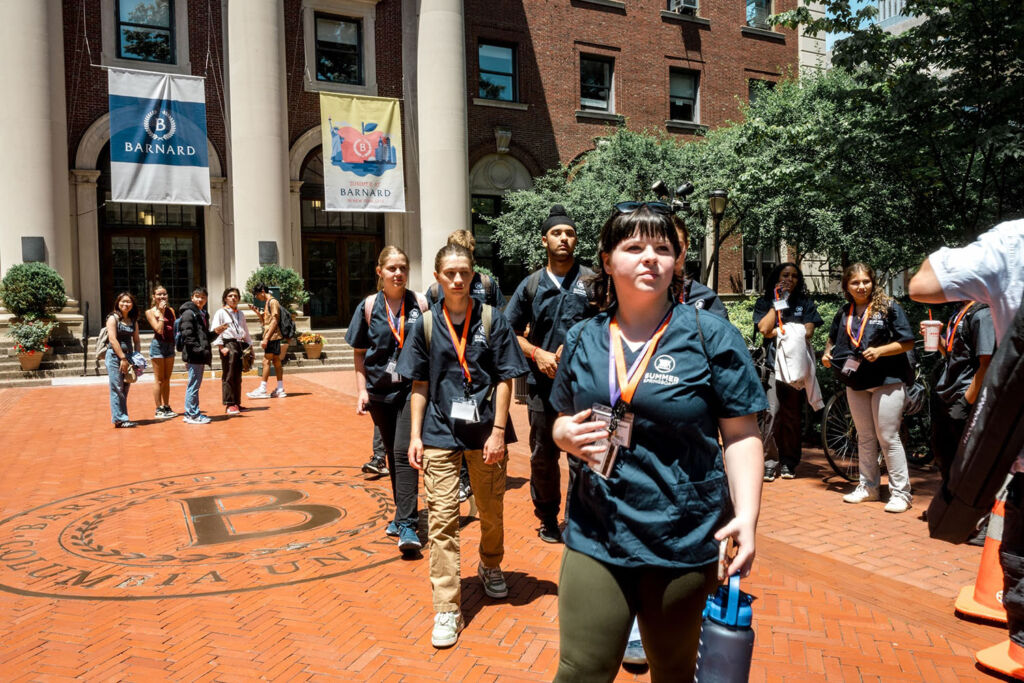
Occupational Therapy is a Summer Springboard course on the Barnard College campus in New York City. High school students spend two weeks learning how occupational therapists help people of all ages get back to everyday activities. Mornings are hands-on classes, such as trying tasks with simulated limitations and measuring range of motion, and the group visits a pediatric therapy gym and an outpatient clinic. At the end, each student designs, builds and demonstrates a piece of low-tech adaptive equipment for a client case study.
 Sean Stevens · SourcesSucceed has a commercial partnership with this provider.
At a glance
Official facts · checked 11 Nov 2026- DatesOfficial
- 2027: 5 to 17 July (Session 1), 18 to 30 July (Session 2)
- Who can applyOfficial
- Students in Grades 9 to 12. Students starting high school in the fall or who graduated in the spring are also eligible. International students show English proficiency through a telephone interview or with TOEFL 490 paper / 60 iBT, Cambridge PET-Distinction or FCE-C, or SAT 450 Reading/Writing
- Total costOfficial
- 2027: $5,998 residential, $3,298 non-residential
- Format and placeOfficial
- In person, Barnard College, Columbia University, New York City
- Length
- Two weeks
- Included / budget separately
- Included: accommodation, meals (Three meals a day for residential students, lunch for commuters). Separately: Course supplement $250 (mandatory), application fee from $99 (non-refundable, $149 after 21 February 2027, $199 after 18 April 2027), airport shuttle $95 each way, weekend excursions for commuters $125 per day
- Deposit and refunds
- Deposit $600. Cancel before 1 March: 100% of tuition is refunded except the $99 application fee
- Financial aid
- Need-based scholarships cover up to 30% of residential tuition or up to 60% of commuter tuition, depending on the program
- Apply by
- 2027: 21 February (1st Wave), 18 April (2nd Wave), 16 May (Final General Admission)
- Cohort and selectivity
- Summer Springboard publishes no acceptance rate. Eligible applicants are reviewed holistically against its Essential Eligibility Criteria, and course places go first come, first served
- Credit or certificate
- Completion certificate and letter of recommendation from the instructor
Get the key facts by email
The dates, costs and how to apply, then 2 reminders: 2 May (2 weeks before) and 13 May (3 days before).
Succeed's assessment
Should you apply?
SucceedIn short
Why it's worth it
The whole two weeks focus on one health profession, with hands-on work like trying daily tasks under simulated limitations and measuring range of motion. It ends with a piece of adaptive equipment you design and build yourself for a client case.
What it asks of you
The bigger commitment is money rather than effort. With nine three-hour morning classes, this is an introduction to the field. Living on campus comes to at least $6,347 before flights, once the required supplement and application fee are added to tuition.
Who should skip it
Students who need credit or something for their transcript. You leave with a completion certificate and a letter of recommendation from the instructor, and Summer Springboard can withhold both for poor conduct or not taking part.
What do the two weeks look like?
Class runs from 9 a.m. to noon, with nine 3-hour sessions in all. Normally that's Monday to Friday in the first week and Monday to Thursday in the second. Session 1 starts on Monday 5 July 2027 because of the holiday, so its classes run Tuesday to Friday and then Monday to Friday.
Afternoons go to Academics in Action, which covers course trips such as the visits to a pediatric therapy gym and an outpatient clinic, guest speakers and class projects, along with recreational outings. You also attend two 90-minute College Readiness Workshops, choosing from public speaking, money management, leadership and college applications, plus True You sessions on personal growth. Commuters leave at 5 p.m., while residential students have dinner at 6, clubs or evening activities from 7 and dorm checks at 10:30. Past excursions have included a New York City day with Top of the Rock, Times Square and a boat tour, and a day at Six Flags Great Adventure.
Who teaches the course?
Christine James teaches it. She's a licensed occupational therapist (OTR/L) with a master's degree in occupational therapy from New York University. She has worked in school-based pediatrics, home-based early intervention and outpatient hand therapy, and she brings real patient cases and hands-on activities into class. On the course trips you'll also hear from other occupational therapists about their training and careers.
Who can apply, and how selective is it?
You need to have finished 8th grade by the start date, so anyone from rising freshmen to students who graduated that spring can apply. You also need a 3.0 GPA or your school's equivalent. International students can prove their English in a telephone interview or with a minimum score: TOEFL 490 on paper or 60 on the iBT, Cambridge PET with Distinction or FCE at grade C, or SAT 450 in Reading and Writing.
The application asks for short-answer essays and signed agreement forms. Summer Springboard reviews each application as a whole against its Essential Eligibility Criteria, which expect you to manage your own daily care and medications, walk more than a mile and follow instructions in English. Its programs aren't therapeutic, and students with some health conditions may be asked for medical clearance and proof of 12 months of independent stability. There's no published acceptance rate, and course places are filled first come, first served.
What does it really cost?
Living on campus costs $5,998 in tuition, plus a required $250 course supplement and an application fee from $99, so at least $6,347 in all. Commuting costs $3,298 plus the same supplement and fee, at least $3,647. These tuition prices apply to applications made by 30 November 2026, and Summer Springboard says tuition rises on 1 December 2026 without giving the new figure. The application fee also goes up, to $149 after 21 February 2027 and $199 after 18 April 2027.
Residential tuition covers your room, all meals, the course and every excursion, weekends included. Commuter tuition covers lunch, the course, weekday excursions and programming from 9 a.m. to 5 p.m. on weekdays, and commuters can add weekend excursions for $125 a day. Flights aren't included, and neither is the airport shuttle, which costs $95 each way. A two-week gym membership is optional at $50, and Summer Springboard suggests bringing about $100 a week in spending money.
You pay a $600 deposit when you apply. If you apply before 10 March, the balance is due in three parts on 10 March, 10 April and 10 May, and a payment after 10 May carries a $150 late fee. Need-based scholarships cover up to 30% of residential tuition or 60% of commuter tuition, but they can't be used for the deposit or application fee.
Canceling costs more the closer you get to summer. From 2 March the deposit is no longer refunded, and after 1 June you get nothing back. An optional Tuition Protection Plan, priced at $699 per application in its 2026 terms and bought when you apply, lets you cancel for any reason up to the start date and get back everything you've paid except the plan's cost.
| If you cancel | What you get back |
|---|---|
| Before 1 March | All tuition except the $99 application fee |
| 2 March to 1 April | All tuition except the deposit and application fee, or 100% as credit for a future year |
| 2 April to 1 May | 75% of tuition except the deposit and application fee, or 100% as future credit |
| After 1 May | 25% of tuition except the deposit and application fee, or 75% as future credit |
| After 1 June | Nothing, and nothing carries over |
How are students looked after at Barnard?
Summer Springboard staff live on every floor of the residence, and the Campus Director and other senior staff live in the dorm too, available 24 hours a day. Barnard Security patrols around the clock, you need your own access card to get into the building and your suite, and students must be in their rooms after 10 p.m. Staff supervise classes and excursions, but in free time you can go anywhere within set boundaries around campus in groups of three or more, so it suits a teenager who's ready for some independence in the city.
Rooms
Suites are separated by gender, and you share a room with one other student or have a single. The suite shares a bathroom, and rooms have air conditioning.
Health
Families fill in a medical form and must show proof of medical insurance. Students keep and take their own medications. If you're sick or injured, staff take you to the nearest medical facility and tell your parents, and the family pays any costs. Mount Sinai Morningside Hospital is close to campus.
Staff
All program staff go through background checks and training.
Rules
Students and parents sign a Code of Conduct. Serious breaches can mean being sent home at the family's expense with no refund.
How do you apply?
Applications go through Summer Springboard's enrollment page.
Check that your session still shows as available, then create an account on the portal and confirm the verification email.
Start a new application and choose Barnard, your session, Occupational Therapy and residential or commuter tuition.
Complete the application, including the short-answer essays, which takes about 30 minutes and needs the student there.
Pay the $600 deposit and the application fee, which starts at $99, to hold your place.
Expect a decision within 5 to 7 business days, then complete the extra forms that open up and return any follow-up paperwork within 48 hours of being asked, or you can't be accepted.
Apply by 16 May 2027 at the latest, when enrollment closes, although some courses may close or move to a waitlist after the February and April deadlines.

Sean
Founder, Succeed
Talk it through with Sean
Want to talk it through?
“I can help you compare the programs you're considering, think through the practicalities and work out what makes sense for you.”
20 minutes · No obligation to enroll
What should you do next?
Frequently asked questions
Sources
- Summer Occupational Therapy Program for Teens in New York
summerspringboard.com · Official page
- Application and Enrollment FAQ
summerspringboard.com
- Terms & Conditions
summerspringboard.com
- Staff and Safety FAQ
summerspringboard.com
- Campus Specific FAQ
summerspringboard.com
- General Information FAQ
summerspringboard.com
- Main FAQ | Knowledge Base
summerspringboard.com
- 2027 HS 2-week Occupational Therapy infosheet (PDF)
summerspringboard.com
Not ready to decide yet? Keep it for later.