
In person in Los Angeles, ages 14 to 18, from $1,999.
Deadline: Not announced yet · From $1,999 · 14-18 · Los Angeles · In-person
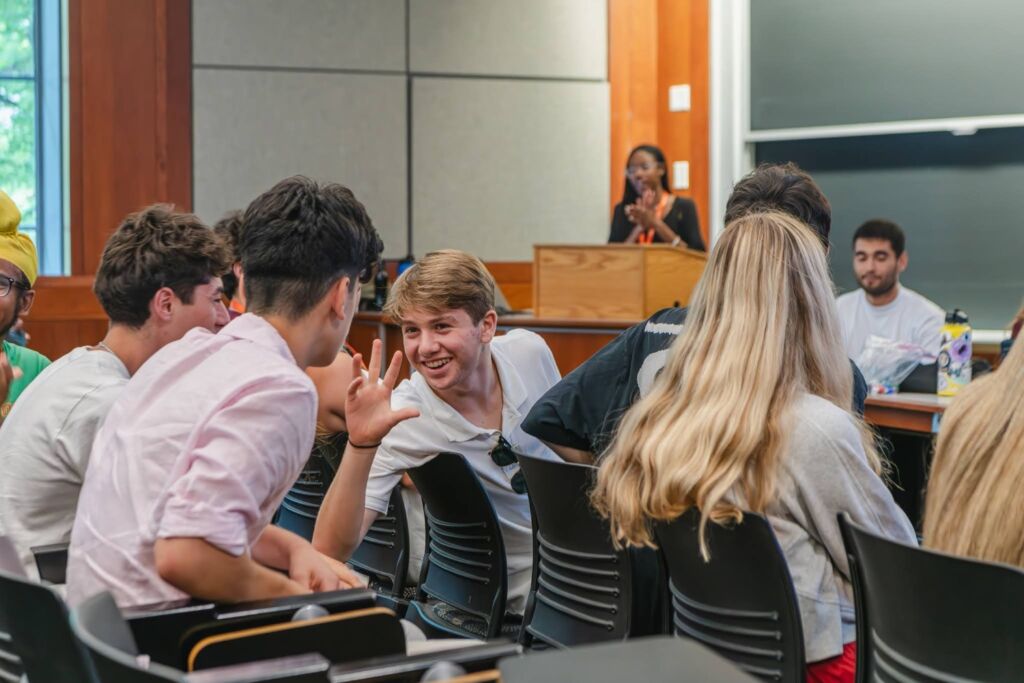
Political Science: Law & US Elections is a two-week Summer Springboard course on the Cal Poly campus in San Luis Obispo, California, with morning classes on how US elections, laws and courts work. Topics run from how laws are made and interpreted to political messaging, voter outreach and how states count and certify votes, and the class runs either an election simulation or a mock Supreme Court case. Outside class there are excursions, college readiness workshops and conversations with local officials about careers in government, and you can live in the dorms or commute.
Get the key facts by email
The dates, costs and how to apply, then 2 reminders: 2 May (2 weeks before) and 13 May (3 days before).
Why it's worth it
The course treats elections as a live subject, from how states count and certify votes to election denialism, and the class runs an election simulation or a mock Supreme Court case. Conversations with local officials about internships and careers add a view of government work that's hard to get from a textbook.
What it asks of you
You'll spend two weeks in San Luis Obispo from 18 to 30 July 2027, with class only in the mornings, so the academic load is light and much of what you get comes from the excursions, workshops and visitors outside class. The bigger commitment is money, at $5,398 to live on campus or $2,998 to commute, before fees and travel.
Who should skip it
Students looking for a program that signals selection on a college application, because Summer Springboard admits applicants who meet the grade and 3.0 GPA requirements and fills courses first come, first served.
Any student in grades 9 to 12 with a 3.0 GPA or equivalent can apply, and that includes students starting high school in the fall and seniors who graduated that spring. International students also need to show their English, either in a phone interview or with one of the test scores below.
The application takes about 30 minutes, and Summer Springboard requires the student to be there while it's filled in. It includes short-answer essay questions and signed agreement forms, and you pay the application fee and $600 deposit when you submit. Summer Springboard says you'll get a decision within 5 to 7 business days. Places aren't competitive in the usual sense, since courses fill first come, first served, but every application is screened against Summer Springboard's Essential Eligibility Criteria. Those cover things like managing your own medication and daily care, following instructions in English and walking more than a mile. A student with certain health conditions may be asked for medical clearance or extra documents, and any paperwork Summer Springboard requests has to come back within 48 hours or the student can't be accepted.
TOEFL
490 on the paper test or 60 on the iBT.
Cambridge
PET with Distinction or FCE at grade C.
SAT
450 in Reading and Writing.
The course is taught by Tyler Johnson, who holds an MSc in Comparative Politics from the London School of Economics and Political Science and whose research has focused on voter behavior and China's Belt and Road Initiative. He has also lived in China studying Sino-Iranian relations and has worked on political campaigns ranging from US presidential races to Congress, where he was a grassroots organizer and strategist, and the California State Senate.
Beyond the instructor, the course brings in local officials to talk about internships and careers in government, campaign work, public policy and legal advocacy. Summer Springboard doesn't publish a class size for this course.
Class runs from 9am to noon, and the rest of the day follows Summer Springboard's campus program. After lunch in the dining hall, 1:30pm brings either a recreational activity or an academic excursion tied to the course, and Summer Springboard lists the SLO Courthouse among the places Cal Poly courses may visit. At 3pm you go to a College Readiness Workshop, on topics such as essay writing and interviews, or a True You session on your strengths and goals. Commuters arrive at 8:30am and leave at 5:30pm, while residential students have dinner at 6pm, clubs or evening activities from 7pm and dorm checks at 10:30pm.
Everyone, commuters included, checks in on the opening Sunday for orientation, icebreakers and dinner. The middle weekend is for trips, most likely a Saturday tour of Morro Rock and Morro Bay and a Sunday with Ravine Water Park, miniature golf and a beach day. Those trips are included for residential students and cost commuters extra.
You leave with a certificate of completion and a letter of recommendation from your instructor, although Summer Springboard says both are earned rather than automatic and can be withheld for breaking the Code of Conduct or not taking part. At Cal Poly, Summer Springboard also says you earn 3 Continuing Education Units (CEUs) from Cal Poly Extended Education.
Summer Springboard doesn't say whether any college or high school will count those units toward a degree or diploma, so check with your school before treating them as more than a record that you took the course. Beyond the simulation, Summer Springboard doesn't mention grades or a final project.
Living on campus costs $5,398, which covers your dorm room, all meals, the course and every excursion, weekends included. Commuting costs $2,998 and covers the course, lunch, excursions and programming from 9am to 5pm on weekdays, while weekend trips cost commuters $125 a day. These are the prices for students who apply by 30 November 2026. Summer Springboard says tuition goes up on 1 December 2026 but hasn't published the new figure.
When you apply, you also pay a non-refundable application fee, which starts at $99 and rises to $149 after 21 February 2027 and $199 after 18 April 2027, along with a $600 deposit. If you don't pay in full, the balance is split into installments, with the last payment due on 10 May 2027, and payments received after that carry a $150 late fee. Travel is extra, and Summer Springboard's optional group airport transfers cost $95 each way, or $145 each way for its unaccompanied minor service. Health insurance isn't covered either. Summer Springboard suggests about $100 a week in spending money.
Need-based scholarships from a limited pool cover up to 30% of residential tuition or 60% of commuter tuition, but never the deposit or application fee. Summer Springboard's refunds shrink from 2 March 2027 and stop altogether after 1 June 2027. An optional Tuition Protection Plan costs $699, has to be bought with the application, and lets you cancel for any reason up to the start date and get back what you paid, apart from the plan itself.
| When you cancel | What you get back |
|---|---|
| Before 1 March 2027 | All tuition except the $99 application fee |
| 2 March to 1 April 2027 | All tuition except the deposit and application fee, or 100% of payments as credit for a future year |
| 2 April to 1 May 2027 | 75% of tuition except the deposit and application fee, or 100% of payments as credit for a future year |
| After 1 May 2027 | 25% of tuition except the deposit and application fee, or 75% of payments as credit for a future year. Changing programs costs $300 |
| After 1 June 2027 | Nothing refunded or transferable to a future year. Changing programs costs $500 |
| After the program starts | No refund if you leave |
A residential Mentor lives on your hall floor, and Summer Springboard's Campus Director, Assistant Campus Director and headquarters staff live in the same building, run regular safety checks and are available around the clock. The dorm doors lock automatically, key cards go only to the Summer Springboard group, and university security patrols 24 hours a day. Staff check rooms at 10:30pm, after which students stay in for the night, and in free time you can move around within set campus boundaries in groups of three or more. Every student and parent signs the Code of Conduct, and breaking it can mean being sent home at the family's expense with no refund.
Before arrival, families fill in a medical form and show proof of medical insurance. A student who gets sick is taken by staff to off-campus urgent care or a hospital, parents are told, and the family pays any costs. Students carry and take their own medication. Two Cal Poly details are worth planning for: the rooms have no air conditioning, and no incoming mail is accepted.

Sean
Talk it through with Sean
“I can help you compare the programs you're considering, think through the practicalities and work out what makes sense for you.”
In person in Los Angeles, ages 14 to 18, from $1,999.
Deadline: Not announced yet · From $1,999 · 14-18 · Los Angeles · In-person
In person in Cambridge, ages 16 to 18, from £5,995.
Deadline: Not announced yet · From £5,995 · 16-18 · Cambridge · In-person
In person in Chicago, ages 14 to 17, from $4,100, apply by 13 January 2027.
13 Jan 2027 · From $5,890 · 14-17 · Chicago · In-person
Save this program in Succeed to compare it with similar programs, dates, costs and formats in one place.
Compare with other programsOfficial page
summerspringboard.com
summerspringboard.com
summerspringboard.com
summerspringboard.com
summerspringboard.com
summerspringboard.com
summerspringboard.com