
In person in Cambridge, ages 13 to 24, from £5,495, several sessions.
Deadline: Not announced yet · From £5,495 · 13-24 · Cambridge · In-person
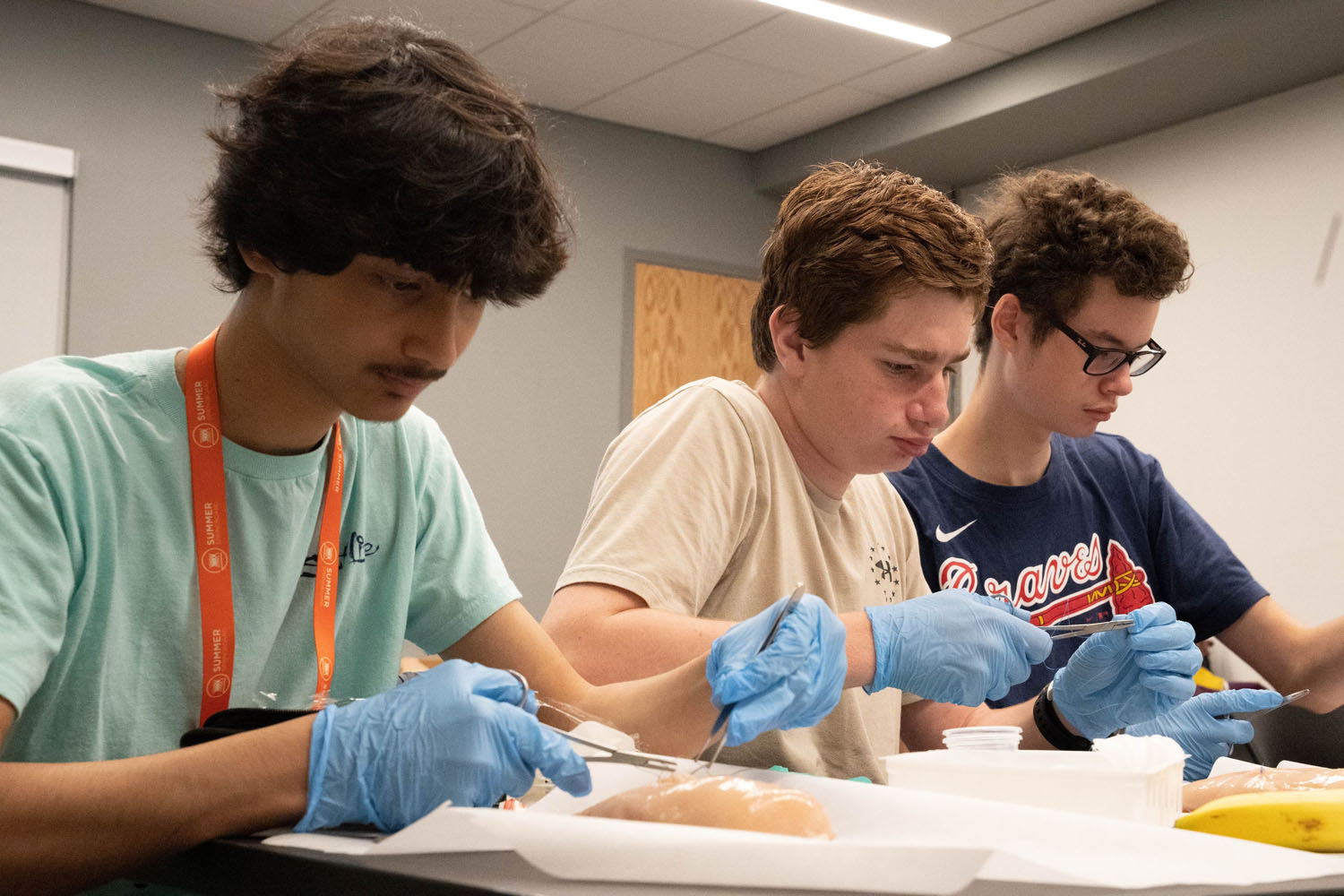
Summer Springboard's Surgery course puts high school students in front of training models to practice suturing, sterile technique and handling surgical instruments, alongside sessions on operating-room teamwork, surgical specialties and the path through medical school and residency. You take it either as a one-week course on the Yale campus in New Haven or a two-week course in Berkeley, with classes in the morning, excursions and activities in the afternoon, and the choice of living in the dorms or commuting.
Get the key facts by email
The dates, costs and how to apply, then 2 reminders: 2 May (2 weeks before) and 13 May (3 days before).
Why it's worth it
Class time goes on practice you can't get at school: suturing, sterile technique and instrument handling on training models, plus frank talk about medical school and residency. That makes it a concrete test of whether the field suits you before you commit years to it.
What it asks of you
The real commitment is money, not workload. Surgery classes fill only the mornings, about 20 hours across the Yale week and 27 across the two Berkeley weeks, so much of what a family pays for is the campus summer around them.
Who should skip it
Students hoping the course will strengthen a college application on its own should skip it. Anyone with a 3.0 GPA can get in while places last, so getting in doesn't signal much, and the course carries no credit.
Surgery class takes up the morning, and the rest of the day belongs to the wider Summer Springboard campus program. At Yale you get five 4-hour sessions, 9am to 1pm Monday to Friday with a 15-minute break, and afternoons go to a course excursion, guest speaker or lab. At Berkeley you get nine 3-hour sessions, 9am to noon on weekdays in the first week and Monday to Thursday in the second, with Wednesday afternoons kept for excursions and speakers.
Berkeley trips
Past surgery excursions have included the UCSF Surgical Skills & Simulation Center and Chan-Zuckerberg San Francisco General Hospital.
Yale trips
Students have toured the Yale Center for Healthcare Simulation, which has laparoscopic and robotic surgery trainers.
Other Berkeley afternoons mix recreation or course trips with a college readiness workshop or True You, Summer Springboard's self-discovery sessions. Commuters leave around 5pm, while residents have dinner and join clubs or evening activities before dorm checks at 9:30pm at Yale and 10:30pm at Berkeley.
It depends on the campus. At Berkeley, Dr. Anna Zhao, a general surgery resident at UCSF (University of California, San Francisco), designs and leads the course, and residents from other surgical specialties teach parts of it. Before medicine she taught high school biology in the Bronx.
At Yale the instructor is Melanie Hamilton, a perioperative nurse educator and registered nurse first assistant who has trained nurses, nurse practitioners and physician assistants in suturing since 2015. She's an operating-room nurse rather than a surgeon, which is worth knowing because Summer Springboard advertises mentorship from practicing surgeons for both versions.
You leave with a Summer Springboard completion certificate and a letter of recommendation written by your instructor, which every student receives. The organizer's course infosheets also say every surgery student earns CPR/AED certification, though they don't name the body that certifies it.
There's no college credit, since Summer Springboard offers credit only on two other campuses. The course's own stated aim is narrower: a clearer sense of whether surgery fits your interests, with sessions on medical school and residency requirements to help you judge.
Getting in means meeting a bar, not beating other applicants. You need to have finished 8th grade by the start date, so rising freshmen up to students who graduated that spring can apply, and a 3.0 GPA or the local equivalent. International students prove their English in a phone interview or with a minimum score: 490 on the paper TOEFL or 60 on the iBT, Cambridge PET with Distinction or FCE at grade C, or 450 in SAT Reading and Writing. Most students in the high school program are 15 to 17.
The application asks for short-answer essays and signed agreement forms and takes about 30 minutes, with the student present. Summer Springboard says decisions come within 5 to 7 business days. Course places go first-come, first-served, and some programs close and move to a waitlist after 21 February 2027. Summer Springboard also screens every applicant against its essential eligibility criteria. It expects students to manage their own care and medication and to walk more than a mile between buildings, and it may ask for medical documentation.
A residential place costs $6,548 for the two-week Berkeley course or $4,548 for the week at Yale, once the mandatory $250 surgery supplement is added to tuition. Commuting brings that to $3,548 at Berkeley and $2,748 at Yale. On top of that comes a non-refundable application fee that starts at $99 and rises to $149 after 21 February 2027 and $199 after 18 April 2027. You also pay a $600 deposit when you apply to hold your place. These tuition figures are for applications made by 30 November 2026, and Summer Springboard says tuition goes up on 1 December 2026 without publishing the new price.
Residential tuition covers your dorm room, all meals, the course and excursions. Commuter tuition covers lunch, the course, excursions and programming from 9am to 5pm on weekdays, and commuters at Berkeley pay $125 a day to join weekend trips. Flights, health insurance and transport to campus aren't included. Group airport transfers cost $95 each way, and the unaccompanied minor service costs $145 each way.
Need-based scholarships cover up to 30% of residential tuition or 60% of commuter tuition, but never the deposit or application fee. Watch the refund dates. The terms refund all tuition apart from the application fee if you cancel before 1 March 2027. After that the deposit and fee are kept, and the refund falls to 75% of tuition from 2 April, 25% after 1 May and nothing after 1 June. Summer Springboard also calls the $600 deposit non-refundable, so ask how it's treated before you count on getting it back.
Summer Springboard staff live on every dorm floor, and other staff, including the campus director at Yale, live in the residence halls and are on call 24 hours a day for emergencies. Dorms at both campuses need a key card to get in and have security on patrol around the clock. Rooms are separated by gender, and Yale students must be in their rooms after 10pm. At Berkeley, staff supervise every excursion. Families sign Summer Springboard's code of conduct, a waiver and a medical consent form before the student can attend, and a serious breach can mean being sent home at the family's expense with no refund.

Sean
Talk it through with Sean
“I can help you compare the programs you're considering, think through the practicalities and work out what makes sense for you.”
In person in Cambridge, ages 13 to 24, from £5,495, several sessions.
Deadline: Not announced yet · From £5,495 · 13-24 · Cambridge · In-person
Global health in Barcelona, in person, ages 16 to 18, from $4,995.
Deadline: Not announced yet · From $4,995 · 16-18 · Barcelona · In-person
Medical work experience in Bangkok, 25 July to 7 August 2027, ages 14 to 18, from £3,535.
Deadline: Not announced yet · From £3,535 · 14-18 · Bangkok · In-person
Save this program in Succeed to compare it with similar programs, dates, costs and formats in one place.
Compare with other programssummerspringboard.com · Official page
summerspringboard.com
summerspringboard.com
summerspringboard.com
summerspringboard.com
summerspringboard.com