
Tufts University Pre-College Programs Climate Resilience Institute
by Tufts University Pre-College Programs
- 2026 program
The Climate Resilience Institute is a two-week summer program on the Tufts University campus outside Boston. Students study climate change through environmental justice, food systems, resilient planning and climate action, with guest talks, data workshops and field trips with local community organizations. In small teams, you research a socio-environmental question and build a capstone project that you present on the last day. You can live in a Tufts dorm or commute, and passing earns 1 Tufts credit.

At a glance
Official facts · checked 12 Nov 2026- DatesOfficial
- 2027: 25 July to 6 August
- Who can applyOfficial
- Entering grades 10 to 12 or a Spring 2027 high school graduate. Non-native English speakers must show English proficiency (TOEFL iBT 100, IELTS 6.5, PTE 68, Duolingo 120, or 1 or more years at an all-English school). Domestic and international students may apply, but Tufts can't sponsor visas for this program
- Total costOfficial
- 2027: $5,750 residential, $4,225 non-residential
- Format and placeOfficial
- In person, Tufts University Medford/Somerville Campus, Medford, Massachusetts
- Length
- 2 weeks
- Included / budget separately
- Included: accommodation, meals (Three meals a day for residential students (brunch and dinner on Sundays), weekday lunch for commuters). Separately: health insurance $55.16 if no valid U.S.-based coverage, Vaccinations $55.00 if received on campus, laundry $1.50 per cycle, travel to and from home
- Deposit and refunds
- Deposit $550. Withdraw in writing by 15 May at 11:59 p.m
- Financial aid
- Limited need-based financial aid for students with demonstrated need, including undocumented and DACA students
- Apply by
- Applications open 14 December 2026. 2027: 1 May
- Cohort and selectivity
- Tufts reviews complete applications holistically on a rolling basis and doesn't publish an acceptance rate or cohort size
- Credit or certificate
- Tufts academic transcript recording 1 pass/fail credit, available on request
Get the key facts by email
The dates, costs and how to apply, all in one place.
Succeed's assessment
Should you apply?
SucceedIn short
Why it's worth it
Tufts lists only three of its pre-college intensives as carrying credit, and this is one, so two weeks can end with a line on a college transcript as well as a finished capstone. Field trips with local community groups and talks from working researchers give the climate topics a practical, local edge.
What it asks of you
In the sample week Tufts publishes, days ran from 9 a.m. to 5 p.m., and part of your team's capstone was due on Canvas by 5 p.m. each day, so there's little slack. The fee is high for two weeks, which makes the limited need-based aid worth looking into early.
Who should skip it
Students who want to dig into one question on their own, because topics change daily and the capstone is a team project. International students who'd come mainly for the credit should know Tufts doesn't award it to them.
What does a typical day look like?
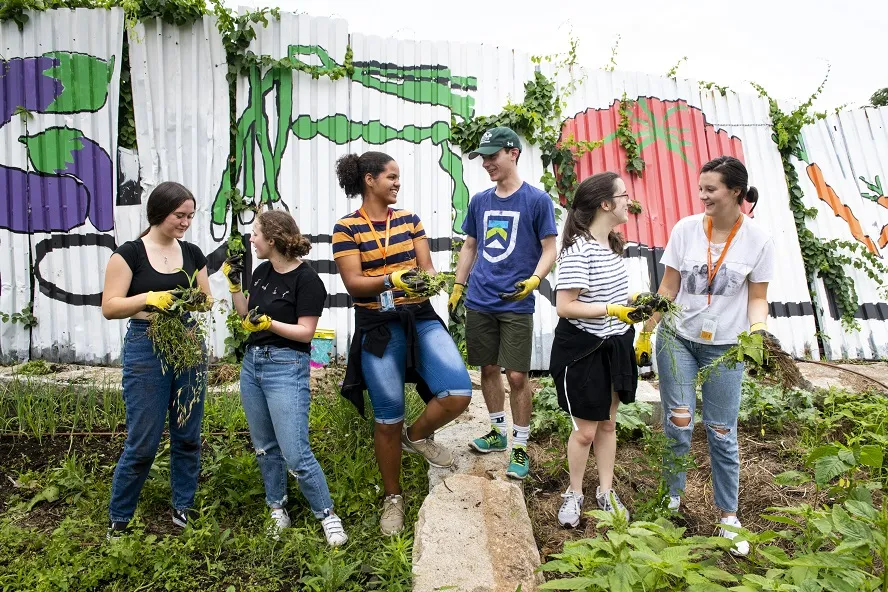
Program days run from an 8:45 a.m. check-in to no later than 6 p.m. In the sample week Tufts publishes from a past summer, sessions ran from 9 a.m. to 5 p.m. Each day had a theme, such as climate justice or food, water and the circular economy. Days mixed guest talks, like Dr. Erin Treanor on pollinators and Prof. Erica Walker on epidemiology, with hands-on sessions such as a BioBlitz with nature journaling. One full day went to a field trip removing invasive species with IRWA. The last stretch of each afternoon went to the capstone, with a team deliverable due on Canvas by 5 p.m. These built from group and topic selection to an annotated bibliography, an outline and a narrative draft by Friday. Tufts says topics change from year to year.
Orientation is on the first Monday, and weekends aren't program days for commuters. Residential students eat three meals a day at Dewick-MacPhie Dining Center and join evening and weekend activities run by residential staff. In past years these included ice cream socials, midnight pancakes and trips to Crane Beach and downtown Boston.
What do you leave with?
You leave with a finished team capstone and, if you pass, 1 Tufts credit. Teams present their work at a showcase on the last day, which family and friends are invited to and which ends by 2 p.m.
The program is graded pass/fail, and Tufts calls the credit pre-matriculation credit. It goes on a Tufts transcript you can request after the program. Whether another college accepts it is up to that college, and Tufts can't promise your high school will count it either. If you later enroll at Tufts, the course stays on your Tufts record with its grade. Tufts is also clear that taking part doesn't lead to admission to a Tufts degree program.
Who can apply, and what does the application ask for?
Students entering grades 10 to 12, or graduating from high school in spring 2027, can apply, and Tufts says you don't need any prior climate study. Living on campus adds an age rule: you must be at least 15 when the program starts and no older than 19 before it ends. You'll also need a laptop. Homeschooled students are welcome to apply.
The application asks for your transcript, a parent permission form, one recommendation from a teacher, counselor or mentor, and a 300-word statement of interest answering a prompt Tufts provides. If English isn't your first language, you'll need a TOEFL iBT score of 100, IELTS 6.5, PTE 68 or Duolingo English Test 120, or proof of at least one year at an all-English school. Tufts doesn't publish an acceptance rate or cohort size. It says it judges applications holistically and that your transcript and recommendation do the most to set yours apart.
What does it really cost?
Living on campus costs $5,750 for the two weeks and commuting costs $4,225. The residential fee covers a bed in a double room, three meals a day (brunch and dinner on Sundays), linens, 24-hour residential staff, program and weekend excursions, and a staff-accompanied airport transfer within set arrival windows. Commuters get the same program activities, materials and excursions plus a weekday lunch, but no breakfast, dinner or weekend meals.
Travel to Boston, laundry ($1.50 a cycle), spending money and any medical bills are extra. Tufts also charges $55.16 for health insurance if you can't show valid U.S.-based coverage, and $55.00 if you have to get required vaccinations on campus.
A $550 deposit holds your place and is never refunded. The rest of the tuition can be refunded until 15 May 2027, which is also when the balance is due. After that date nothing comes back, and a visa delay or denial doesn't change that. Across its pre-college programs, Tufts says its limited need-based scholarships typically cover 75% to 100% of the fee. Awards go out twice a month from February, but international students can't apply. If you need aid to attend, Tufts suggests waiting for the aid decision before paying the deposit, although your spot could fill in the meantime.
How do you apply?
You apply through Tufts' online Pre-College application.
From 14 December 2026, submit the online application with your details, your residential or commuter choice, your recommender's contact and any English test scores you need.
Give the contact details of a school official, who uploads your transcript, while Tufts emails your parent for permission and your recommender for the letter.
Tufts only starts reviewing once all three are in, usually sends a decision within 10 business days and needs everything by 1 May 2027.
If you're admitted, accept your place and pay the deposit within 10 days, counting weekends and holidays.
Pay the balance by 15 May 2027 and finish your enrollment forms, including health and vaccination records, by 1 June 2027, or Tufts withdraws you automatically.
How are students looked after?
Residential programs run at one staff member for every 10 students. Tufts says it makes reasonable efforts to background-check every staff member responsible for students and give them Title IX training. Resident counselors live in each hall, check in with students several times a day and go along on off-campus trips. Halls are split by gender and age, and you need a Tufts ID card to get in. Curfew has you in your room by 11 p.m. Sunday to Thursday and by midnight on Friday and Saturday, and breaking it can mean dismissal without a refund. You can't leave campus without staff supervision or official parental permission, and you use a buddy system during free time.
Staff hold any medications you bring. In an emergency, Tufts uses on-campus and hospital care and contacts your emergency contact, and Tufts University Police are on duty 24 hours a day. Commuters are supervised only during program hours, so getting to and from campus is the family's responsibility. The full rules are in Tufts' pre-college policies.

Sean
Founder, Succeed
Talk it through with Sean
Want to talk it through?
“I can help you compare the programs you're considering, think through the practicalities and work out what makes sense for you.”
20 minutes · No obligation to enroll
What should you do next?
Frequently asked questions
Sources
- Pre-College Environmental Science Summer Program ❘ Boston
universitycollege.tufts.edu · Official page
- Tufts 2026 Pre-College Social Impact Programs ❘ Boston, MA
universitycollege.tufts.edu
- Tufts On Campus Housing for Pre-College Students + More
universitycollege.tufts.edu
- University Policies - Boston, MA - Tufts University College
universitycollege.tufts.edu
- Get Your Questions Answered with the Tufts Pre-College FAQ
universitycollege.tufts.edu
- How to Complete Your Tufts Precollege Application ❘ Boston
universitycollege.tufts.edu
- Tuition & Fees
universitycollege.tufts.edu
- Billing & Payment
universitycollege.tufts.edu
Not ready to decide yet? Keep it for later.