
Succeed has a commercial partnership with this provider.
Business & Economics
Deadline: Not announced yet
From £4,495
13-18
Cambridge
In-person
by Tufts University Pre-College Programs
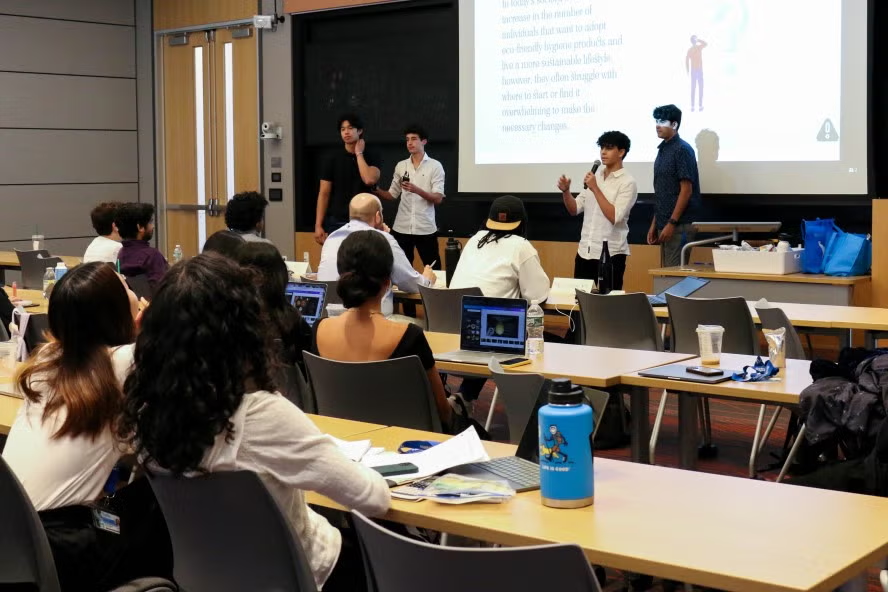
Over two weeks on Tufts University's campus just outside Boston, you join a team, settle on an idea for a startup, small business or nonprofit, and develop it into a venture with a business case and a go-to-market plan. Tufts students and alumni mentor the teams, and the bootcamp ends with each team pitching to a panel of judges in the style of a startup accelerator's Demo Day. You can live in a Tufts dorm or commute if you're local.
 Sean Stevens · Sources
Get the key facts by email
The dates, costs and how to apply, all in one place.
Succeed's assessment
In short
Why it's worth it
Everything builds toward one team venture and a Demo Day-style pitch, so in two weeks you go through the full arc of idea, business case and judged presentation, with Tufts students and alumni as mentors along the way.
What it asks of you
Two full weeks in which every session is compulsory, and a fee that's a significant outlay for families who don't receive need-based aid.
Who should skip it
Students who already run a project and want help growing it, or who'd rather work alone, because teams form on the first day and spend the whole two weeks on one shared venture.
Weekdays run from an 8:45 a.m. check-in to no later than 6 p.m., and Tufts posts the exact daily timetable on the program's Canvas page in June. There are no program sessions on weekends. Things start on Monday 12 July 2027 with a required orientation on the schedule, policies and safety, and residential students move in the day before. On the first day you meet the cohort, find people who share your industry and technology interests, form teams and settle on an idea for a for-profit or nonprofit venture.
The first week teaches frameworks and skills through workshops, team-building exercises and elevator-pitch practice. In the second week your team builds out the venture and its business case. The bootcamp ends with a pitching event where teams present to a panel of judges, styled on a startup accelerator's Demo Day, and everything wraps up by 2 p.m. on Friday 23 July after a closing ceremony that families can attend.
If you live on campus, residential staff plan evening activities that might include ice cream socials, midnight pancakes and visits to Davis Square. Past weekend outings have included Six Flags New England, Crane Beach and the Museum of Fine Arts, although the trips change from year to year.
Luke Fraser teaches the bootcamp. He founded and runs Stepwise Innovation, a consulting and training firm that helps corporate teams develop new ideas. He started out in corporate strategy at Liberty Mutual Insurance, where he also built new products on the Digital Health & Wellness Innovation team. He also founded a fintech venture focused on college students' financial literacy through the DCU Bank FinTech Accelerator, and he holds a BA in Economics and International Relations from Tufts.
Tufts runs the program with its Derby Entrepreneurship Center, and your mentors are Tufts students and alumni who share how they got started and point you to entrepreneurship resources around campus.
You leave with a venture your team designed from scratch, the business case, go-to-market strategy and sales plan behind it, and the experience of pitching it to a panel of judges. Tufts also says the program helps you start a professional network, both with students from around the world and with people in Boston's innovation scene.
The bootcamp isn't for credit, and taking part doesn't result in or guarantee admission to any Tufts degree program, although you're free to mention it on college applications. Any conduct report from your time on the program can be seen by Tufts admissions offices if you apply there later.
You can apply if you're entering grades 10 to 12 or graduating from high school in 2027. To live in the dorms you must be at least 15 when the program starts and no older than 19 by its last day. Homeschooled students are welcome, and Tufts asks them to send as many of the usual credentials as they can.
Besides the online form, you'll write a statement of up to 300 words on why you're interested and what you hope to learn. You also give contact details for a school official, a recommender and a parent, and Tufts emails each of them directly. The school official uploads your transcript, your recommender, who can be a teacher, counselor or mentor, writes one letter, and your parent completes a permission form. Tufts won't start reviewing your application until all of these have arrived. If English isn't your first language, you'll also need proof of proficiency, such as a TOEFL iBT score of 100, IELTS 6.5, PTE 68, Duolingo 120, or at least a year in good standing at an all-English school.
Tufts doesn't publish an acceptance rate. It reviews each application as a whole and says your transcript and recommendation letter do the most to set you apart, so choose a recommender who can write in detail about your curiosity and interests. Decisions are made on a rolling basis, usually within 10 business days of Tufts receiving everything.
Living on campus costs $5,750 and commuting costs $4,225. For residents, that covers a shared air-conditioned dorm room with bedding and towels, three meals a day from Monday to Saturday with brunch and dinner on Sundays, and the weekend excursions. Both options include all program activities and materials and the opening and closing events. Commuters also get lunch on weekdays, but they'll need to buy breakfast or dinner on campus if they want them.
Once you're admitted, you have 10 business days to pay a $550 deposit, which counts toward the fee and is never refunded. The balance is due by 15 May 2027. That's also the last day a written withdrawal can qualify for a tuition refund, and after it nothing is refunded. If you apply after 15 May, you pay in full on admission, and Tufts' tuition payment plan can't be used for summer charges.
On top of that, budget for travel to Boston and some spending money. You'll pay $55.16 for health insurance if you can't show U.S.-based coverage for the whole program, and $55 if you can't document the required vaccinations. Any visits to Tufts Health Services, hospital care or counseling are billed separately, and laundry costs $1.50 a cycle. International students should check visa fees with the official source.
Tufts offers limited need-based scholarships, which it says typically cover 75% to 100% of the fee across its pre-college programs, with decisions twice a month from February. International students aren't eligible. If you need aid to attend, Tufts suggests waiting for your aid decision before paying the deposit, although the program could fill in the meantime and leave you on a waitlist.
Residential students have one resident advisor for every 10 students, working under a director and senior staff, and counselors check in with students several times a day and go with them on off-campus trips. Halls are divided by gender and age, you need a Tufts ID card to get in, and rooms lock. From Sunday to Thursday you must be in the hall by 10 p.m. and in your room by 11 p.m., moving to 10:30 p.m. and midnight on Fridays and Saturdays, and breaking curfew can get you sent home without a refund.
You can't leave campus without a staff member or parental permission given through Tufts' official process, and you have to use the buddy system during free time. Tufts says it makes reasonable efforts to background-check staff and give them Title IX training, and the university police are on duty 24 hours a day. On arrival day, staff meet students at Logan Airport, North Station and South Station and bring them to campus by shuttle. Tufts makes reasonable efforts to help students who need to arrive early or leave late, but it can't guarantee the same services outside the set times. Commuters are supervised only during program hours and can't enter the residence halls.

Sean
Founder, Succeed
Talk it through with Sean
“I can help you compare the programs you're considering, think through the practicalities and work out what makes sense for you.”
20 minutes · No obligation to enroll
Succeed has a commercial partnership with this provider.
Save this program in Succeed to compare it with similar programs, dates, costs and formats in one place.
Compare with other programsuniversitycollege.tufts.edu · Official page
universitycollege.tufts.edu
universitycollege.tufts.edu
universitycollege.tufts.edu
universitycollege.tufts.edu
universitycollege.tufts.edu
universitycollege.tufts.edu
universitycollege.tufts.edu
Not ready to decide yet? Keep it for later.