
University of Chicago Summer Session Summer Immersion Program
by University of Chicago Summer Session
- 2027 program
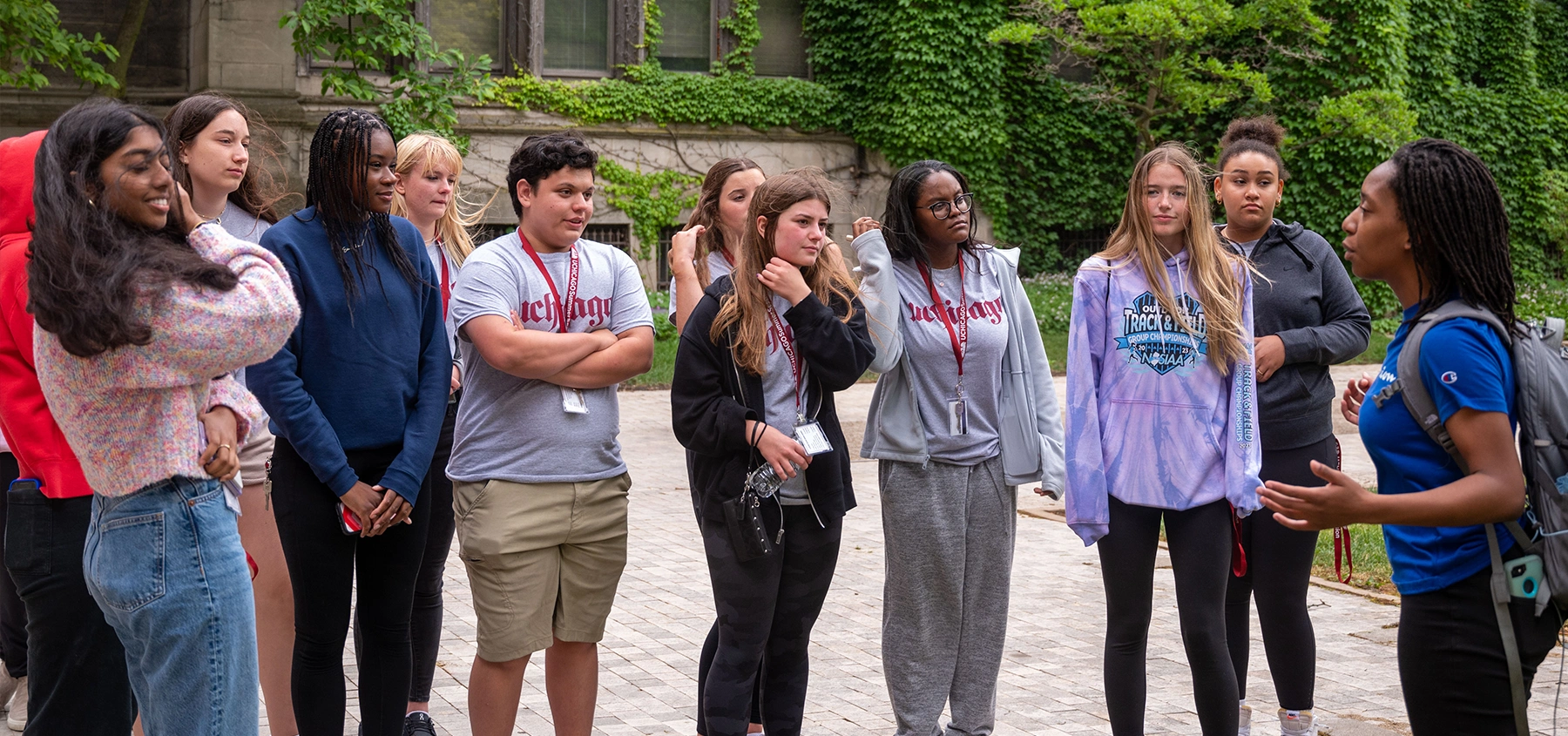
Summer Immersion is a three-week University of Chicago program where you take one undergraduate-level course on the Hyde Park campus, with class Monday to Friday from 9:00 a.m. to 3:00 p.m. Past courses have included Creative Writing and Pathways in Economics, and each one combines discussion or lectures and projects with daily homework such as reading or problem sets. You finish with an A to F grade on an official UChicago transcript. Students live in campus housing unless they live in the Chicago area with a parent or guardian and choose to commute.
 Sean Stevens · Sources
At a glance
Official facts · checked 11 Nov 2026- DatesOfficial
- 2027: Not announced yet. 2026: 15 June to 2 July (Session 1), 7 to 23 July (Session 2)
- Who can applyOfficial
- Current high school students in 9th, 10th or 11th grade. At least 14 years old
- Total costOfficial
- $9,300 residential, $6,100 commuter (2026)
- Format and placeOfficial
- In person, On-campus residence hall, Chicago
- Length
- 2 or 3 weeks
- Included / budget separately
- Included: accommodation, meals (breakfast, lunch, dinner). Separately: application fee $75 (waived when applying for aid), O'Hare airport shuttle (additional fee), travel to and from Chicago, Required course materials
- Deposit and refunds
- Deposit $1,000. The $1,000 enrollment deposit and the $75 application fee are never refunded, and in 2026 the rest of the program fee could be refunded on written request until 4 May 2026
- Financial aid
- Need-based partial aid, awarded first come, first served, generally for admitted students with household income of $125,000 or below
- Apply by
- 2027: 13 January (Priority), 3 March (Regular)
- Cohort and selectivity
- Admission is by review of transcripts, essays, a graded writing sample and a teacher recommendation, with no published acceptance rate, and in 2026 courses such as Creative Writing filled and moved to a waitlist
- Credit or certificate
- 100 UChicago units of graded undergraduate credit (5 quarter hours, 3.3 semester hours) from the University of Chicago, recorded on an official UChicago transcript
Get the key facts by email
The dates, costs and how to apply, then 2 reminders: 17 Feb (2 weeks before) and 28 Feb (3 days before).
Succeed's assessment
Should you apply?
SucceedIn short
Why it's worth it
This is a full university course rather than a taster. UChicago says each one covers what a nine-week quarter does, it's taught by UChicago faculty and lecturers, and the grade goes on an official UChicago transcript.
What it asks of you
You're committing to three weeks in Chicago with attendance required every day, and UChicago warns that missing more than a day has a significant impact on your grade. Students who aren't U.S. citizens also need a student visa, with UChicago issuing the I-20 for it, unless they already hold a U.S. status that allows summer study, because for-credit study isn't allowed on a tourist visa or under ESTA.
Who should skip it
Students hoping for a light summer should skip it, because UChicago expects five to six hours of course-related work a day, plus daily homework and longer papers, projects or exams.
Who can apply, and what do courses expect?
You need to be in 9th, 10th or 11th grade and at least 14 years old. UChicago admits only students who show a superior level of English, and it offers no ESL support. Your application itself can show your English, or you can add a score from any English test you choose, such as TOEFL, IELTS or Duolingo. Some courses set their own bar. Pathways in Economics required pre-calculus, and Creative Writing applicants had to send a piece of fiction as well as the usual writing sample. Courses in computer science, creative writing, data science, economics, math, physics and quantum also ask for an extra Additional Academic Information section. SAT, ACT and AP scores are optional.
UChicago doesn't publish an acceptance rate or cohort size. By the end of the 2026 cycle, though, Creative Writing and Pathways in Economics were both listed as full, with later applicants considered from a waitlist as places opened up.
What does a typical day look like?
Class runs Monday to Friday from 9:00 a.m. to 3:00 p.m. with a lunch break, so most of your day is spent in one course. The format depends on the course. Creative Writing runs mostly as a seminar with daily writing and one-on-one conferences with the instructor, while Pathways in Economics pairs lectures with small discussion groups led by current UChicago students. There's no class on Juneteenth (19 June) or 4 July.
Each session starts with a two-day orientation after check-in, which residential students must attend in full and commuters attend for the first day. Evenings and weekends combine homework with activities run by the residential staff, which in past summers included baseball games, museum and aquarium trips, beach days and city festivals, many of them free or low-cost. Meals are in the dining commons, and if the pace gets hard, there's a weekly writing tutor and an academic adviser you can book.
What do you leave with?
You leave with an A to F grade in an undergraduate course worth 100 UChicago units, which UChicago equates to 5 quarter hours or 3.3 semester hours. It's recorded on an official UChicago transcript that you can order from the Registrar from late August. UChicago notes that college applications, including the Common App, will require you to submit that transcript, so the grade goes on your record whether it's strong or weak.
Whether the credit counts anywhere else is up to the college receiving it, since transfer is at that school's discretion. If you later enroll at UChicago, it won't count toward your graduation requirements.
What does it really cost?
For summer 2026, the fee was $9,300 to live on campus, which covered tuition, housing, dining hall meals and accident and sickness insurance. Students who live in the Chicago area with a parent or guardian could commute for $6,100, which included lunch on class days, but they had to arrange their own transportation. On top of either option, you pay the $75 application fee (waived if you apply for aid), travel, course materials and spending money for outings, plus an extra fee if you want the shuttle from O'Hare. International students should also budget for visa costs. Check the 2027 fee when applications open in December.
Need-based aid is partial only, and UChicago awards it first-come, first-served from a limited number of awards. In 2026, the residential fee after aid was $4,650 for households earning under $125,000 and $2,325 for those under $80,000, depending on available funds, while the commuter fee dropped to $3,000 and $1,500. Chicago Public Schools students in 9th to 11th grade from households earning under $125,000 could instead apply for a CPS-UC Summer Scholarship as commuters. It cut the fee to $800 plus a $75 transcript fee, or to $0 for households earning under $60,000, although UChicago describes it as highly competitive.
Payment comes soon after admission, with a $1,000 non-refundable deposit due within a week and the balance within four weeks. In 2026, the rest of the fee could be refunded on written request only until 4 May, and no refunds were issued after that, although students who had to leave for medical or serious family reasons could contact UChicago to discuss what they owed.
How are students looked after?
Students under 18 live in their own residence hall (Woodlawn Residential Commons in 2025). Resident assistants, who are UChicago undergraduates or recent alumni, live on the same floors, and senior residential staff are available 24 hours a day. Curfew runs from 10:00 p.m. to 6:00 a.m., and you sign in with your RA during a 15-minute window from 9:45 p.m. Missing curfew brings escalating discipline and a call to your parents, and repeat offenders can be dismissed. Before curfew, you can leave campus without staff, as long as you tell the residential staff where you're going. UChicago has a zero-tolerance policy on alcohol and drugs, so possessing or using them, or even being around them, can get you dismissed immediately.
Halls have security staff, a 24-hour front desk and secured entrances, and you show your UChicago ID to get in. For health care, you can use Student Health Services, an on-call physician after hours and the University of Chicago Medical Center on campus. Parents sign a medical release, and if a student has to leave for health reasons, a parent must pick them up within 48 hours at the family's own cost.
How do you apply?
Everything goes through UChicago's Summer Session application portal, which opens in December.
Rank your courses
You can list up to four course choices in order of preference.
Gather your documents
You'll need unofficial transcripts for every high school year (plus 8th grade grades if you're in 9th grade), a typed essay or research paper with your teacher's grade and comments as your writing sample, and the email address of a teacher in a related subject who will write your recommendation.
Write two essays
One of up to 500 words explains why you chose your courses, and the other, of up to 250 words, describes your most rewarding academic project.
Request aid at the same time
If you need aid, fill in the Financial Aid section and upload your parents' tax documents. UChicago can't award aid after an admissions decision, so this has to go in with your application.
Submit by a deadline
Apply by the priority deadline of 13 January 2027 for a decision in mid-March, or by the regular deadline of 3 March 2027 for one in mid-April. Make sure your parent or guardian answers the confirmation email, because UChicago won't review your application without it.
Confirm your place
Accept your offer and pay the $1,000 non-refundable deposit within seven days of your decision, or you won't be registered for your course.

Sean
Founder, Succeed
Talk it through with Sean
Want to talk it through?
“I can help you compare the programs you're considering, think through the practicalities and work out what makes sense for you.”
20 minutes · No obligation to enroll
What should you do next?
Frequently asked questions
Sources
- Immersion
summer.uchicago.edu · Official page
- Creative Writing
summer.uchicago.edu
- Pre-College
summer.uchicago.edu
- Residential and Campus Life
summer.uchicago.edu
- Pre-College FAQ
summer.uchicago.edu
- Application Instructions
summer.uchicago.edu
- Costs & Aid
summer.uchicago.edu
- Application Management
applypcs.uchicago.edu
Not ready to decide yet? Keep it for later.