NYU Precollege
Applications open
04 Jan 2027 · From $6,276 · 15-18 · New York · Hybrid
by University of Maryland Terp Young Scholars
Terp Young Scholars is a University of Maryland summer session where high school students take one three-credit UMD course, taught by UMD faculty, over three weeks in July. You choose a course and that sets your format: a commuter class on the College Park campus or a fully online class. Classes meet every weekday, usually in the morning, and the assignments, projects and exams are graded like any other UMD course.
 Sean Stevens · Sources
Get the key facts by email
The dates, costs and how to apply, then 2 reminders: 18 May (2 weeks before) and 29 May (3 days before).
Why it's worth it
You take an actual UMD course from UMD faculty and leave with a real grade and credits rather than a certificate of attendance. Getting in depends on your grades and how early you apply, not on essays or recommendations.
What it asks of you
UMD tells students to plan on about 45 hours a week, 15 in class and 30 studying, and every class is mandatory, so a summer job, club sport or family trip in those three weeks could lead to dismissal or a poor grade. That grade can't be taken pass/fail, and it counts toward your GPA if you later enroll at UMD.
Who should skip it
Students who live too far from College Park to commute and want campus life, since the only housing is a limited number of places tied to the BMGT262 business course.
Your class meets every weekday, usually for about three hours somewhere between 9 a.m. and 1 p.m., and some courses add an afternoon lab or discussion. Each course sets its own times, so check the meeting times for the one you pick. In 2026, for example, the AI for Environmental Good course ran from 9:30 a.m. to 12:30 p.m., mixing short lessons, AI exercises and field work on campus, with presentations every Friday.
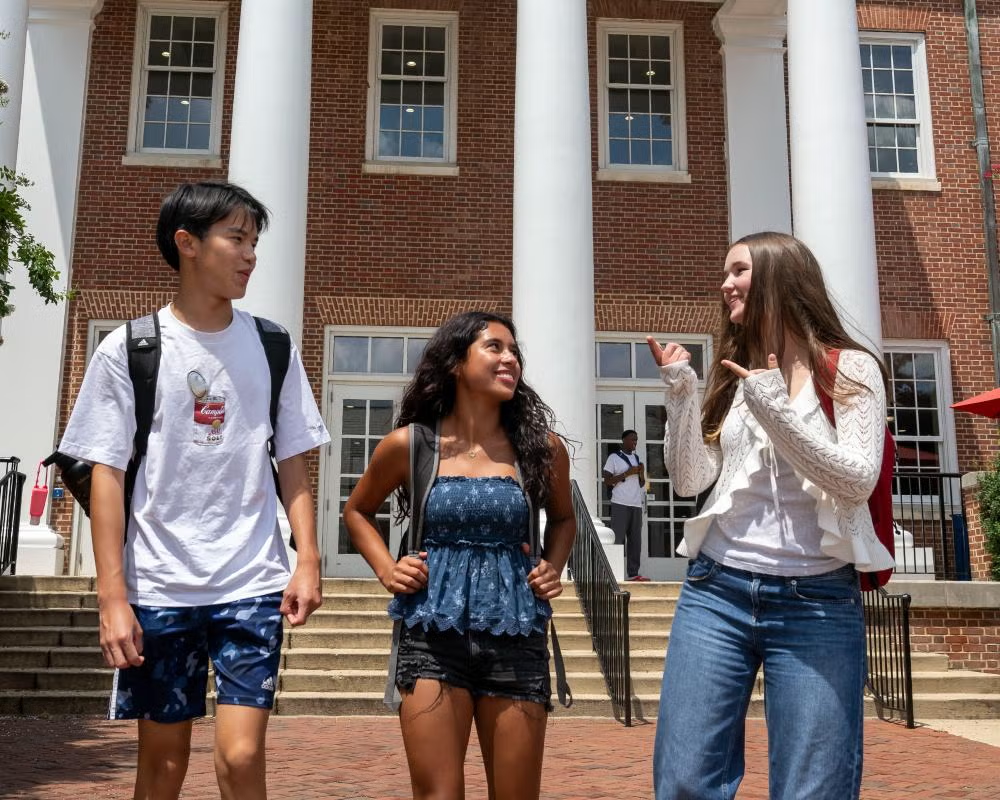
On campus, the first day starts with check-in at Tawes Hall between 8 and 9:30 a.m. on 12 July 2027, and staff walk students to their classrooms. After class, the afternoons are yours. A non-photo UMD ID gets you into the pools, recreation centers, the six campus libraries and the Stamp Student Union, home to TerpZone, and you can eat in the all-you-care-to-eat dining halls, which take cards but not cash. The program adds a few free get-togethers, including an ice cream social, a dining hall lunch and an evening of bowling and games at TerpZone that families are welcome to join. Depending on the course, the last day brings an exam, a presentation or a course event that parents are invited to.
Online students meet live on Zoom at their course's set times, with materials on UMD's ELMS-Canvas site. Sessions may be recorded, and a few courses require you to keep your webcam on the whole time. Students in both formats can join evening webinars on UMD admissions and financial aid.
You leave with a letter grade and three University of Maryland credits on an official UMD transcript, because the program enrolls you in UMD's Summer Session as a non-degree-seeking student. Final grades post by the end of August and appear on your unofficial transcript online rather than arriving by mail. Many courses in the 2026 list also met a specific UMD General Education requirement, such as Scholarship in Practice or History and Social Sciences, which matters if you later study at UMD.
Taking part doesn't guarantee you a place at UMD, and the university says so plainly. UMD doesn't say how other colleges treat the credits, so ask any college you're considering. Depending on the course, you may also leave with work to show. In 2026, Discovering Architecture ended with a portfolio of architectural drawings and physical models, and Mock Trial closed with two civil mock trials.
You need to be entering grades 10 to 12 or graduating from high school, with an unweighted GPA of at least 3.0, and domestic applicants must be at least 13. A lower GPA isn't automatically the end, since students whose grades were hit by extenuating circumstances can file a GPA Exception Appeal before applying. Most courses take rising sophomores and up, but some set extra prerequisites. In the 2026 list, The Enterprising Leader required rising juniors, and courses such as Medical Physiology, Why Do Things Fail? and Creative Coding for Digital Media asked for high school biology or algebra.
There's no essay or recommendation to write. The application asks for a transcript or report card showing your current courses and cumulative GPA, along with a health insurance card, and homeschooled students send an academic overview with course descriptions, books used and grades. Offers go out first-come, first-served, and you name a second-choice course in case your first is full, so once you meet the requirements, applying early is what improves your chance of getting the course you want.
International applicants must prove their English with a TOEFL score of 95, an IELTS score of 7 in every section or a Duolingo English Test score of 120, unless they come from an English-speaking country or attend a U.S. high school. UMD doesn't issue I-20s for the program. Students living outside the U.S. and those holding F-1 or J-1 status through another school are eligible for the online option, U.S. permanent residents can choose either format, and B-visa holders can't enroll. Campus courses also require you to live within commuting distance of College Park.
The 2027 package costs $1,860 on campus or $1,537 online. Both include $1,377 in tuition, which is three credits at Maryland's in-state rate of $459 each, and the rest is fees: on campus a $233 summer campus fee and a $250 option fee for activities and staff supervision, and online a $110 distance learning fee and a $50 option fee.
New applicants also pay a non-refundable $80 application fee, plus a $280 deposit that's credited toward the bill. Some courses add their own studio, lab or supply fee, which ran from $25 to $140 in the 2026 course list, and textbooks, parking permits and food aren't included. UMD's payment plan can't be used for this program, so plan to pay the full balance by your payment deadline.
Partial scholarships are competitive, never cover more than 30% of the package fee and only go to students who haven't had one before. You can apply only once you've been admitted, between 15 February and 1 April 2027, with a copy of a federal income tax return and a personal statement, and decisions come on 15 April. Children of eligible University System of Maryland faculty and staff can use tuition remission for the tuition part, and some public school districts help with dual-enrollment costs, so it's worth asking your guidance office.
The $80 fee and $280 deposit come back only if UMD can't place you in any course you listed. Cancellation requests go to the program in writing, and they cost more as July gets closer.
| When you cancel | What you get back |
|---|---|
| By 20 June 2027 | All of the course tuition, campus services fee, program fee and any course fee |
| 21 June to 11 July 2027 | All of the course tuition, campus services fee and any course fee, but not the program fee |
| First day of classes (12 July 2027) | 80% of course tuition, campus services fee and any course fee, but not the program fee |
| Second day of classes onward | Nothing, and the course stays on your UMD record marked as withdrawn |
UMD is an open campus, so after the first day students come and go as they like between 8 a.m. and 5 p.m. without checking in with program staff. Instructors and teaching assistants supervise in class. Outside class, program staff are in Jimenez Hall on weekdays from 8 a.m. to 5 p.m., and parents are told to reach them through the program email, which is constantly monitored. The Program Assistants who support students are UMD graduate and undergraduate students who are required to complete criminal background checks and child protective services clearances.
Medical care has limits families should know about. Staff can't give medication, so students must manage their own, and the University Health Center calls a guardian before seeing a minor except in an emergency, with co-pays falling to the family. If a student needs a hospital, a staff member goes along, but a parent has to take over responsibility for care. The Code of Student Conduct applies on campus and online, and a student dismissed under it is withdrawn from the course without a refund.
Applications go through UMD's online form, reached from the domestic or international application page, and you can save it and come back before submitting.
Choose two courses
Pick a first and a second choice, checking each one's format, prerequisites and meeting times, since seats fill in the order applications arrive.
Appeal your GPA if needed
If extenuating circumstances pulled your GPA below the requirement, submit the GPA Exception Appeal before you apply.
Apply between 12 January and 1 June 2027
Upload your transcript and health insurance card as PDF, JPG or PNG files and pay the application fee and deposit by card.
Apply for a scholarship once admitted
The separate scholarship form closes on 1 April 2027.
Pay your bill on time
Payment is due 20 May 2027 if you're admitted by 24 April, or 20 June 2027 if you're admitted later, and missing it cancels your place.
Attend orientation
Students and parents join a mandatory online orientation in mid-June, before classes start on 12 July 2027.

Sean
Talk it through with Sean
“I can help you compare the programs you're considering, think through the practicalities and work out what makes sense for you.”
04 Jan 2027 · From $6,276 · 15-18 · New York · Hybrid
Deadline: Not announced yet · From $1,800 · 14-18 · Cambridge · In-person
Deadline: Not announced yet · From $2,395 · 12-18 · Online · Online
Save this program in Succeed to compare it with similar programs, dates, costs and formats in one place.
Compare with other programsexst.umd.edu · Official page
exst.umd.edu
exst.umd.edu
exst.umd.edu
exst.umd.edu
exst.umd.edu
exst.umd.edu
exst.umd.edu