Neuroscience Summer Course
Applications open
In person in Cambridge, ages 13 to 17, from £5,795, several sessions.
31 Dec 2026 · From £5,795 · 13-17 · Cambridge · In-person
by University of Warwick Pre-University Summer School
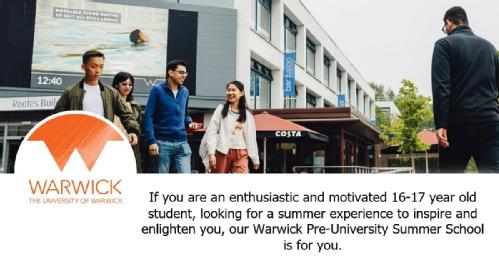
Over ten nights on the University of Warwick's campus near Coventry, you sample six university subjects in taster sessions: psychology, health and medical sciences, biomedical science and neuroscience, biochemistry, biological sciences and integrated natural sciences. The 29 hours of contact time combine lectures and seminars with skills workshops, and the course also includes sessions on applying to UK universities and a group project you present to the rest of the summer school. You live in a campus hall with current Warwick students who act as ambassadors, and the fee also covers day trips to Oxford and Warwick Castle.
 Sean Stevens · Sources
Get the key facts by email
The dates, costs and how to apply, then 2 reminders: 21 May (2 weeks before) and 1 Jun (3 days before).
Why it's worth it
You can try several possible degree subjects at one university before deciding what to apply for, and you get practical help with UK applications and your personal statement, including the chance to put questions to current students.
What it asks of you
Skills workshops share the 29 hours of contact time, so the science teaching is a fairly small part of what the £5,500 pays for. It's better value if you also want the campus life, trips and time away from home that come with it.
Who should skip it
Students who want to go deep in one subject, since each field gets a single taster and you leave with a Certificate of Attendance rather than any academic credit.
Warwick staff teach the course, but the only teacher Warwick has named so far is Prof Philip Young, a neuroscientist who researches spinal muscular atrophy (SMA) and leads the biomedical and neuroscience session. Warwick also says the topics and teaching team may change before the syllabus is finalized, so the six tasters below are the current plan.
Psychology
How psychologists study behavior scientifically, from chemicals in neurons to falling in love or making friends, and no previous psychology is needed.
Health and Medical Sciences
The case of James, who was left with a spinal cord injury after a road collision, looked at from biological, psychological and social angles using the biopsychosocial model.
Biomedical and Neuroscience
The biology of SMA and Zolgensma, a viral gene therapy for it, taught by Prof Young.
Biochemistry
Why protein structure matters, how scientists investigate it and how artificial intelligence is speeding up structure prediction, with a look at what that could mean for drug discovery.
Biological Sciences
How peatlands store carbon, followed by an outdoor survey estimating the carbon held in trees on campus.
Integrated Natural Sciences
Investigating a gene's sequence from molecular, evolutionary and functional angles, drawing on biology, chemistry, physics, math and computing.
Most weekdays pair lectures with a skills session, with a trip to Warwick Castle in the first week and a day in Oxford and team-building activities over the weekend. Warwick's sample timetable, which is shared by all its summer courses and may change, runs roughly like this.
Arrival, Tuesday 20 July
Registration, a welcome event and time to settle into your hall, with airport pick-up if you've booked it.
First week
A welcome talk, campus tour and guest lecture on Wednesday, a trip to Warwick Castle on Thursday, then lectures, a skills session and a Personal Statement Workshop on Friday.
Weekend
A Saturday in Oxford with a walking tour, free time for lunch and a punting tour, then free time on campus and a team-building day on Sunday.
Second week
Lectures and skills sessions each day, your team's group presentation on Tuesday 27 July, an off-campus activity evening and a farewell night with karaoke and a disco on Thursday.
Departure, Friday 30 July
Check-out is by 9:30am.
In the evenings, the ambassadors run basketball, football, campus walks, film nights and card and board games, and the social program includes a street food event and time in the campus e-sports center.
You need to be 16 or 17 for the whole of 20 to 30 July 2027, so a student who turns 18 on or before 30 July, or is still 15 when the course starts, doesn't qualify. Warwick also expects you to be thinking about applying to university, but there are no subject requirements, so you don't need to have studied psychology or biology before.
Teaching is in English and you'll need to follow it confidently, although Warwick doesn't ask for a test score as proof. Its admissions team reviews each application and makes an offer if it thinks you're right for the course. Warwick doesn't publish how many students it takes, and offers turn into places first-come, first-served as deposits are paid.
A place costs £5,550 in total, which is the £5,500 course fee plus a £50 assessment fee you pay when you apply and don't get back. The £1,000 deposit that secures your place is part of the £5,500 rather than on top of it, and the full fee is due by 11 June 2027.
The fee covers ten nights in a campus hall, breakfasts, dinners and refreshments, all the teaching and the guest lecture, the social program, travel to Oxford and the activities on trips.
On top of that, you'll need money for lunches on some days, snacks and souvenirs, and your own travel to and from campus. Airport transfers from Heathrow or Birmingham cost extra and open for booking in April, and Warwick advises taking out travel and medical insurance. If you need a UK visa or travel authorization, check its fee with the UK government. Warwick asks applicants to read its full 2027 terms and conditions, so check what they say about cancellations before you pay the deposit.
Warwick provides at least one student ambassador for every 12 students, and each flat gets two who live alongside you for the whole program, join every trip and offer pastoral support. Lead Ambassadors add another layer, and Night Managers cover the night, so help is available around the clock. The core staff are trained in safeguarding students of this age, and key staff and the ambassadors have passed a DBS check, the UK's criminal record check run by the Disclosure and Barring Service.
Rooms
You get a single study bedroom with a private en-suite bathroom in a flat of around 10 students who share a kitchen, with bedding and towels provided.
Paperwork
A parent or guardian signs a consent form and gives the details of a contact in the UK for the length of the program, and you sign a code of conduct before you arrive.
Rules
Warwick has zero tolerance for breaking the code of conduct. Parents are told and asked to arrange for the student to leave the program, at their own cost.
Health
A campus safety team works 24 hours a day and provides emergency first aid, and staff can advise if you need medical help or counseling or are feeling homesick. Tell Warwick before arrival if you've been unwell, because it may ask for medical evidence that you're fit to take part.
Applications go through Warwick's online form, which covers all its summer courses.
Choose this course on the online form and pay the £50 assessment fee, by 31 May 2027 if you need a UK visa or by 4 June 2027 if you don't.
Submit a copy of your passport data page.
Warwick's admissions team assesses your application and aims to reply within 3 to 5 working days.
If you're offered a place, the offer email gives your deposit deadline, and the place is yours only once the £1,000 deposit is paid.
Pay the rest of the fee by 11 June 2027.
If you need a visa, Warwick emails a support letter within a week of your deposit or full payment, as long as your application included your passport copy. You can't submit the visa application more than three months before the course starts, and Warwick recommends waiting until you have the visa before booking flights.

Sean
Talk it through with Sean
“I can help you compare the programs you're considering, think through the practicalities and work out what makes sense for you.”
In person in Cambridge, ages 13 to 17, from £5,795, several sessions.
31 Dec 2026 · From £5,795 · 13-17 · Cambridge · In-person
In person in Berkeley, ages 14 to 18, from $3,298, several sessions.
21 Feb 2027 · From $3,298 · 14-18 · Berkeley · In-person
In person in London, ages 16 to 17, from £3,295, 12 to 16 July 2027.
09 Apr 2027 · From £3,295 · 16-17 · London · In-person
Save this program in Succeed to compare it with similar programs, dates, costs and formats in one place.
Compare with other programswarwick.ac.uk · Official page
warwick.ac.uk
warwick.ac.uk
warwick.ac.uk
warwick.ac.uk
warwick.ac.uk
warwick.ac.uk
warwick.ac.uk
Facts checked against the official page on 11 Nov 2026
Editor: Sean Stevens
Succeed has no commercial relationship with University of Warwick Pre-University Summer School.
Spot an error? Report it