In-person chemistry course in Cambridge, ages 13 to 24, from £5,495.
Deadline: Not announced yet · From £5,495 · 13-24 · Cambridge · In-person
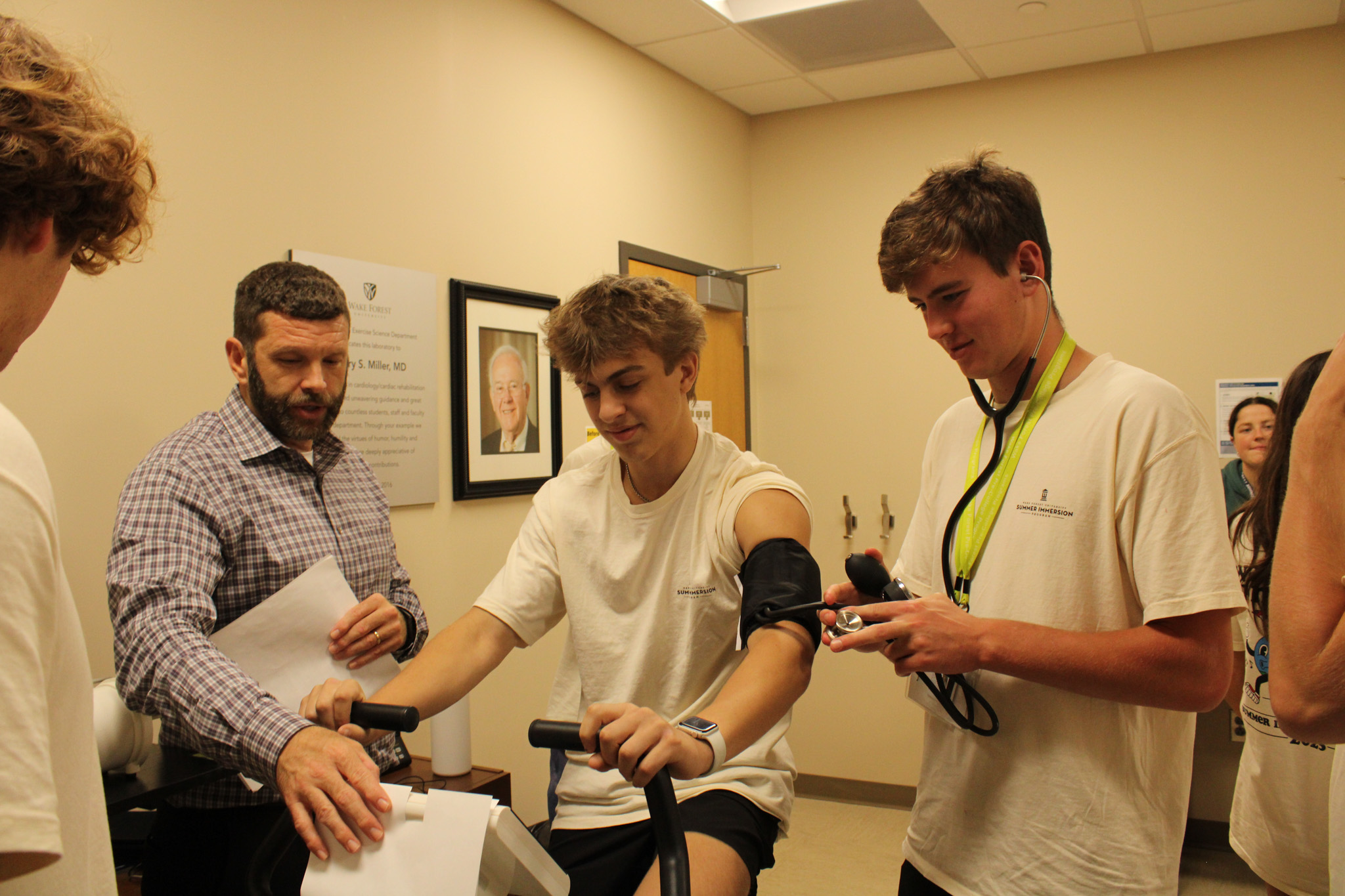
You spend a week living on Wake Forest University's campus in Winston-Salem, North Carolina, learning how the heart, lungs and muscles work and how that knowledge turns into careers in exercise science. Most of the day is hands-on, with labs where you measure heart rate and blood pressure, run lung and muscle-function tests and use electromyography (EMG), along with tours of health and fitness facilities on and off campus. Dr. Ted Eaves, who teaches anatomy and exercise physiology at Wake Forest, leads the program.
 Sean Stevens · Sources
Why it's worth it
You use the equipment yourself, from blood pressure cuffs to lung-function and EMG testing, and the sample day takes you into the football program's strength center for drills with Wake Forest's Director of Sports Performance. That's a close look at several exercise science careers in a single week.
What it asks of you
A week away from home, $3,500 in tuition plus travel, and an application with two essays and a recommendation. Everyone lives on campus, local students included, so there's no cheaper day option.
Who should skip it
Students who want something more formal to show for their summer, because the week carries no high school or college credit and ends with a certificate of attendance.
A catch for athletes
Wake Forest doesn't let Summer Immersion students use the university gym, so a student hoping to keep up their own training that week is limited to the basketball and volleyball courts and running around campus.
Classes run from 8:00 am to 5:00 pm Monday through Thursday, after Sunday afternoon check-in, and you leave at noon on Friday.
On Wake Forest's sample day, you start with a morning meeting and breakfast at 8:00 am, then spend the morning on pulmonary function testing and measuring the results. After lunch you tour the Strength and Conditioning Center at the WFU Football Center and go through strength and agility tests with the university's Director of Sports Performance. A 5:00 pm debrief wraps up the day, followed by dinner, evening activities at 6:30 pm, free time from 7:30 pm and lights out at 10:30 pm. Staff-led evenings include things like basketball, karaoke, Spikeball and s'mores, with an optional panel on topics such as study abroad. Wake Forest notes that the sample day and the hands-on labs can change.
Dr. Ted Eaves runs the institute as its Academic Leader. At Wake Forest he teaches biomechanics of human movement, human anatomy, human physiology and exercise physiology, he holds athletic training and strength and conditioning credentials (LAT, ATC, CSCS), and he wrote the textbook The Practical Guide to Athletic Training.
Teaching assistants and Wake Forest undergraduate interns support him through the week, and the sample day also brings in the university's Director of Sports Performance. Wake Forest doesn't publish a class size or staff ratio for this institute.
You leave with an official Wake Forest University Certificate of Completion, and the institute carries no high school or college credit. Wake Forest encourages students to attend all five days to receive the certificate.
The bigger takeaway is first-hand experience of the field, across cardiovascular and pulmonary anatomy, muscle function, physical therapy and rehabilitation, strength conditioning and sports nutrition, and the careers that use them. On admissions, Wake Forest says plainly that taking part gives no preferential treatment if you later apply there, although it does count as demonstrated interest in the university.
Plan on $3,565 before travel, which is the $3,500 tuition for the week plus the $65 application fee you pay when you apply and don't get back. Meals and transport to field trips are included, and every student lives in a residence hall because Wake Forest has no commuter option.
A $550 deposit secures your seat when you register and is non-refundable, and the rest of the tuition is due by 2 April 2027. Register after that and you pay the full amount at once. Wake Forest says payment plans are available if you ask. If you can't attend, you get back everything except the deposit as long as you give at least three weeks' notice. Within three weeks of the start, nothing is refunded, although Wake Forest will defer your place and deposit to a future summer.
Need-based scholarships are limited and first come, first served, and students classified as international can't receive them. You apply in the scholarship section of the main application with the previous year's W-2 by 1 February 2027, but Wake Forest warns the money often runs out by January.
Airport shuttle
$100 each way from Piedmont Triad (GSO) or $150 each way from Charlotte Douglas (CLT), and bookings can't be refunded. There's no shuttle from Raleigh-Durham.
Parking
$50 for a pass if you drive yourself, and your keys stay with staff from Sunday check-in to Friday checkout.
Laptop
This institute's packing list asks for one, and the 2025 list offered a limited number of loaners at $25 for the week.
Card fees
Paying by credit card adds a processing fee, which you avoid by paying by electronic check (ACH).
Spending money
Optional, for snacks or the University Store during free time.
Summer Immersion staff are with students at all times, evenings and recreation included. Professional staff and student interns live in the residence hall overnight, a staff team is on call 24 hours a day, and Wake Forest University Police are available around the clock for emergencies.
Arrival
Staff meet flights in baggage claim at GSO and CLT, but don't book your child as an unaccompanied minor, because no one collects students at the airline gate.
Health and diet
After registering you complete a Medical Authorization Form and list any dietary needs, and The Pit dining hall has an allergen-friendly station.
Rules
Each student and a parent sign a Code of Conduct before arrival, and a student dismissed for breaking it has to be picked up and gets no refund.
Applications go through Wake Forest's Pre-College application portal, where you create an account first.
Applications for summer 2027 are accepted from 1 November 2026 on a rolling basis with no fixed deadline, until institutes fill.
Submit two essays, a self-reported GPA (no transcript or test scores), the contact details of a teacher, counselor or administrator who'll recommend you, and the $65 fee, and tick the scholarship option if you need aid.
Wake Forest emails a decision, usually within two weeks, or up to four weeks if you've applied for a scholarship, with reviews paused over Thanksgiving and winter break.
Acceptance is to the Summer Immersion Program as a whole, so you then register for this institute and your chosen week with the deposit, or join its waitlist if it's full.
Before arrival, you complete the medical form, the Code of Conduct and the travel survey on your student status page.

Sean
Talk it through with Sean
“I can help you compare the programs you're considering, think through the practicalities and work out what makes sense for you.”
In-person chemistry course in Cambridge, ages 13 to 24, from £5,495.
Deadline: Not announced yet · From £5,495 · 13-24 · Cambridge · In-person
In-person chemistry program in Cambridge for ages 16 to 18, from £5,995.
Deadline: Not announced yet · From £5,995 · 16-18 · Cambridge · In-person
In-person science and biology course in Oxford, ages 15 to 17, from £3,980.
Deadline: Not announced yet · From £3,980 · 15-17 · Oxford · In-person
Save this program in Succeed to compare it with similar programs, dates, costs and formats in one place.
Compare with other programsimmersion.summer.wfu.edu · Official page
immersion.summer.wfu.edu
immersion.summer.wfu.edu
immersion.summer.wfu.edu
immersion.summer.wfu.edu
prod.wp.cdn.aws.wfu.edu
prod.wp.cdn.aws.wfu.edu
immersion.summer.wfu.edu
Facts checked against the official page on 4 Nov 2026
Editor: Sean Stevens
Succeed has no commercial relationship with Wake Forest University.
Spot an error? Report it