
Wake Forest University, in person in Winston-Salem, ages 14 to 18, from $3,500.
Deadline: Not announced yet · From $3,500 · 14-18 · Winston-Salem · In-person
A three-week fiction course on Brown University's campus in Providence, run as part of Brown Pre-College's Summer@Brown. You write every day, bring your pieces to small workshops for feedback from your instructor and classmates, study published fiction and hear from practicing writers. The 2026 section met on weekday afternoons from 6 to 24 July.
Get the key facts by email
The dates, costs and how to apply, all in one place.
Why it's worth it
The real value is the routine of writing daily and getting regular, close responses to your own drafts from a teacher and a group of classmates, which is hard to arrange on your own at home.
What it asks of you
Three weeks of weekday afternoon classes plus 2 to 3 hours of writing and reading every day, and Brown expects you at every session. Missing days for a trip or a test can get you dismissed without a refund or certificate, so keep the dates completely clear.
Who should skip it
Families who would need help with the cost but don't qualify for Brown's need-based aid, because the fee is the biggest hurdle here. In 2026 Brown offered no scholarships to international students and doesn't give merit awards, so the similar programs below are worth comparing on price.
In 2026 the class met Monday to Friday from 12:15 p.m. to 3:05 p.m., but the writing doesn't stop there. You write each morning before class and again after each workshop, and those assignments are what your group discusses.
Outside class Brown doesn't set your timetable, so you decide when to write and read around the workshops, talks and social events that run from morning to night, including off-campus trips to local beaches and escape rooms. Residential students eat three meals a day in the dining halls, and everyone should expect to walk 15 to 20 minutes between buildings, because the program uses the whole campus.
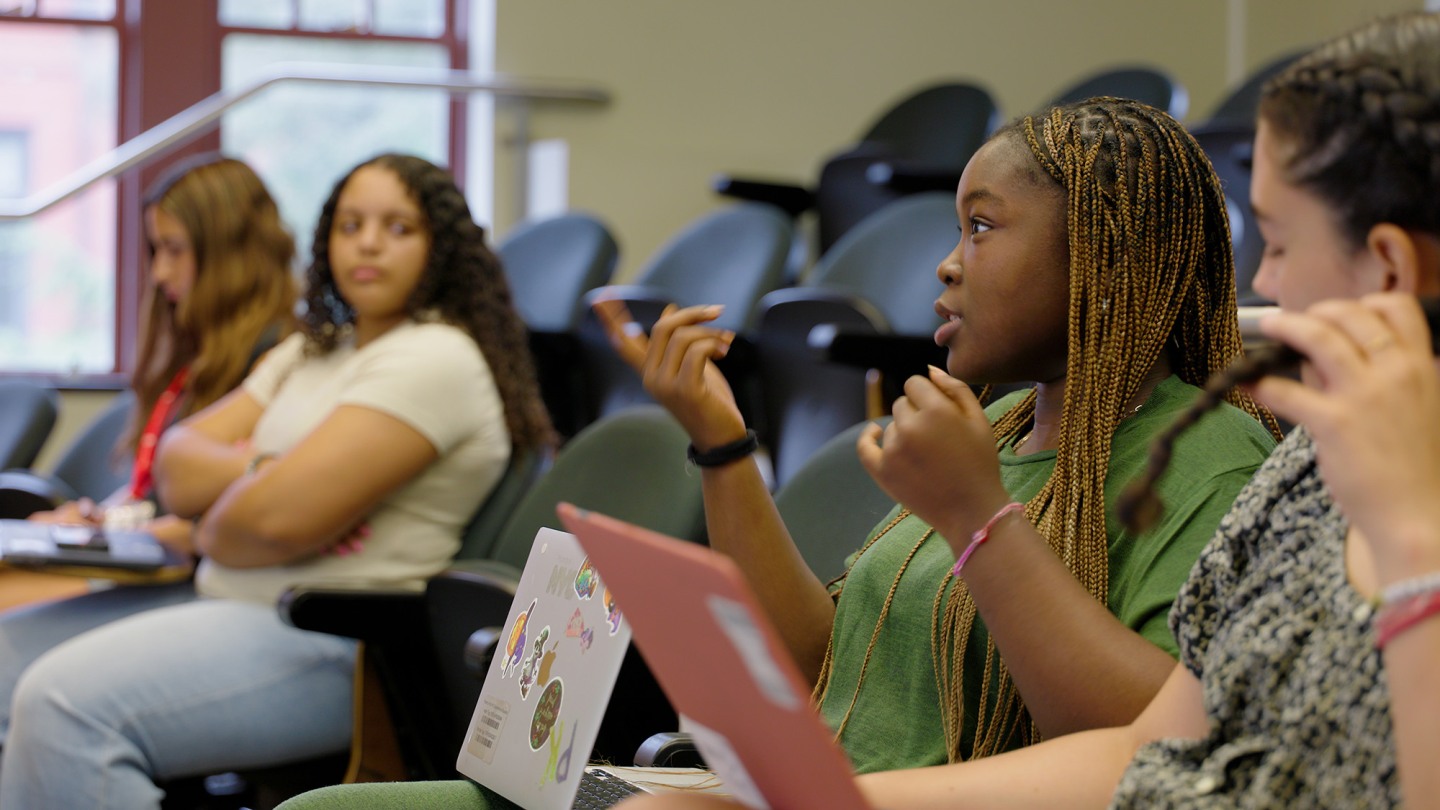
Victor Wildman taught the 2026 section, and Brown describes the course as a blend of small workshops and presentations by practicing writers. Your assignments are read in workshop, where your group teacher and classmates give supportive feedback, and you also study published fiction to pick apart the techniques authors use.
In the final week the instructor meets you one to one to talk about your progress before you write a final retrospective piece. Outside class you can book free sessions with Brown's Writing Center, where trained graduate students help with writing at any stage. Brown doesn't publish how many students sit in each workshop.
Essay
A 250- to 500-word essay on one of two prompts, either a school subject you can't get enough of or a time you tried something new.
Grades
Your complete grades from the current school year and the previous one, submitted in English. An unofficial transcript, report card or portal screenshot showing your full name is fine.
Recommendation
Optional, but Brown strongly suggests one if you'll be under 15 on 14 June 2026 or have any grade of C or below.
English
For 2026, international students whose primary language isn't English sent TOEFL iBT or Duolingo results from a test taken on or after 1 July 2025. Successful applicants generally score at least 105 on a TOEFL taken before January 2026, 5.5 on one taken from January 2026, or 130 on Duolingo.
The course has no prerequisites, so any student who meets Summer@Brown's age and grade limits can take it. You don't apply to the course itself, though. You apply to Brown Pre-College as a whole, which weighs your grades, motivation, interests and English together and says not every applicant is admitted, without publishing an acceptance rate. Decisions usually come within 15 business days of a complete application.
Admission doesn't guarantee you a place in this workshop. Once admitted, you pay a $500 non-refundable deposit and then enroll in any course with space, so check the catalog before you pay. Full courses keep a waitlist, and self-enrollment for on-campus courses closes three weeks before the start date.
Essay
A 250- to 500-word essay on one of two prompts, either a school subject you can't get enough of or a time you tried something new.
Grades
Your complete grades from the current school year and the previous one, submitted in English. An unofficial transcript, report card or portal screenshot showing your full name is fine.
Recommendation
Optional, but Brown strongly suggests one if you'll be under 15 on 14 June 2026 or have any grade of C or below.
English
For 2026, international students whose primary language isn't English sent TOEFL iBT or Duolingo results from a test taken on or after 1 July 2025. Successful applicants generally score at least 105 on a TOEFL taken before January 2026, 5.5 on one taken from January 2026, or 130 on Duolingo.
In 2026 the three weeks cost $8,372 if you lived on campus and $6,416 if you commuted. The residential price covered the $5,948 course fee, housing, three meals a day, a wellness fee and use of the fitness and aquatics centers. Commuters paid the course fee plus a $468 commuter fee and got one dining-hall meal a day, free rides on RIPTA public transit with their Brown ID and the same free activities.
On top of that come the $80 nonrefundable application fee, an $80 accident insurance plan that international students and U.S. students without health insurance have to take, travel to Providence, any books the course requires and spending money. Paying the balance by card adds a processor fee of 2.95% for U.S. cards or 4.25% for international ones. The $500 deposit isn't refunded unless Brown cancels the course and you choose not to switch to another one. In 2026, withdrawing in writing by 29 June got back everything you'd paid except the deposit, the application fee and any card fees. After that the refund dropped to 80% from 30 June to 7 July and 50% from 8 to 11 July, with nothing after that.
Sibley Scholarships
Need-based aid for U.S. citizens, permanent residents, refugees, asylees and DACA or undocumented U.S. residents. It's awarded first come, first served until the money runs out, so apply right after you submit your application.
PPSD Scholarships
A full scholarship for admitted students at a Providence Public School District school who complete the scholarship form by its deadline.
Partner and employee scholarships
Partner scholarships go only to students nominated by Brown's partner organizations, and dependents of eligible Brown employees can get 20% or 50% off.
If you complete the course, you get a Digital CeCertificate of Completion and a Course Performance Report from your instructor, both sent in September. For this workshop, the instructor's written evaluation looks at the quality and range of your writing, how you took part in workshop discussions and your attitude toward classmates, faculty and writing itself. You'll also leave with three weeks of daily drafts and journal entries.
The course carries no credit and produces no transcript or grade. Brown says Pre-College isn't a recruiting program for its own undergraduate admissions, though it does say finishing a course shows any admissions office your interest in a subject. Brown removes students' Google Drive and Canvas access at the end of August, so save your writing to your own device before then.
Residential students check in face to face with residential staff at 10 p.m. every night and have to stay on their floor until 6 a.m. If someone isn't accounted for, staff call the parents and then bring in campus police. Resident Assistants live in the halls, Pre-College staff are on call 24 hours a day, and Brown Health Services is open on weekdays with a 24/7 nursing line. Medical emergencies generally go to Hasbro Children's Hospital in Providence. Rooms are singles, doubles or triples, usually shared with students within a year of your age, and roommate requests aren't honored.
Outside class and curfew, students get a lot of freedom and can travel anywhere in Rhode Island without permission or supervision. Leaving the state, or staying away overnight for one of the reasons Brown allows, needs a parent's form at least 24 hours ahead. Brown doesn't provide transportation, so families arrange travel themselves, and students check in on the Sunday before the course between 9 a.m. and 1 p.m. The full rules are in Brown's Handbook of Pre-College Policies.

Sean
Talk it through with Sean
“I can help you compare the programs you're considering, think through the practicalities and work out what makes sense for you.”
Wake Forest University, in person in Winston-Salem, ages 14 to 18, from $3,500.
Deadline: Not announced yet · From $3,500 · 14-18 · Winston-Salem · In-person
USC Pre-College, in person in Los Angeles, ages 15 to 18, from $8,130.
Deadline: Not announced yet · From $8,130 · 15-18 · Los Angeles · In-person
ISSOS, in person in St Andrews, ages 15 to 18, from £7,900.
Deadline: Not announced yet · From £8,650 · 15-18 · St Andrews · In-person
Save this program in Succeed to compare it with similar programs, dates, costs and formats in one place.
Compare with other programscatalog.precollege.brown.edu · Official page
precollege.brown.edu
precollege.brown.edu
precollege.brown.edu
precollege.brown.edu
precollege.brown.edu
precollege.brown.edu
Facts checked against the official page on 10 Nov 2026
Editor: Ben Stacy
Succeed has no commercial relationship with Brown Pre-College Programs.
Spot an error? Report it