
Dramatic Writing Summer High School Program
Closing soon
Four weeks in New York, from $12,552, ages 15 to 17.
01 Dec 2026 · From $12,552 · 15-17 · New York · In-person
by Carnegie Mellon Pre-College Programs
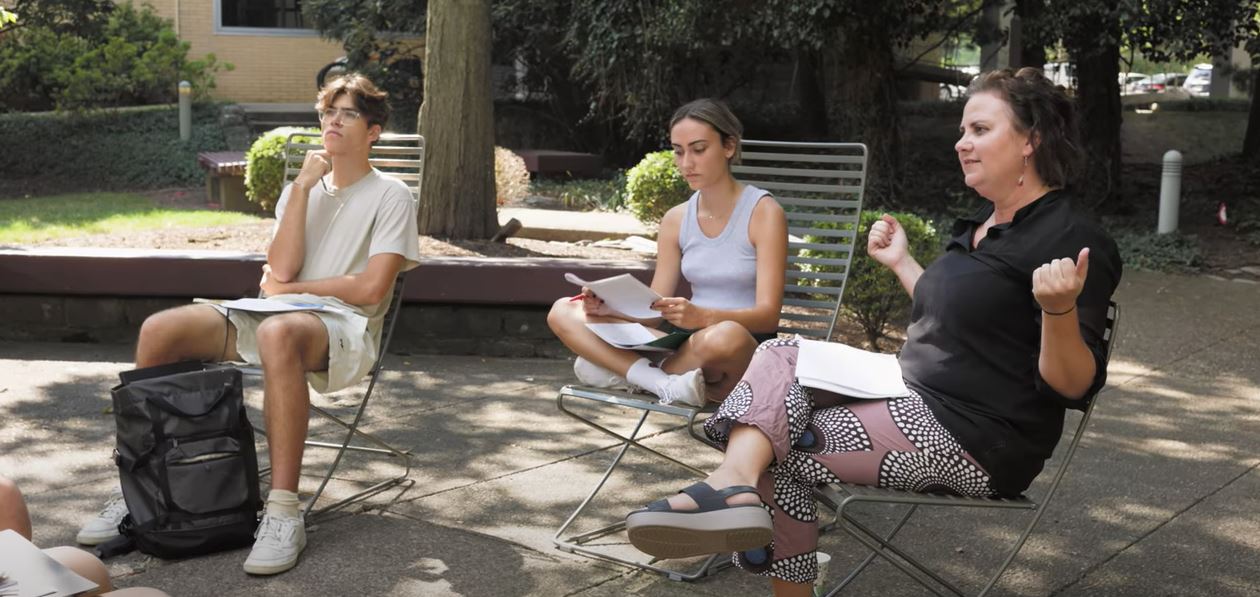
Writing & Culture is a four-week summer program at Carnegie Mellon University in Pittsburgh where you take your own story ideas through several forms. A poem leads to a short story, the story becomes a visual presentation, both turn into a screenplay, and a scene from it is filmed. Classes with CMU English faculty run Monday to Friday, alongside author readings, museum visits, sessions in the university's archives and rare book rooms, and help with college essays and resumes.
Get the key facts by email
The dates, costs and how to apply, all in one place.
Why it's worth it
You take your own ideas through poetry, fiction, a visual presentation and a screenplay, with mentoring from the people who teach CMU's English and film courses, and Pittsburgh's museums, author readings and the university's rare book rooms are part of the program itself.
What it asks of you
Getting in takes a portfolio of at least three pieces, three short essays and a teacher's letter, and living on campus costs $9,973, with the full balance due by 5 May 2027, well before the summer starts.
Who should skip it
Students who mainly want to shoot and edit film should look elsewhere, because CMU says outright that this isn't a film production course. The Film Production & Screenwriting Summer Program, run by the National Student Leadership Conference from $3,925 and in person, is the closer match for that.
The program is led by Jeffrey Hinkelman, a Senior Lecturer who directs the Film and Visual Media Program in CMU's Department of English and earned his doctorate in Literary and Cultural Studies at the university. His book For No Reason at All looks at how American film told the story of the First World War, and he has designed a number of CMU's undergraduate film courses.
The rest of the teaching comes from the same department, which CMU describes as a mix of published creative writers, literary and cultural studies scholars, rhetoricians and digital humanities specialists. The college essay and resume sessions bring in CMU's Writing & Communication faculty, staff and students. CMU doesn't publish a class size, but it does promise individual feedback built around each student's strengths and interests.
You leave with a body of your own work in several forms, from poems and short pieces to a screenplay and a short film built from a scene of it, along with a polished resume and a college application essay. Once the program ends you can ask for a recommendation letter, and you join the Writing & Culture alumni network.
CMU is clear about what it won't do. There's no college credit, and the university says being admitted to any of its Pre-College programs has no influence on a later application to study there. Students who leave early may not get a certificate or an academic evaluation.
You need to be 16 by 26 June 2027 and a sophomore or junior when you apply, with either a B average (3.0 out of 4.0) or a B or higher in your most recent English class. Beyond that, the application leans heavily on your own creative work. CMU publishes no acceptance rate or class size, but it does warn that programs can fill up.
Portfolio
At least three samples, such as videos, written pieces or other creative work that fits the program.
Essays
Three responses of 300 to 500 words each: what you hope to gain from the program, which kinds of media you enjoy most and why, and what you've already made in writing or other media.
Letter and transcript
One recommendation from a counselor, teacher or similar adult who can speak to your readiness for college-level work and living independently, plus an unofficial transcript. Test scores are optional.
From outside the U.S
CMU issues I-20 student visa paperwork only for its Summer Session, so international students can join this program only if they're already in the U.S. in another status. Non-native speakers also need an English score such as IELTS 7.5 or Duolingo 135, and scholarships are limited to U.S. citizens and permanent residents.
Applications for summer 2027 open on 1 December 2026.
If your family needs financial help, apply by 1 February 2027 and choose scholarship consideration in the application, and you'll hear on 1 April 2027.
Everyone else applies by 1 March 2027 at 11:59 p.m. Eastern, with decisions usually arriving within 15 working days of a complete application.
Your application isn't reviewed until your recommender's letter arrives, so send the request through the application as early as you can.
If you're admitted, you have seven days to accept and pay the $800 deposit, or $100 with a scholarship.
By 5 May 2027 you pay the balance and submit your enrollment paperwork, medical forms and travel plans, or CMU cancels your place.
The four weeks cost $9,973 if you live on campus and $7,539 if you commute, plus a $75 application fee that CMU doesn't refund. The residential price covers tuition, a shared room in a first-year residence hall, three meals a day on weekdays with brunch and dinner on weekends, $16 a week to spend at campus stores, a CMU ID that gets you into many Pittsburgh museums for free, and free rides on Pittsburgh Regional Transit. Commuters get tuition and $100 a week in campus dining credit, but you can only commute if your family's permanent home is within about 30 miles of campus or in Allegheny County.
If you're admitted, you pay an $800 deposit within seven days. It's non-refundable but comes off the total, and the rest is due by 5 May 2027. That date also decides your refund, so settle your summer plans before then.
Budget too for getting to Pittsburgh (CMU runs a free airport shuttle for students traveling alone), tickets for optional trips, your own bedding and fan, and $15 to $35 for each visit to the campus health service. Every student needs health insurance that covers inpatient and outpatient emergency care during the program.
CMU offers a very limited number of full scholarships, covering tuition, housing and dining, to U.S. citizens and permanent residents who can show financial need. They're only considered for applications in by 1 February 2027, and scholarship students pay a $100 deposit that's loaded onto their ID card to spend on campus.
| Written withdrawal received | Refund |
|---|---|
| On or before 5 May 2027 | Full program cost, minus the $800 deposit |
| 6 to 21 May 2027 | 50% of the program cost |
| On or after 22 May 2027 | No refund |
Residential staff live in the halls with students and someone is on call 24 hours a day. They're current CMU undergraduates, picked through a competitive process and cleared under Pennsylvania's Act 153, which means criminal history, child abuse and FBI background checks. Curfew is 10 p.m. Sunday to Thursday and 11 p.m. on Friday and Saturday, after which you stay on your own floor, and a missed check-in sets off CMU's missing-student protocol, which brings in parents and police.
CMU expects students to manage much of their own day, and its staff don't monitor routines one-on-one. The 2027 Pre-College Handbook sets out the full rules and is worth reading together before you apply.
Leaving campus
Any overnight stay or ride in a private car, even with family, needs a request 48 hours ahead, and staff phone a parent to approve it.
Medication
Students take their own medication, staff can't hold or give it, and anyone bringing prescriptions needs a lockbox.
Rooms
Most students share a double, on single-gender floors or in opt-in queer community housing, usually with a roommate from the same program.
Emergencies
Campus police patrol around the clock, staff go with students to urgent care or the emergency room, and parents have a 24/7 help line while the program runs.

Sean
Talk it through with Sean
“I can help you compare the programs you're considering, think through the practicalities and work out what makes sense for you.”
Four weeks in New York, from $12,552, ages 15 to 17.
01 Dec 2026 · From $12,552 · 15-17 · New York · In-person
In person in Los Angeles, from $3,925, ages 14 to 18.
Deadline: Not announced yet · From $3,925 · 14-18 · Los Angeles · In-person
Two weeks in Mexico City, from $7,750, ages 16 to 18.
20 Jan 2027 · From $7,750 · 16-18 · In-person
Save this program in Succeed to compare it with similar programs, dates, costs and formats in one place.
Compare with other programscmu.edu · Official page
drive.google.com
cmu.edu
cmu.edu
cmu.edu
cmu.edu
drive.google.com
drive.google.com
Facts checked against the official page on 19 Nov 2026
Editor: Ben Stacy
Succeed has no commercial relationship with Carnegie Mellon Pre-College Programs.
Spot an error? Report it