Conrad Challenge
- 2027 competition
The Conrad Challenge is a yearly STEM innovation competition run by Space Center Houston. Teams of two to five students aged 13 to 18, each with an adult coach, invent a product in one of five categories and build a business plan around it. Teams start with a free Lean Canvas, then submit a written brief, a 3- to 5-minute video and a website online. The top-scoring teams pitch in person at Space Center Houston in April.
 Sean Stevens · Sources
At a glance
Official facts · checked 25 Nov 2026- 2027: 7 January (Innovation Stage submission and payment), 25 March (Summit registration and payment, finalists), 1 April (Power Pitch materials, finalists)
- Students who will be 13 to 18 years old between August 2026 and April 2027. Open to international participants anywhere in the world
- Free Activation Stage, $499 per team Innovation Stage, $499 per attendee Summit
- Video as a YouTube or Vimeo link set to unlisted or public, Video as an MP4 file smaller than 800 MB, Website accessible by direct link, Written answers in the Conrad Portal
- Team
- 2 to 5 students plus one adult coach
- Stages
- 2026: - Conrad Challenge (27 August to 24 April 2027)
- Results
- 26 February 2027
- Prizes
- Pete Conrad Scholar title in each category, plus 2025-2026 prizes of an all-expenses-paid trip, free patent support and academic scholarships
- Entrants
- 7,890 students and 1,578 innovations from 74 countries (2025-2026)
- Official page
- conrad.spacecenter.org/the-challenge
Get the entry pack by email
The deadline, entry steps, what to submit and how entries are judged, then 2 reminders: 18 Mar (2 weeks before) and 29 Mar (3 days before).
No Succeed account needed. This doesn't register you for Conrad Challenge.
It stays in your Saved list, and we remind you before it closes.
Register with Conrad Challenge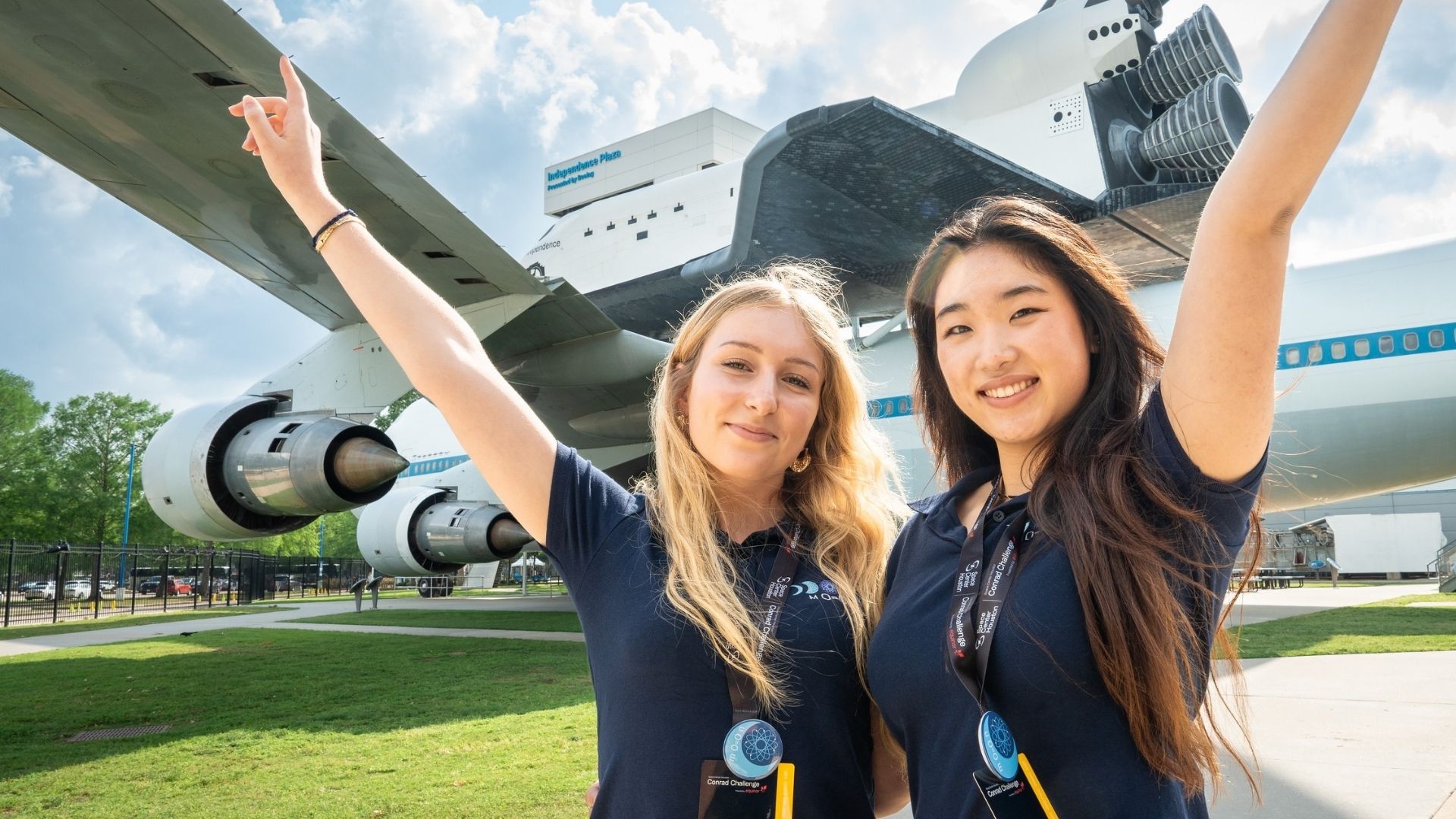
Should you enter?
SucceedWhy it's worth it
Every team that submits in the Innovation Stage gets written coaching comments from the judges, who Space Center Houston says include leaders from companies such as Equinor, Google and Blue Origin. So the feedback is useful even if you never reach Houston, and because the first stage is free, a team can test an idea before paying anything.
What it asks of you
More than four months of team work, from late August to early January, ending in a 3,000-word brief, a video and a website, plus the $499 team fee for the Innovation Stage. Finalists add $499 per attendee and pay for their own trip to Houston, although financial aid, based on need and the quality of the application, is offered for both fees.
Who should skip it
Students whose strength is the lab work rather than the pitch, because Innovation (30%) and Practicality (20%) make up only half of the Scoring Guide and the rest goes to storytelling, marketing and finances. It's also a poor fit for anyone set on working alone, since every team needs at least two students and an adult coach.
How do teams get from an idea to the Houston final?
Teams go through three stages, and only the top scorers make it to Houston. A team needs two to five students who will be 13 to 18 between August 2026 and April 2027, plus a coach aged at least 18, such as a teacher, parent or subject-matter expert. Teammates can come from different schools, cities or even countries, and every member and the coach register under one account in the Conrad Portal.
The free Activation Stage (27 August to 29 October 2026) asked each team for a Lean Canvas, which Space Center Houston checked for completeness and feasibility on a rolling basis before letting the team move on. The online Innovation Stage runs until 7 January 2027. Judges score every entry, and the top-scoring teams are named Finalists in a livestream on 26 February 2027.
The Innovation Summit at Space Center Houston, from 21 to 24 April 2027, is by invitation only. Finalists register and pay by 25 March 2027 and send in their Power Pitch slides by 1 April 2027. In Houston they pitch on stage in front of the other teams and a judging panel, answer the judges' questions, show their work to the public at the Expo and finish at the Awards Ceremony. The $499 per attendee fee doesn't cover travel or accommodation, so the trip to Houston is a cost for the family.
What goes into the brief, the video and the website?
For the Innovation Stage your team submits three things by 7 January 2027: a written Innovation Brief, a 3- to 5-minute Innovation Video and a website for the public. Space Center Houston calls the brief the most important item the judges review. It answers 10 questions in up to 3,000 words in total, with a list of references and up to two optional attachments such as visual aids.
The video has to tour a model of the innovation, which can be a sketch, 3D model, storyboard, wireframe or physical prototype, so you don't need a working device. You upload it twice, as a YouTube or Vimeo link set to unlisted or public and as an MP4 file under 800 MB. The website tells your team's story, shows the model and carries your brand. Judges only need to reach it by direct link, so you can keep it out of search results.
Before any of this comes the Lean Canvas from the first stage, 12 short questions answered in 40 words or fewer (10 for the tagline). Space Center Houston gives no estimate of the hours involved. In our view, most of the time goes into what the brief asks you to back up, such as validating the idea, sizing the market and costing the product, rather than the writing itself.
Elevator Pitch
150 words on the innovation, its impact, customers and business potential.
Team
150 words on how the team formed and what each member brings.
Opportunity
300 words on the problem the innovation addresses.
Key Metrics
750 words on how it works, what is new about it, its impact and how it could be protected.
Validation/Progress
450 words on how you've tested the idea and how far you've got.
Market
300 words on customers, segments and the size of the opportunity.
Competition
300 words on rivals, advantages and positioning.
Go-To-Market
150 words on how you'll reach and sell to customers.
Business Model
300 words on revenues, costs and unit pricing.
Fundraising
150 words on the money needed and where it will come from.
How do judges score the innovation?
Judges score the brief, video and website together against a published Scoring Guide with five weighted areas. Innovation carries the most weight, but whether the idea is new and workable makes up only half the total. The other half rewards how well you present it and whether the business adds up.
Innovation
Is it unique and impactful? Covers originality, impact, ambition, a search ruling out duplicates and whether the idea can be protected.
30%
Storytelling and Professionalism
Would a reasonable investor want to learn more? Covers clarity, credibility, a consistent story across brief, video and website, and polish.
20%
Practicality
Will it work? Covers feasibility, realism, proof of concept, evidence and next steps.
20%
Marketing Strategy
Does the team understand key markets? Covers target customers, market entry, the industry around you, differentiation and the website as a sales channel.
20%
Finances
Does the team understand costs and funding? Covers cost estimates, revenue projections, a funding plan and whether the budget is realistic.
10%
In practice the guide asks for things a team can plan for. Run an online search that shows nobody has already built your idea. Show proof of concept, such as a tested component, a prototype or a graphic mock-up. Back up your claims with data or expert testimony, and give realistic costs and revenue figures. Each judge coaches around five teams and writes about a paragraph per coaching area, and these comments are released in February 2027.
How many teams make it to the final?
Very few. In 2025-2026, 7,890 students from 74 countries entered 1,578 innovations, and Space Center Houston says the Summit finalists were the top 2% of all teams. That works out to roughly 30 teams (2% of 1,578). Teams that do well in the Innovation Stage without reaching the final can still earn the title of Conrad Innovator.
At the 2026 Summit, one team per category was named Pete Conrad Scholars, alongside Power Pitch winners and special awards. The winners' summaries back up their claims with test results and market figures, such as a prototype with 20% less mass than current technology or field trials across four bee colonies.
Aerospace and Aviation (2026)
A lightweight multi-axis satellite steering actuator built around a spherical motor, from California, USA.
Cyber Technology and Security (2026)
A non-invasive headset that turns facial muscle signals into speech for people with speech disorders, from Illinois, USA.
Energy and Environment (2026)
An AI web app that diagnoses beehive health from video, from California and Massachusetts, USA.
Health and Nutrition (2026)
A machine-learning platform that predicts immunotherapy response in head-and-neck cancer, from Washington, USA.
The Water Challenge (2026)
A smart backwashing safe-water system for herders in high-altitude pastoral areas, from China.
What do winning teams actually take home?
The top prize is a title, not cash: Pete Conrad Scholar, given to the top venture in each of the five categories. For 2025-2026, Space Center Houston listed three prizes. These were an all-expenses-paid trip from Equinor and United Airlines with visits to STEM institutions and networking with industry experts, free patent support from intellectual property lawyers, and academic scholarships for higher education.
Space Center Houston doesn't publish scholarship amounts or say which award comes with which prize, so treat the scholarships as help toward future college costs of an unknown size rather than money in hand. Special awards recognize the best Power Pitch, Expo displays, citizenship and entrepreneurial vision, along with the Equinor "Searching for Better" award. Every finalist also becomes part of the Conrad Challenge alumni network.
Which rules could trip up your team?
A few of Space Center Houston's rules matter long before the final, and it can disqualify a team at any stage that doesn't meet the eligibility rules.
Your team is locked early
Once you've submitted the Activation Stage you can remove members but can't add new ones, and the team must always have at least two students.
The coach guides, the students build
Everything submitted must be entirely the students' own work, and coaches may not create any of it or have too much influence on the design.
Cite your AI tools
AI tools count as outside material and must be cited like any other source, and every submission must be in English.
Reused ideas need real changes
Returning teams who resubmit a similar innovation must show significant changes and disclose their earlier participation. An innovation can go into the Global Challenge or the China Challenge, never both.
Patents and publicity
Finalist teams based in the United States must file a provisional patent application, and anything shared at the Summit counts as public. The names, photos and locations of Conrad Innovators and Finalists are posted online.
What should you do next?
Frequently asked questions
Sources
- The Challenge - Conrad Challenge
conrad.spacecenter.org · Official page
- Conrad Challenge
conradchallenge.awardsplatform.com
- 2026 Conrad Challenge Innovation Summit Awards - Conrad Challenge
conrad.spacecenter.org
- About the Challenge - Conrad Challenge
conrad.spacecenter.org
- 2026-2027 Conrad Challenge Finalists Announcement - Conrad Challenge
conrad.spacecenter.org
- Prizes - Conrad Challenge
conrad.spacecenter.org
- Conrad Challenge Rules and Regulations - Conrad Challenge
conrad.spacecenter.org
- 2026-2027 Conrad Challenge Student Guide (PDF)
conrad.spacecenter.org