Fundamentals of Engineering High School Course
Applications open
Engineering study for high school students
21 Feb 2027 · From $2,498 · 14-18 · Berkeley · In-person
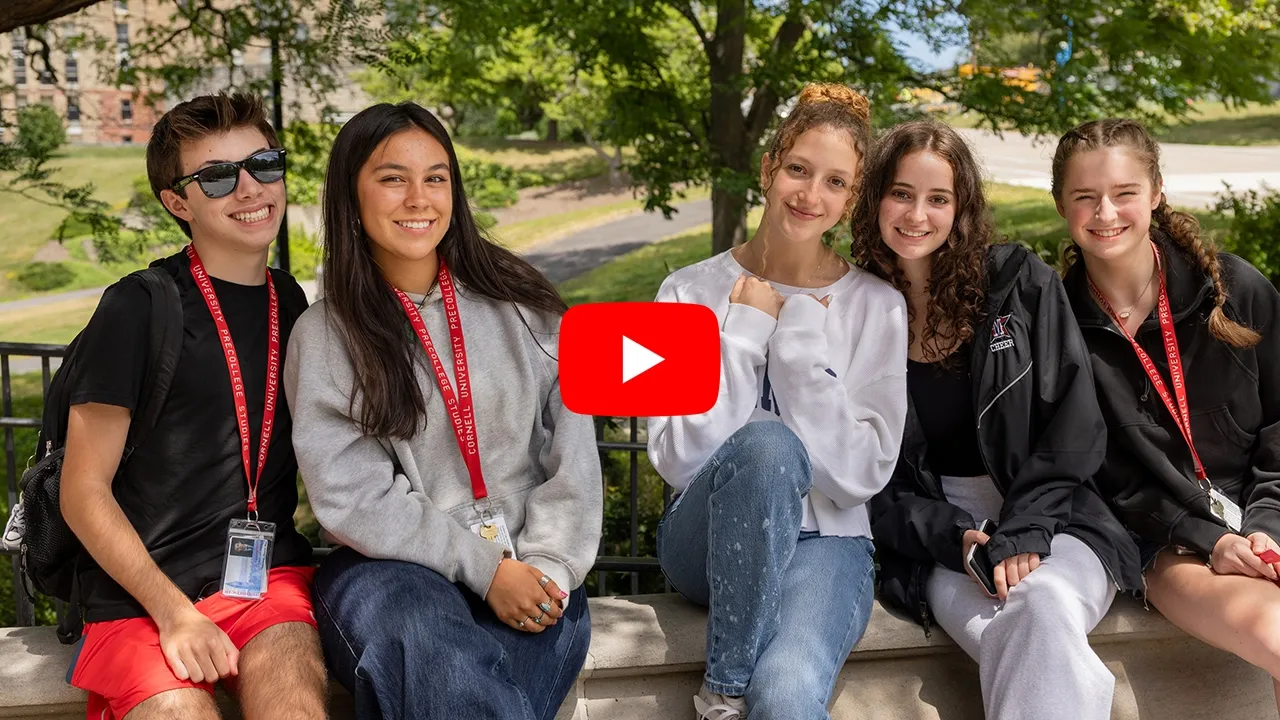
Cornell's Precollege Studies Residential Program has students aged 16 to 18 living in a residence hall in Ithaca, New York, for three or six weeks while they take regular Cornell undergraduate courses for credit and a letter grade. In 2026, courses ranged from architecture and computer science to government, marketing and veterinary medicine. The only six-week option was architecture, which paired a design studio with a lecture course. Outside class, Summer Discovery staff run supervised activities and trips in the evenings and on weekends.
 Sean Stevens · Sources
Get the key facts by email
The dates, costs and how to apply, all in one place.
Why it's worth it
These are regular Cornell undergraduate courses, taught by Cornell instructors and graded to the same standards as the college students who may share your class, so you get real credit and a fair test of whether you're ready for college work. Architecture students take a design studio alongside the lecture course, so they make work as well as study it.
What it asks of you
Expect your summer to be mostly coursework, since Cornell squeezes a 15-week course into three or six weeks. For architecture that means six weeks in Ithaca, with supplies that cost more than the usual book budget.
Who should skip it
Students who want a low-stakes trial run, because there's no pass/fail or audit option and a poor grade can't be removed from your Cornell transcript.
Expect a few hours of class every weekday and roughly twice that in homework. In Cornell's example of an on-campus summer course, classes run from 9 a.m. to noon Monday to Friday, with discussions on Tuesday and Thursday afternoons from 1:00 to 2:15 p.m. Cornell says to plan on two to three hours of homework for every hour of lecture. So two three-credit six-week courses, which is what the architecture pairing involves, work out to about three hours in class and up to six hours of homework a day.
Meals are in the campus dining halls, and Summer Discovery staff organize activities in the evenings and on weekends. Past activities have included trivia nights, movies, ice cream socials, stargazing from the North Campus observatory, trips to the Johnson Museum of Art and the Ithaca Farmers Market, and hiking, bowling and swimming. There have also been student-selected clubs for games, sports, photography and art.
You need to have finished 10th grade (or the international equivalent) and be 16 to 18 when your class starts, and if you'll already have graduated from high school, you must still be under 18. Students admitted to Cornell as undergraduates for the coming fall can't apply. Each course also has its own prerequisites, so check the one you want before you apply.
There's no interview and no minimum GPA, although Cornell says students with a B+ average or above across their classes are generally well prepared. Decisions are rolling, usually within two weeks of a complete application, and Cornell says most programs fill before the deadline.
Personal essay
Written in English, ideally 1,000 to 1,500 words and no more than 2,000. The prompts ask about the subject you want to study, what you expect to gain, why you're confident you'll succeed, the background you bring and what sets you apart from other applicants.
Documents
Your complete high school transcript, your most recent grade report and one teacher or counselor recommendation.
English scores
If English is neither your native language nor the main language of your secondary schooling, you'll need at least 100 on the TOEFL (tests taken before January 2026) or 5.0 (January 2026 onward), 7.5 on the IELTS or 130 on the Duolingo English Test.
International students
You'll need an F-1 student visa, which means enrolling for at least six weeks and six credits, either two six-week courses or two three-week courses taken back to back. A single three-week course isn't an option. Your I-20, the document you take to your visa appointment, can take up to four weeks to arrive after you submit your deposit and I-20 documents.
In 2026, three weeks cost $9,274 for a 3-credit course or $11,214 for a 4-credit one, and six weeks cost $18,402 for 6 credits, $20,342 for 7 or $22,282 for 8. The architecture program's two required courses add up to 6 credits, so it cost $18,402. Each total covered tuition, the $167 student health fee and the residential fee, which pays for your room, a full meal plan, 24/7 supervision, activities including transport and entrance fees, and admissions workshops. Cornell has set tuition for fall 2026 through summer 2027 at $2,013 per credit, up from about $1,940 per credit in the 2026 totals ($5,820 for 3 credits), so expect summer 2027 to cost more.
On top of that come the $85 application fee, travel to Ithaca and spending money. Cornell suggests budgeting about $100 to $150 for books and supplies over three weeks and $150 to $200 over six, and more for architecture. Students who live outside the US and take 6 or more credits are automatically enrolled in Cornell's health insurance plan, which cost $676 for summer 2026. International students also have visa fees, which are an extra to check with official sources. A $1,500 nonrefundable deposit, which counts toward the total, is due when you choose your courses.
If you withdraw in the first three days of the session, you get all your tuition back apart from the nonrefundable charges. On days four and five you get half, and after that you get nothing. The residential fee had its own 2026 schedule, with a full refund before 3 June, half from 3 to 20 June and nothing from 21 June.
| Session | Credits | 2026 total |
|---|---|---|
| Three weeks | 3 | $9,274 |
| Three weeks | 4 | $11,214 |
| Six weeks | 6 | $18,402 |
| Six weeks | 7 | $20,342 |
| Six weeks | 8 | $22,282 |
There's one staff member for every 10 students. Residential staff come from Summer Discovery, a company Cornell contracts to provide residential staff and run the social program, while Cornell keeps control of the courses and instructors. Resident counselors are current college students or recent graduates who live in the hall with you.
You'll live in Ruth Bader Ginsburg Hall on North Campus, in pods of singles, doubles, triples or quads that share a lockable bathroom, with floors or wings separated by gender identity. Most students have roommates, because singles are generally kept for students with approved accommodations or other circumstances. Staff assign roommates and you can't request one. When you check in, you hand any prescription medicines to the staff nurse. Once you've checked in, you can't leave campus or have visitors until the session ends, and Cornell asks parents not to visit.
Daytime
Until 6 p.m. you can move around set areas of campus in groups of three or more.
Evenings
After 6 p.m. you stay on North Campus unless a resident counselor goes with you, and you're back in the hall by curfew.
Phone and check-ins
You carry a charged phone, share your live location with staff through the program's app and check in electronically at meals, classes, activities and when you get back to the hall in the evening.
You leave with Cornell undergraduate credits and a letter grade on an official Cornell University transcript, which becomes part of your permanent record there. Whether those credits count toward a degree is up to the college you go on to attend, so check with that college rather than assuming they'll transfer. Grades come out about 10 days after the class ends, and Cornell won't send them to your high school, so you order an official transcript yourself for $10 per copy.
In 2026, architecture students could also show their work at an optional exhibition in the dome of Milstein Hall on 1 August, after checking out of the program, and family and friends were welcome to attend.

Sean
Talk it through with Sean
“I can help you compare the programs you're considering, think through the practicalities and work out what makes sense for you.”
Engineering study for high school students
21 Feb 2027 · From $2,498 · 14-18 · Berkeley · In-person
International business and finance summer study
Deadline: Not announced yet · From $6,695 · 14-18 · Oxford · In-person
Save this program in Succeed to compare it with similar programs, dates, costs and formats in one place.
Compare with other programssce.cornell.edu · Official page
sce.cornell.edu
sce.cornell.edu
sce.cornell.edu
sce.cornell.edu
sce.cornell.edu
sce.cornell.edu
sce.cornell.edu
Facts checked against the official page on 16 Nov 2026
Editor: Sean Stevens
Succeed has no commercial relationship with Cornell Precollege Studies.
Spot an error? Report it