
Engineering Innovation & Design (Oakland)
Applications open
Computer Science
15 Jan 2027
From $6,995
15-18
In-person
by Tufts University Pre-College Programs
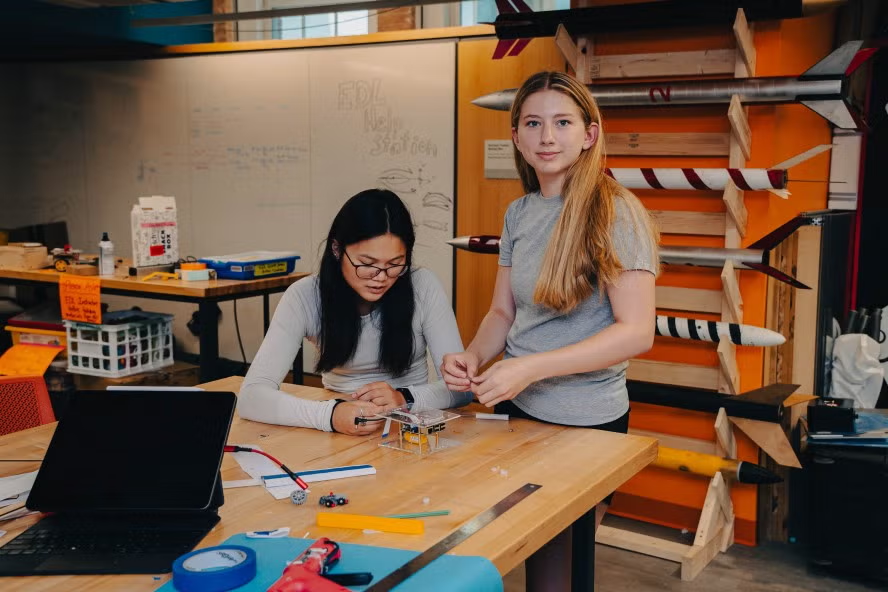
Engineering Design Lab is a two-week summer program on Tufts University's Medford/Somerville campus near Boston. In the first week you learn laser cutting, 3D printing and other fabrication tools in the Nolop Makerspace, alongside robotics and Python programming. In the second week you work with a small team to design, build and test a prototype that solves a real-world problem. Classes run 9am to 5pm on weekdays with guest speakers from Tufts and industry, and the session ends with a public presentation of your prototype. You can live in a Tufts dorm or commute, and you keep the Raspberry Pi and GoPiGo3 robot kit afterward.
 Sean Stevens · Sources
Get the key facts by email
The dates, costs and how to apply, all in one place.
Succeed's assessment
In short
Why it's worth it
You get a university makerspace, daily talks from guest speakers and a team project, all in the same two weeks. You finish with a prototype you present in public, documentation for your portfolio and the Raspberry Pi and GoPiGo3 robot kit to keep experimenting with at home.
What it asks of you
You'll need to commit to two weeks of full 9am-to-5pm days and bring a laptop or tablet with a physical keyboard, which program staff can lend you if you ask before you arrive. The fee is a lot for two weeks unless you qualify for aid, and getting to Boston costs extra.
Who should skip it
Students who need credit or a grade on a transcript should skip it, because Tufts lists the program as not for credit. So should anyone hoping it will lead to a place at Tufts, since Tufts says its pre-college programs don't result in or guarantee admission to its degree programs.
Class runs 9am to 5pm, Monday to Friday, in both weeks. Every day mixes hands-on work in small groups or on your own with a talk from a guest speaker on topics such as careers, research and the problems engineers run into in the real world. In week 1 you learn to use the fabrication tools in the Nolop Makerspace, covering CAD, 3D printing, laser cutting and woodworking. You also build your own robot and learn Python to control its motors, sensors and servos. Week 1 also covers brainstorming and planning your team project, ready to build in week 2.
Week 2 introduces robotic control systems, computer vision, machine learning and AI, communication protocols that use cloud services, and the Internet of Things, though Tufts says each gets a different amount of time. Week 2 is also when your small group researches a real-world problem and then designs, prototypes and tests a solution, which you present publicly at the end of the session. Teaching stops at 5pm, but you're welcome to keep working on your own after that.
There are no classes in the evenings or on weekends. Residential students eat dinner between 5pm and 8pm and can join activities the residential staff plan, such as ice cream socials and visits to Davis Square. Weekend trips vary from year to year, and past ones have included Crane Beach, Six Flags New England and Downtown Boston. Commuters start at 9am on the first Monday, finish at 2pm on the last Friday and aren't expected on campus at weekends.
Two School of Engineering instructors lead the program. Dr. Jennifer Cross is a research assistant professor at Tufts' Center for Engineering Education and Outreach who studies human-robot interaction and robotics in education. While doing her graduate degrees at Carnegie Mellon, she helped develop Arts & Bots, a robotics program for middle school students. Brandon Stafford directs the Nolop Makerspace where you'll work. He studied mechanical engineering at Stanford, ran his own startup for five years and now teaches electronics and design-for-fabrication courses in Tufts' mechanical engineering department.
Teaching assistants work alongside you during challenges and project time and also hold office hours. The guest speakers come from Tufts faculty, students and industry partners. Tufts doesn't publish a class size or student-to-instructor ratio for this program.
You can apply if you're entering grades 10 to 12 or graduating from high school in 2027. If you plan to live on campus, you must be at least 15 when the program starts and no older than 19 when it ends. Tufts welcomes international and home-schooled applicants.
The application asks for your transcript, which your school sends, one letter of recommendation from a teacher, counselor or mentor, a parent permission form and a statement of interest. Test scores are optional unless English isn't your first language. In that case Tufts wants a TOEFL iBT score of 100, IELTS 6.5, PTE 68 or Duolingo 120, or a transcript showing at least a year at an all-English school.
Tufts doesn't publish an acceptance rate or cohort size, and it reviews each application as a whole. It says your transcript and recommendation are where you stand out, so choose a recommender who can describe your curiosity and interest in engineering in detail. Admission is rolling, so programs can fill before the deadline, and Tufts gives no feedback if you're turned down.
Living on campus costs $5,950 and commuting costs $4,425 for the two weeks. The residential fee covers your room, three meals a day (brunch and dinner on Sundays), bedding and towels, lab materials, 24-hour residential care, planned activities and weekend trips, and a staff-run airport shuttle during set arrival windows. The commuter fee covers classes, activities and a weekday lunch. Commuters pay at the door for breakfast and dinner.
Either way, you also pay for travel to and from Boston, spending money and any medical bills. Residential students pay $1.50 per laundry load. Tufts charges $55.16 for health insurance if you can't show U.S.-based coverage. If you can't prove you've had the required vaccinations and get them on campus, you pay $55 per vaccine. International families should also budget for a visa and check the fee with the official source.
Once you're admitted, you pay a $550 deposit, which counts toward the fee but is never refunded. The rest of the tuition can be refunded only until 15 May 2027, and nothing comes back after that. Tufts' payment plan can't be used for summer charges.
Tufts offers limited need-based aid. It says many of its pre-college programs offer a small number of scholarships, which typically cover 75% to 100% of the program fee. Awards go out twice a month from February until the enrollment deadline or until the money runs out. International students can't apply. If you need aid to attend, Tufts suggests waiting for the decision before paying the deposit, although your place isn't held while you wait.
Residential students have one resident advisor for every ten students, plus a director and senior staff. They live in air-conditioned double rooms in halls divided by gender and age, and you need a Tufts ID card to get into the building. From Sunday to Thursday, students must be in the hall by 10pm and in their rooms by 11pm. On Fridays and Saturdays, they must be in the hall by 10:30pm and in their rooms by midnight. Breaking curfew can mean dismissal without a refund. Students use a buddy system in their free time and can't leave campus or be in a lab without a staff member or official parental permission.
Tufts makes reasonable efforts to run background checks on staff and give them Title IX training, and its own police department works around the clock. Tufts Health Services provides urgent, non-emergency care for a fee. There's no on-site mental health counseling, though, so a student who needs it should stay in touch with their own provider. Commuters aren't supervised on their journey or outside program hours, and they aren't allowed into the residence halls. Tufts covers the details on its health and wellness and policies pages.
Applications go through Tufts' pre-college application, which opens on 14 December 2026.
Start the online application from 14 December 2026. It asks for your details, your choice of living on campus or commuting, your statement of interest, and contact details for a parent and your recommender.
Give the contact details of a school official, who uploads your transcript directly.
Tufts then emails your parent the permission form and your recommender the request for a letter. Your application isn't reviewed until both have arrived along with your transcript.
Get everything in by 1 May 2027, and earlier if you can. Tufts typically decides within 10 business days of receiving a complete application.
If you're admitted, pay the deposit within 10 days (weekends included), pay the balance by 15 May 2027 and submit your enrollment forms by 1 June 2027. If you're admitted after 15 May, you pay the full fee straight away. If you miss these dates, Tufts withdraws you from the program.

Sean
Founder, Succeed
Talk it through with Sean
“I can help you compare the programs you're considering, think through the practicalities and work out what makes sense for you.”
20 minutes · No obligation to enroll
Save this program in Succeed to compare it with similar programs, dates, costs and formats in one place.
Compare with other programsuniversitycollege.tufts.edu · Official page
universitycollege.tufts.edu
universitycollege.tufts.edu
universitycollege.tufts.edu
universitycollege.tufts.edu
universitycollege.tufts.edu
universitycollege.tufts.edu
universitycollege.tufts.edu
Not ready to decide yet? Keep it for later.