
Biology
Deadline: Not announced yet
From $3,945
14-18
Berkeley
In-person
by University of Notre Dame Pre-College Programs
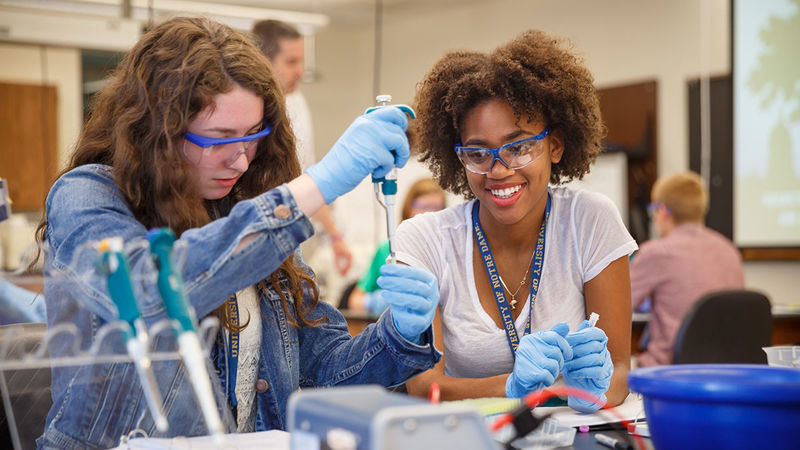
Over two weeks on the University of Notre Dame's campus in Indiana, you split your time between a cancer biology lab and ecology fieldwork. In the lab, your research team uses techniques such as tissue culture and immunoblotting to characterize an assigned cancer cell line. In the field, you collect data on a local stream for a research project and presentation, with trips to Warren Dunes and Warren Woods in Michigan. You live in a residence hall, the course runs in both Summer Scholars sessions, and you could earn one transferable college credit.
 Sean Stevens · Sources
Get the key facts by email
The dates, costs and how to apply, then 2 reminders: 3 Feb (2 weeks before) and 14 Feb (3 days before).
Succeed's assessment
In short
Why it's worth it
You carry out research in two very different settings, running molecular techniques such as immunofluorescence and immunoblotting on cancer cells and collecting stream data in the field, and you present your findings from both.
What it asks of you
Two weeks living on campus, where every class, meal and check-in is required. The cost is $5,200 plus a $75 application fee, and travel to Indiana isn't included. The application takes two essays, along with a counselor and a teacher who are willing to submit materials for you.
Who should skip it
Families whose summer plans could still change after April, since the $300 enrollment fee is due by 23 April 2027 and none of the money comes back if the student withdraws.
Two Notre Dame biology teaching professors direct the course, and their research backgrounds match its two halves. Mark Olsen, an associate teaching professor who coordinates the university's majors and honors biology lab program, has been on the Notre Dame faculty since 1994. His graduate research was on lake ecology and how invertebrates survive sub-zero temperatures, and he teaches an environmental science course for non-majors that includes field-based environmental assessment. David Veselik, a teaching professor and associate dean for undergraduate advising in the College of Science, earned his Ph.D. at Georgetown studying how environmental estrogens affect breast cancer. He has also led a National Science Foundation workshop that helps local high school teachers make their biology courses more inquiry-based.
You'll also hear from other scientists, through colloquia with Notre Dame researchers on stream ecology and restoration, virtual tours of cancer labs with live Q&A sessions, and field trips led by interpretive naturalists. Notre Dame says it keeps Summer Scholars classes small but doesn't publish a class size or staff ratio.
You can. Notre Dame says students may receive one transferable college credit once they complete all program requirements, with a Satisfactory (S) grade rather than a letter grade. You request the transcript from the University Registrar.
You also come away with two pieces of research to talk about: a project and presentation on the environmental quality of a local stream, built from field data you collect, and a team presentation on the hallmarks of cancer and what your group found when characterizing its assigned cancer cell line.
You can apply if you're a high school sophomore or junior now, so a rising junior or senior in summer 2027, and you'll be at least 16 on or by 1 August 2027. Notre Dame makes no exceptions to the age rule, citing its insurance, liability and child protection policies, so a younger sophomore should check their birthday before starting.
Beyond that, Notre Dame looks for strong academic standing, solid extracurriculars, and applicants who are self-motivated, mature and keen to be part of the Notre Dame community. It calls the essays very important. The teacher's letter should speak to your ability to handle college-level work and to your maturity, integrity and leadership. Notre Dame finds it helpful when the letter comes from a teacher who can support your interest in this course, which makes a science teacher the natural choice. SAT, ACT or PSAT scores are encouraged but not required. International applicants whose high school doesn't teach in English need a TOEFL (5.5+), IELTS (7.5+), PTE (55+) or Duolingo (120+) score.
Applications go through Notre Dame's enrollment portal, and Notre Dame reviews a file only once every document has arrived.
Create an account and complete the online application, including two essays and either the activities section, a resume or both.
Add your counselor's contact details, and your teacher's once they've agreed to write for you. Notre Dame emails your counselor for your transcript, school report and school profile, and your teacher for the recommendation. It's up to you to check that both received those emails.
If you're sending SAT, ACT or PSAT scores, upload them by 31 January 2027.
Submit everything by 17 February 2027 and pay the $75 application fee. If you need aid, have a parent file the Financial Aid Request Form by the same date.
If you're admitted, pay the $300 enrollment fee by 23 April 2027 to hold your place and the $4,900 balance by 14 May 2027.
A family paying in full spends $5,275, which is the $5,200 program cost plus the $75 application fee. The $5,200 covers tuition, room and board, extracurricular activities and class field trips. Once you're admitted, you pay it in two parts: a $300 enrollment fee by 23 April 2027 and the $4,900 balance by 14 May 2027. Travel to campus isn't in Notre Dame's list of what the fee covers.
None of these fees is refundable.
Aid is need-based only, with no merit scholarships. Notre Dame has a limited number of partial to full-tuition scholarships. Grants also cover tuition, room and board for qualifying students who live in Indiana, through the Lilly Endowment, or in the Philadelphia area, through donors. A parent or guardian has to complete the Financial Aid Request Form by 17 February 2027, and any award arrives with the admission letter. Application fee waivers are rare and only for extreme circumstances.
Closely. Under the rules Notre Dame has published for its summer 2026 programs, students can't leave campus except on a scheduled, supervised activity or with a Pre-College staff member or Resident Counselor as chaperone, and they can't drive any vehicle during the program. Every class, field trip, meal and check-in is required unless it's clearly marked optional. Notre Dame's housing code for high school residents has students back in their hall by 11 PM Sunday to Thursday and midnight on Friday and Saturday, and in their rooms by 12:30 AM. Visitors need written approval, and students can't enter halls of the opposite gender.
Staff don't store or give out medication, so students manage their own. Parents must arrange any medical or mental health accommodations at least 30 days before the program starts, and they pay for any care the student needs during the program. A student dismissed for breaking the rules gets no refund, and the family pays for the trip home.

Sean
Founder, Succeed
Talk it through with Sean
“I can help you compare the programs you're considering, think through the practicalities and work out what makes sense for you.”
20 minutes · No obligation to enroll
Succeed has a commercial partnership with this provider.
Succeed has a commercial partnership with this provider.
Save this program in Succeed to compare it with similar programs, dates, costs and formats in one place.
Compare with other programsprecollege.nd.edu · Official page
precollege.nd.edu
precollege.nd.edu
precollege.nd.edu
precollege.nd.edu
precollege.nd.edu
precollege.nd.edu
precollege.nd.edu
Not ready to decide yet? Keep it for later.