International business and finance study in New York
Deadline: Not announced yet · From $6,695 · 14-18 · Oxford · In-person
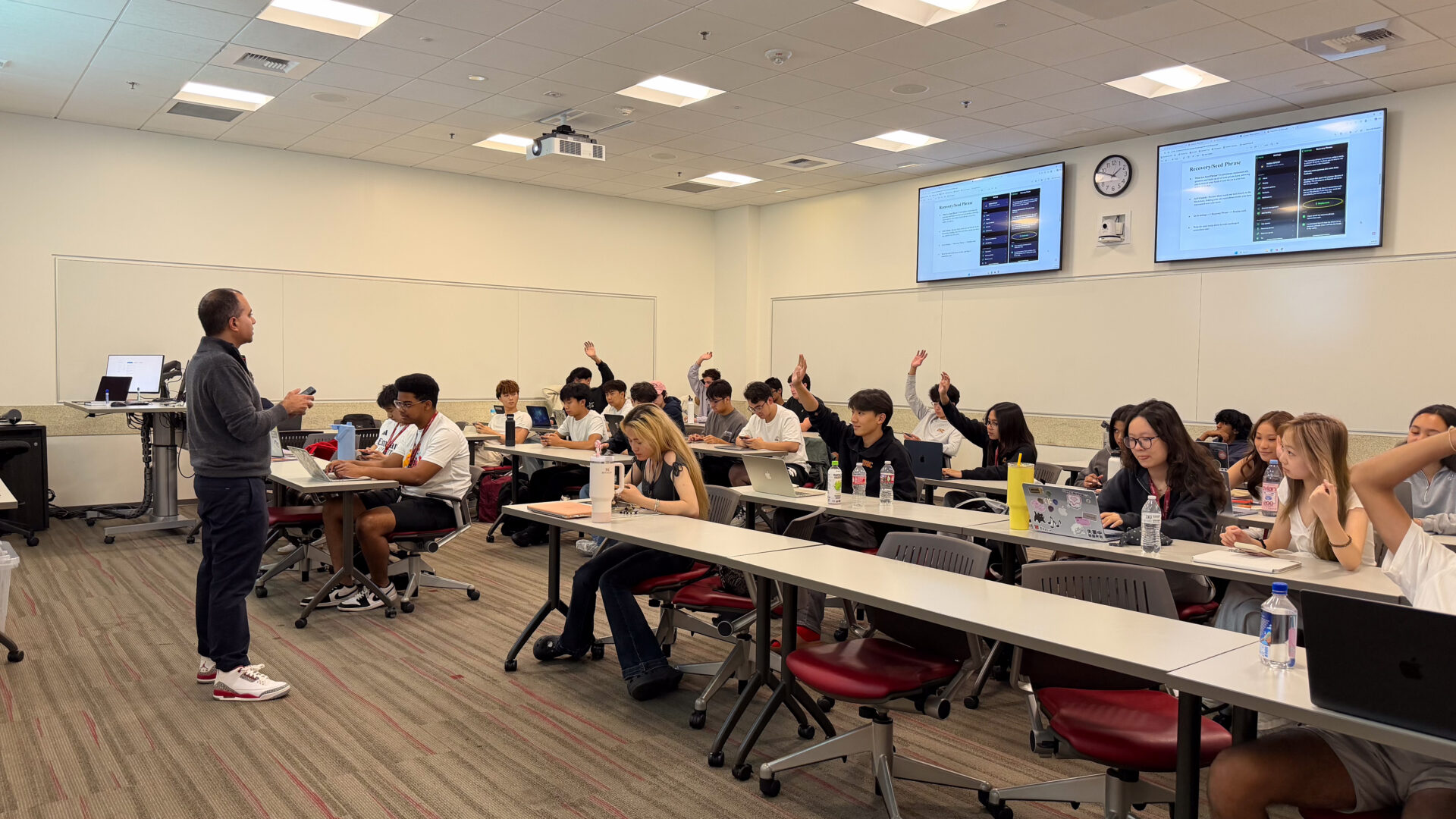
Over four weeks on USC's Los Angeles campus, you take a single college-level course. It starts with the history of money and today's dollar-based financial system, then moves on to how Bitcoin works and how AI is changing the economy. Along the way there's a field trip to JP Morgan, and in the third week you use AI tools to turn a business idea into your own website or app. You finish by presenting your own forecast for the future of money, and passing the course earns three units of USC elective credit.
 Sean Stevens · Sources
Get the key facts by email
The dates, costs and how to apply, then 2 reminders: 23 Apr (2 weeks before) and 4 May (3 days before).
Why it's worth it
It treats a hyped topic as serious economics, starting with the history of money and the dollar system before it gets to Bitcoin, and it makes you produce and defend your own work, from a vibe-coded site or app to a final thesis you have to argue in front of the class.
What it asks of you
You have to be there for all four weeks, with no late arrival or early departure, and class takes up five to six hours a day. The money is due up front too, because USC offers no payment plan and wants the full balance by 28 May 2027.
Who should skip it
Families who'd need financial help to make it work, because USC offers no scholarships or aid of any kind, and the cheaper commuter option is only open to students who live in Los Angeles or Orange County.
Class runs from 9 a.m. to 3:30 p.m. each day, with breaks for lunch or field trips, and the four weeks build from how money works to your own forecast of where it's heading. Bring your own laptop, and pack one business casual outfit for the JP Morgan trip. Phones have to be off and out of sight in class.
| Week | Focus | What you do |
|---|---|---|
| 1 | Introduction to Finance, Money and Cryptography | Corporate finance, investment theory and the history of cryptography, plus the Layered Money framework for understanding the monetary system |
| 2 | Bitcoin Mechanics and AI's Impact on the Economy | How Bitcoin works and how AI is changing the economy, with a field trip to JP Morgan |
| 3 | Bitcoin as a Financial Asset and Using AI to Create a Business | What drives Bitcoin's price, then using AI to build a business idea and vibe-coding your own website or app |
| 4 | Leadership and Critical Thinking | Presenting your business idea and a thesis-based final presentation on the future of the economy and monetary system |
Once class ends, students are free to study in the campus libraries or use the gym. Residential students get evening activities run by residential advisors, such as game nights and movies on the lawn, plus weekend day trips to beaches, theme parks and sports events. Those activities, weekend trips included, are compulsory for residential students, while commuters can choose whether to join in.
Pass the course and you earn three units of USC elective credit. Other colleges can accept those units, but USC says that's up to each school and suggests keeping a copy of your syllabus. You also leave with the website or app you built in week 3 and your final presentation, and USC points to the chance of a recommendation letter from its faculty or staff.
Attending doesn't guarantee admission to USC, and anyone who wants an undergraduate place still applies through USC's Office of Admission. If you withdraw between 26 June and 12 July 2027, your transcript shows a W, which doesn't affect your GPA. Leave after that and you get whatever grade the instructor gives you.
You need to have finished at least ninth grade by the time the program starts in June 2027, and USC says you should be taking a rigorous high school curriculum. Students in the US and abroad can both apply. USC doesn't publish an acceptance rate, but it says it looks for students with a record of challenging coursework, such as honors and AP classes, and a real interest in the subject.
International applicants also have to show English proficiency in one of the ways below.
SAT or ACT
650 on SAT Evidence-Based Reading and Writing, 600 on the older SAT Critical Reading, or 27 on ACT English.
TOEFL iBT
100 overall with at least 20 per section on the older scale, or a band score of 5 with at least 4 per section on the newer one.
IELTS, PTE or Duolingo
IELTS 7, PTE 68 or Duolingo English Test 120.
Waiver
An English Language Proficiency Waiver in place of a test score.
For summer 2027, a US student living on campus pays $11,946 and a commuter pays $8,371. An international student pays $12,602, plus any fees paid directly to the US government for a visa. Commuting is only open to students whose main home is in Los Angeles County or Orange County, and international students and US students living abroad have to live on campus. Room and board covers a shared residence hall room and three meals a day, while commuters buy their own meals. US students who don't send proof of personal health insurance by USC's deadline are also enrolled in, and billed for, USC's student health insurance.
On top of that comes the $85 application fee, which USC won't waive. Once you're admitted, a $1,000 deposit holds your place. It counts toward the total but is nonrefundable. The rest is due by 28 May 2027, and anyone who hasn't paid in full by then is dropped from the program. USC doesn't take credit or debit cards or offer a payment plan, so you'll pay by bank or wire transfer. If you cancel in writing before 25 June 2027, you get your tuition back, but not the deposit or other fees. After that, nothing is refunded. USC also suggests residential students bring $50 to $75 a week in spending money.
| Item | US residential | US commuter | International |
|---|---|---|---|
| Tuition (three units of credit) | $7,617 | $7,617 | $7,617 |
| Course materials and academic field trips | $300 | $300 | $300 |
| Program fee (activities and weekend trips) | $350 | $350 | $350 |
| Room and board | $3,575 | Not offered | $3,575 |
| Health center | $104 | $104 | $104 |
| I-20 administration fee | Not charged | Not charged | $370 |
| Student health insurance | Only without proof of own insurance | Only without proof of own insurance | $286 |
| Total | $11,946 | $8,371 | $12,602 |
Residential advisors, including the director of USC Summer Programs, live in the residence halls and are available at all times, and you need a student ID card to get into the residence and dining halls. Residential students have to be back in their hall by 10 p.m. every night, weekends included, with lights out at 11:30 p.m., and breaking curfew means leaving the program. A nurse works in the residence halls from 8 a.m. to 5 p.m. every day, and a 24-hour USC Student Health line handles anything after hours, which parents can call too.
Residential students have to stay inside a set campus boundary unless the associate director approves otherwise. They can't drive, and those signed out on an approved absence can't use public transit or Uber, Lyft or Waymo. Roommates are assigned by gender, and USC doesn't take roommate requests. Commuters leave at the end of the class day, or by 9 p.m. if they have a parent's written consent to join evening activities. Parents can read USC's Protecting Minors Policy and can report a concern at any time, anonymously if they prefer.
Everything goes through USC's Summer Programs application portal, and USC sends decisions and payment notices only by email.
Create an account using your legal name and an email address you check often, because you can't make changes once you submit.
List up to three course choices, knowing you'll be admitted to just one, and put this course in all three slots if it's the only one you want.
Write a 300- to 500-word essay on one of the portal's prompts yourself, since USC can reject applications that used paid help or were written with someone else.
Ask a teacher, counselor or mentor to fill in the online recommendation, and ask a school administrator to upload your transcript as a PDF from their professional email.
Pay the application fee and click Submit by noon Pacific time on 7 May 2027, or on 12 March 2027 if you're an international applicant.
If you're admitted, pay the deposit to hold your seat. International students then have three more deadlines: passport and financial documents (or the equivalent for their visa status) by 29 March 2027, the SEVIS receipt and signed I-20 by 14 May 2027, and a newly issued F-1 visa by 29 May 2027 if they need one.

Sean
Talk it through with Sean
“I can help you compare the programs you're considering, think through the practicalities and work out what makes sense for you.”
International business and finance study in New York
Deadline: Not announced yet · From $6,695 · 14-18 · Oxford · In-person
Software development and gaming study in London
Deadline: Not announced yet · Cost not listed · 15-18 · London · In-person
Business fundamentals spanning entrepreneurship, marketing, finance and strategy
Deadline: Not announced yet · From £3,095 · 15-17 · Folkestone · In-person
Save this program in Succeed to compare it with similar programs, dates, costs and formats in one place.
Compare with other programsprecollege.usc.edu · Official page
precollege.usc.edu
precollege.usc.edu
precollege.usc.edu
precollege.usc.edu
precollege.usc.edu
precollege.usc.edu
precollege.usc.edu
Facts checked against the official page on 10 Nov 2026
Editor: Sean Stevens
Succeed has no commercial relationship with USC Pre-College.
Spot an error? Report it