Essentials of Entrepreneurship
Applications open
Ages 14 to 17, in person, from $8,599, applications due 27 January 2027.
27 Jan 2027 · From $8,599 · 14-17 · In-person
Exploring Entrepreneurship is a four-week USC course on the Los Angeles campus where high schoolers develop a business idea of their own. You work through value propositions, customer discovery, financing and marketing before the course ends in a final pitch competition. Along the way there are field trips and guest speakers, including founders of fast-growing companies and people from venture capital. You can live in a residence hall or, if you live locally, commute, and students who complete the course earn three units of USC elective credit.
 Sean Stevens · Sources
Get the key facts by email
The dates, costs and how to apply, then 2 reminders: 23 Apr (2 weeks before) and 4 May (3 days before).
Why it's worth it
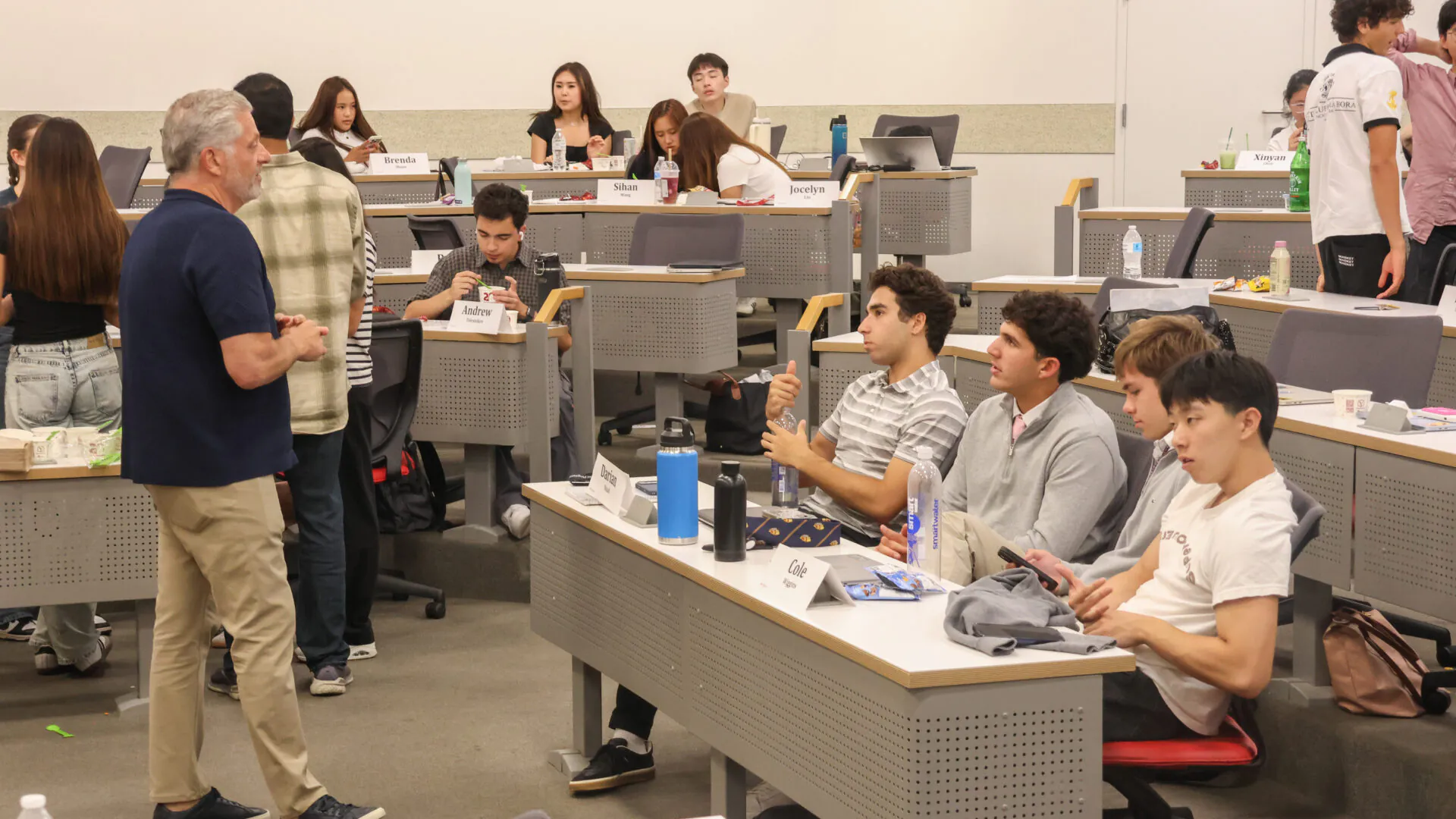
The final pitch rests on four weeks of real groundwork, from talking with industry leaders to hearing from founders of fast-growing companies and from venture capital, and the work is graded and recorded on a USC transcript.
What it asks of you
Four full weeks with no late arrivals or early departures, full days of class and what USC calls a significant amount of work outside the classroom, including research out in the marketplace. USC says the course suits self-motivated, independent and resilient students, and you'll need your own laptop.
Who should skip it
Students whose families would need financial aid, because USC doesn't offer any for its summer programs, so even the commuter option means paying the full $8,371 yourselves.
Class runs from 9 a.m. to 3:30 p.m. each day, with breaks for lunch or field trips around Los Angeles, and USC says each course involves five to six hours of instruction a day. Residential students move in on 21 June 2027, everyone attends a mandatory orientation on the morning of 22 June, and the course ends on 16 July.
Week 1: Ideation and innovation
Value propositions, design, creativity and invention.
Week 2: Finding product-market fit
Lean startup methods, effectuation and customer discovery, with a field trip and guest speakers who founded fast-growing companies.
Week 3: Financing and go-to-market strategy
Financial analysis, customer acquisition, customer lifetime value and marketing basics, with a field trip and speakers from venture capital.
Week 4: Pitching and growing your venture
Public speaking and a leadership philosophy for young founders, ending in the final pitch competition, for which you dress in professional clothes.
Afternoons after class are free for studying in the campus libraries or going to the gym, while evenings bring activities run by residential advisors, such as game nights and movies on the lawn. Weekends add day trips to beaches, theme parks and sports events, which are required for residential students and optional for commuters. The four weeks build toward the pitch like this:
You need to have finished ninth grade by the start of the program and be taking a rigorous high school curriculum, and both U.S. and international high school students can apply. USC doesn't publish an acceptance rate but says it looks for students who've challenged themselves with honors or Advanced Placement (AP) courses and extracurriculars, and who have a dedicated interest in their chosen field.
Decisions are made on a rolling basis and classes fill quickly. You can list up to three courses but will be enrolled in only one, so if Exploring Entrepreneurship is full, a qualified applicant goes into their second or third choice. If this is the only course you want, you can list it in all three slots. International applicants also have to show English proficiency in one of these ways:
Domestic students pay $11,946 to live on campus or $8,371 to commute, and international students pay $12,602 plus U.S. government visa fees, which you'll need to check with the official source. Commuting is only open to students whose primary residence is in Los Angeles County or Orange County, and international students and domestic students living abroad have to live on campus.
The residential price covers a shared room in a residence hall, three dining-hall meals a day, field trips, course materials and social activities. The international total adds a $370 I-20 administration fee and $286 of required health insurance to the residential price. Domestic students who don't send proof of their own health insurance by the deadline are billed for USC's policy too.
You pay the $85 application fee when you apply. If you're accepted, a nonrefundable $1,000 deposit holds your seat and counts toward the total, and the balance is due by 28 May 2027 by bank transfer or wire. USC doesn't take credit or debit cards or offer payment plans, and anyone who hasn't paid in full by then is dropped.
USC refunds tuition, though not fees or the deposit, if you cancel in writing before 25 June 2027, and after that there's no refund at all. Commuters buy their own meals and parking, and spending money on trips is extra for everyone.
| Item | Residential | Commuter |
|---|---|---|
| Tuition | $7,617 | $7,617 |
| Course materials and academic field trips | $300 | $300 |
| Program fee (social activities and recreational trips) | $350 | $350 |
| Room and board | $3,575 | Not included |
| Health center | $104 | $104 |
| Total for domestic students | $11,946 | $8,371 |
Finishing the course earns three units of USC elective credit, and you request the official transcript showing your grade from the USC Registrar. Other colleges can accept those units, but each one decides for itself, so USC suggests keeping a copy of the syllabus. You also leave with a business you've developed through the course assignments and pitched in the final competition.
USC is clear that taking part doesn't guarantee admission to USC or any of its schools, though it says you may be able to get letters of recommendation from USC faculty and staff. Withdrawing between 26 June and 12 July 2027 puts a W on your transcript without affecting your GPA, while leaving later gets you whatever grade your instructor assigns.
Residential advisors, including the director of USC Summer Programs, live in the residence halls with students and are available at all times, while USC's Department of Public Safety patrols campus around the clock and residence and dining halls need a student ID card to enter. Residential students must be in their hall by 10 p.m. every night, with lights out at 11:30 p.m., and breaking that rule means leaving the program.
A nurse works in the residence halls from 8 a.m. to 5 p.m. daily, the Student Health Center sees students during office hours, and a 24-hour wellness line covers nights. Residential students can't leave the program's campus boundary without approval or keep a car on campus. They can only stay away overnight on a Friday or Saturday, and only with an approved absence request that a parent has signed. Parents can read USC's Protecting Minors Policy for the full safeguarding rules.
Everything happens in the USC Summer Programs application portal, and USC won't review your application until every task is complete.
Create an account with your legal name and an email address you check often, and list up to three course choices.
Write the 300- to 500-word essay yourself from the prompts in the portal, since USC can reject applications prepared with paid help.
Ask a teacher, counselor or mentor to fill in the online recommendation form.
Have a school administrator upload your high school transcript as a PDF, with the request sent to their professional school email.
Pay the $85 application fee and submit by 12 p.m. Pacific on 12 March 2027 if you're an international applicant or 7 May 2027 if you're domestic.
If you're accepted, pay the $1,000 deposit to hold your seat and the balance by 28 May 2027.

Sean
Talk it through with Sean
“I can help you compare the programs you're considering, think through the practicalities and work out what makes sense for you.”
Ages 14 to 17, in person, from $8,599, applications due 27 January 2027.
27 Jan 2027 · From $8,599 · 14-17 · In-person
Ages 15 to 18, in person in Los Angeles, from $9,300.
Deadline: Not announced yet · From $9,300 · 15-18 · Los Angeles · In-person
Ages 15 to 18, in person in Oxford, from £6,995.
Deadline: Not announced yet · From £6,995 · 15-18 · Oxford · In-person
Save this program in Succeed to compare it with similar programs, dates, costs and formats in one place.
Compare with other programsprecollege.usc.edu · Official page
precollege.usc.edu
precollege.usc.edu
precollege.usc.edu
precollege.usc.edu
precollege.usc.edu
precollege.usc.edu
precollege.usc.edu
Facts checked against the official page on 11 Nov 2026
Editor: Sean Stevens
Succeed has no commercial relationship with USC Pre-College.
Spot an error? Report it