
Reality Bites: Understanding the Complexity of Failure in Addressing Wicked Problems
Applications open
Two weeks in person, 10 to 24 July 2027, ages 16 to 18, from $5,200.
17 Feb 2027 · From $5,200 · 16-18 · In-person
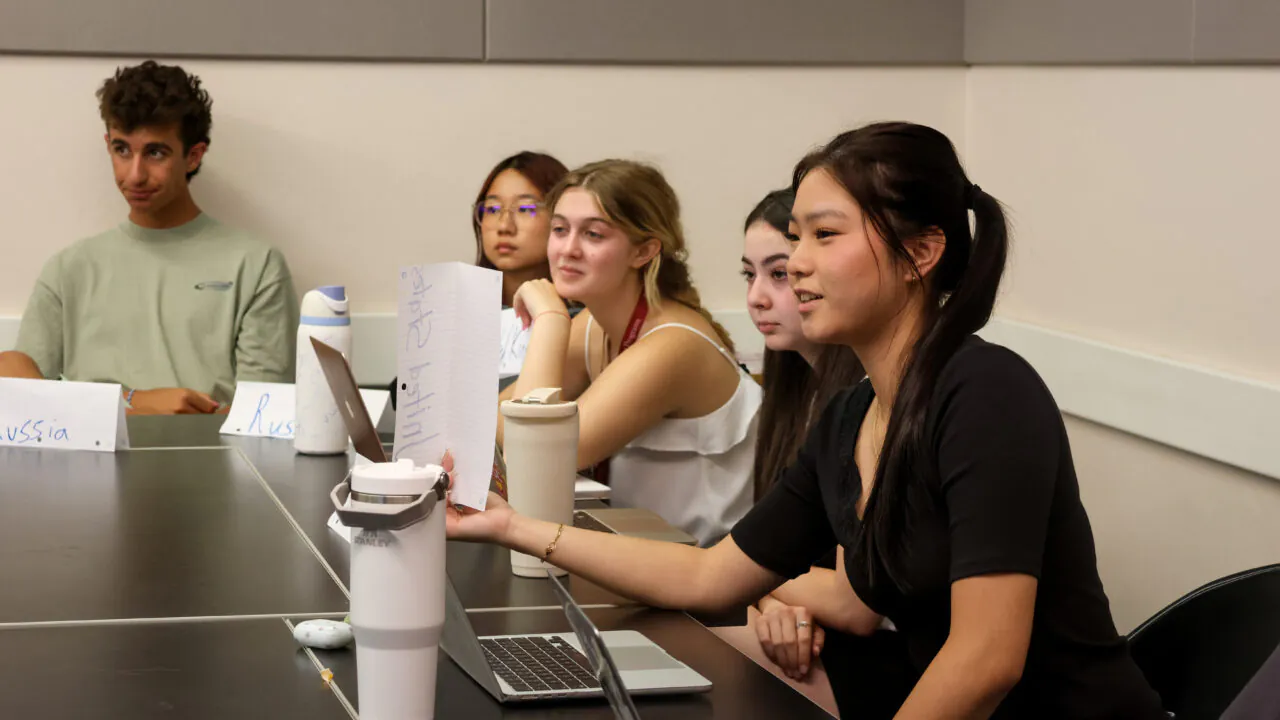
International Relations is a four-week, in-person USC course on the Los Angeles campus. You study the main theories of international relations and the causes of war, then use them in UN Security Council simulations, negotiation exercises and an individual case study on resolving a conflict. Field trips include the Museum of Tolerance, and you live in a residence hall unless your family lives in Los Angeles or Orange County and you commute. Passing the course earns three units of USC elective credit.
Get the key facts by email
The dates, costs and how to apply, then 2 reminders: 23 Apr (2 weeks before) and 4 May (3 days before).
Why it's worth it
You get a real USC course with a grade and three units of elective credit, and the material moves from theory to live issues like China-U.S. relations, Kashmir and nuclear arms control. That suits a student who's weighing diplomacy, law or human rights as a career.
What it asks of you
It takes four weeks, from 21 June to 16 July 2027, with five to six hours of class a day, a paper and a final exam. USC doesn't allow late arrival or early departure.
Who should skip it
Students who'd need help paying, because USC offers no financial aid, won't waive the application fee and doesn't allow payment plans. Unless your family lives in Los Angeles or Orange County, you'll also be paying for room and board on top of tuition.
Class runs from 9 a.m. to 3:30 p.m. each day, with a lunch break or a field trip in between, which USC counts as five to six hours of instruction. Free afternoons go to campus libraries or the gym. Evenings bring activities run by residential advisors, such as game nights and movies on the lawn, and weekends include day trips to beaches, theme parks and sports events.
Week 1
The main theories of international relations, the cultural causes of conflict and the causes of genocide, with a field trip to the Museum of Tolerance and presentations on pop culture and politics.
Week 2
The UN and other international actors, with a UN Security Council simulation based on a real case, a game on environmental protection and a simulation on truth commissions.
Week 3
Pandemics, the status of women and climate change, including a Security Council simulation built around a fictional zombie outbreak and a joint climate simulation with the Global Health class.
Week 4
China-U.S. relations, the rise of India, the Israeli-Palestinian conflict and nuclear weapons, with simulations on Kashmir and arms control, paper presentations and a final exam.
The course moves from theory to current conflicts week by week, and participants have also visited the USC Wrigley Institute for Environmental Studies.
You need to have finished at least ninth grade by the start of the program, and USC expects you to be taking a rigorous high school course load. Both US and international students can apply. USC publishes no acceptance rate, but says it looks for students who've challenged themselves with honors or Advanced Placement (AP) classes and extracurriculars and who have a real interest in their chosen field. Decisions are made on a rolling basis and USC says classes fill quickly. If International Relations is full, a qualified applicant is placed in their second or third choice instead.
International applicants, including those already at a US high school, also have to show English proficiency in one of these ways: 650 on SAT Evidence-Based Reading and Writing (or 600 on the old SAT Critical Reading), 27 on ACT English, a TOEFL iBT score of 100 with at least 20 per section on the older scale or a band of 5 with at least 4 per section on the newer one, IELTS 7, PTE 68, Duolingo 120, or an English proficiency waiver.
Passing the course earns three units of USC elective credit with a grade. You request the official transcript from the USC Office of Academic Records and Registrar, because the summer office doesn't hold it. Other colleges decide for themselves whether to accept the units, so USC suggests keeping a copy of the syllabus. You also finish with an individual case study and a research paper you present in the final week. One past student, Lucy Wei, used hers to examine how ballet shapes international influence. USC also presents the course as a chance to earn a college recommendation letter from its faculty and staff.
The grade counts. Withdraw between 26 June and 12 July 2027 and your transcript shows a W, which doesn't affect your GPA, while leaving from 13 July means a grade set by your instructor. Attending doesn't guarantee admission to USC or any of its schools.
For US students, a residential place costs $11,946 and a commuter place costs $8,371, which is the same course without room and board. Room and board covers a shared residence hall room, three dining hall meals a day and meals on academic field trips, while the program fee pays for social activities and weekend trips. You can commute only if you live with a parent in Los Angeles or Orange County, and commuters pay for their own lunches and any parking permit.
International students have to live on campus and pay $12,602, which adds a $370 I-20 administration fee and $286 for required USC health insurance. US visa and SEVIS fees come on top, so check those with the US government. US students who don't send proof of their own health insurance by USC's deadline are billed for USC's student insurance as well.
Before any of that, there's an $85 application fee that can't be waived or refunded. Once you're admitted, you pay a $1,000 nonrefundable deposit, which counts toward the total. You can pay the balance from 1 May 2027, and it's due by 28 May 2027. It has to go by transfer from a US bank account or by wire, since USC doesn't take cards or offer payment plans. Anyone not paid in full by then is dropped. If you cancel in writing before 25 June 2027, USC refunds the tuition you've paid but keeps the deposit and fees, and after that date nothing is refunded. Nothing is refunded either if a student is dismissed or can't enter the US because they have the wrong visa.
| Fee | Residential | Commuter |
|---|---|---|
| Tuition | $7,617 | $7,617 |
| Course materials and academic field trips | $300 | $300 |
| Program fee | $350 | $350 |
| Room and board | $3,575 | Not included |
| Health center | $104 | $104 |
| Total | $11,946 | $8,371 |
Residential advisors, including the program director, live in the halls and are available at all times. USC's Department of Public Safety patrols campus around the clock, and you need your student ID card to get into residence and dining halls. Residents must be back in their hall by 10 p.m. every night and in their room with lights out at 11:30 p.m. Breaking curfew means being sent home. USC's Protecting Minors policy covers staff screening and supervision.
Health care
A full-time nurse works in the residence halls from 8 a.m. to 5 p.m. every day, an advisor takes students to the Student Health Center when needed, and a 24-hour wellness hotline handles after-hours concerns, including calls from parents.
Staying in bounds
Residents can't leave the program's campus boundary without approval and can't use public transportation or services like Uber, Lyft or Waymo. Overnight stays away are allowed only on Friday or Saturday, with a parent-signed request sent 72 hours ahead.
Rooms and cars
Rooms are shared and assigned by gender, roommate requests aren't accepted, and residents may not drive or keep a car on campus.
Staff ratios
USC's university-wide policy requires background checks and youth protection training for staff and at least one staff member for every 10 residential participants aged 15 to 18.
Everything goes through USC's Summer Programs application portal, where you register with your legal name and an email address you check often.
Create an account and list up to three course choices, and you can put International Relations in all three slots if it's the only course you want.
Write a 300- to 500-word essay on one of the portal's prompts yourself, because USC can reject applications prepared with paid help or written with others.
Send the recommendation request to a teacher, counselor or mentor who can speak to your academic record, maturity and integrity.
Ask a school administrator to upload your transcript as a PDF, sending the request to their professional school email address.
Pay the $85 fee and submit everything by noon Pacific Time on 12 March 2027 if you're international or 7 May 2027 if you're a US applicant. USC won't review an application until every part is in, and nothing can be added after the deadline.
If USC admits you by email, pay the $1,000 deposit. International students then have until 29 March 2027 to submit their immigration documents, such as the passport and proof of funds USC needs to issue the I-20 for an F-1 student visa, and anyone who misses that date is dropped.

Sean
Talk it through with Sean
“I can help you compare the programs you're considering, think through the practicalities and work out what makes sense for you.”
Two weeks in person, 10 to 24 July 2027, ages 16 to 18, from $5,200.
17 Feb 2027 · From $5,200 · 16-18 · In-person
Leadership and politics, in person, ages 14 to 18, from $9,299.
Deadline: Not announced yet · From $9,299 · 14-18 · In-person
International relations and politics in Oxford, ages 15 to 18, from £7,995.
Deadline: Not announced yet · From £7,995 · 15-18 · Oxford · In-person
Save this program in Succeed to compare it with similar programs, dates, costs and formats in one place.
Compare with other programsprecollege.usc.edu · Official page
precollege.usc.edu
precollege.usc.edu
precollege.usc.edu
precollege.usc.edu
precollege.usc.edu
precollege.usc.edu
precollege.usc.edu
Facts checked against the official page on 11 Nov 2026
Editor: Ben Stacy
Succeed has no commercial relationship with USC Pre-College.
Spot an error? Report it