Essentials of Finance
Applications open
In-person finance program for ages 14 to 17, fees from $8,599.
27 Jan 2027 · From $8,599 · 14-17 · In-person
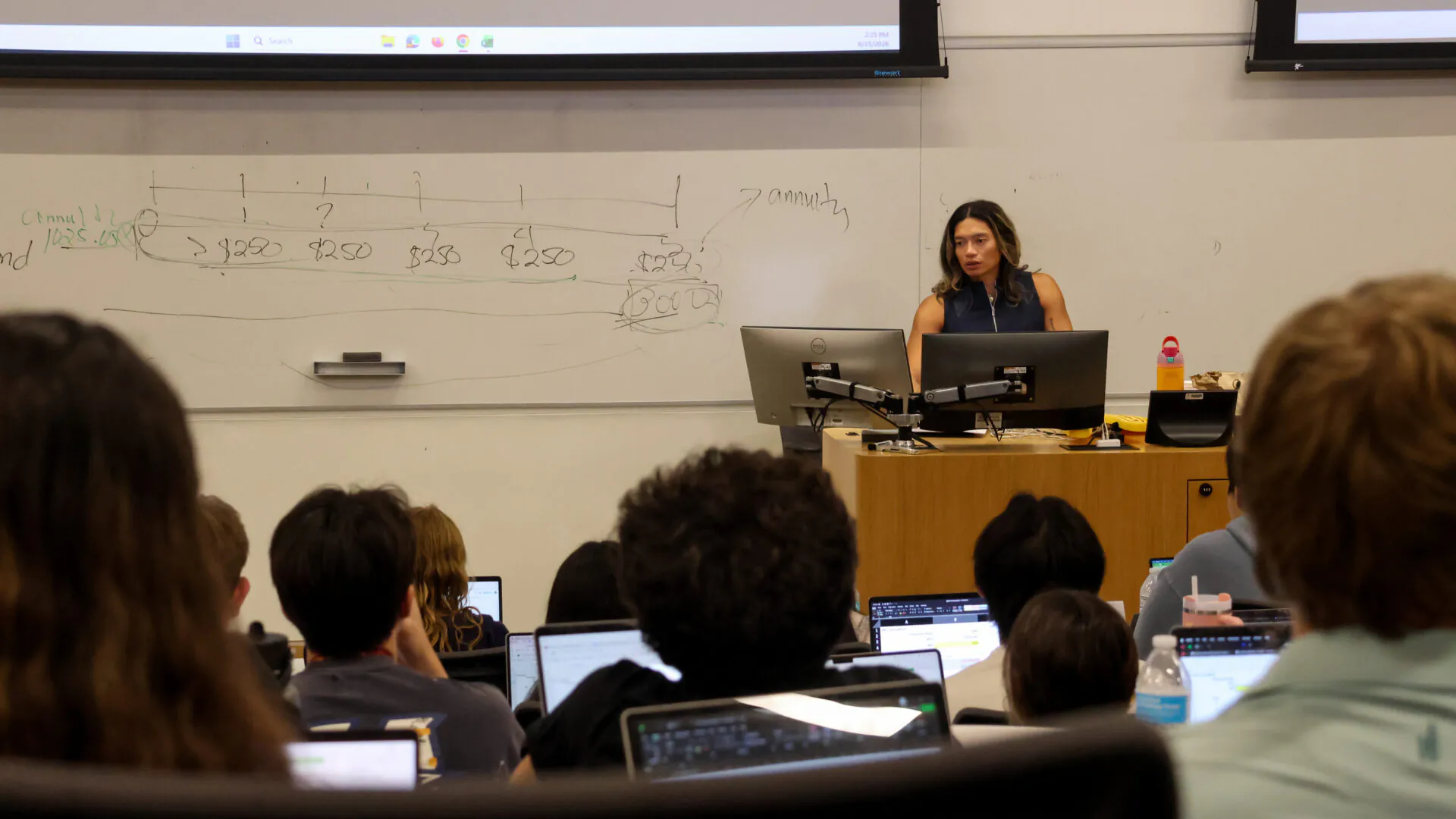
Introduction to Business is a four-week, full-day course on USC's Los Angeles campus that takes high school students through accounting and finance, marketing, product design, data analytics, strategy and business ethics. USC faculty and industry guests bring in real examples from sports and entertainment, and the course ends with a Capstone Case Competition where your team analyzes a real company and pitches its solutions. Students who finish earn three units of USC elective credit.
 Sean Stevens · Sources
Get the key facts by email
The dates, costs and how to apply, then 2 reminders: 23 Apr (2 weeks before) and 4 May (3 days before).
Why it's worth it
You take a graded university course that leaves real credit on a USC transcript, and it's built around working industry contacts, with past panels featuring ESPN and NFL staff, before your team pitches its analysis of a real company.
What it asks of you
Four full weeks in Los Angeles, because USC allows no late arrival or early departure, and a five-figure bill with no financial aid or payment plan. You'll also need your own laptop and business attire for the final pitch.
Who should skip it
Students who mainly want finance, because accounting and finance share the course with marketing, product design, analytics, strategy and ethics. Essentials of Finance, run by Wharton Global Youth Program, is an in-person option with fees from $8,599.
Class runs from 9 a.m. to 3:30 p.m., with a lunch break from noon to 1:30 p.m., and USC counts five to six hours of instruction a day. Some days break for field trips around Los Angeles, and past groups in this course have visited SoFi Stadium and heard a panel of ESPN and NFL staff on the business of sports and entertainment. Phones have to be off and out of sight in class.
The first class day, 22 June 2027, opens with a mandatory orientation in Bovard Auditorium before class starts at 11 a.m. After class, afternoons are free for studying in the campus libraries or heading to the gym. Evenings bring activities run by residential advisors, such as game nights and movies on the lawn, and weekends bring day trips to beaches, theme parks and sports events.
You need to have finished at least ninth grade by the start of the program and be taking a rigorous high school course load. USC doesn't publish an acceptance rate, but says it looks for students who have challenged themselves with honors or Advanced Placement (AP) classes and extracurriculars, and who have a real interest in the subject. Admission is rolling and USC warns that classes fill quickly.
You can list up to three courses but will be placed in only one, so if Introduction to Business is full you may land in your second or third choice. International applicants also need to show English proficiency in one of the ways below, and most will need an F-1 student visa.
For students living in the U.S., a residential place costs $11,946 and commuting costs $8,371, though commuting is only open to families whose home is in Los Angeles County or Orange County. International students have to live on campus and pay $12,602 to USC, which adds a $370 I-20 fee and $286 of required health insurance, plus U.S. visa and SEVIS fees paid to the government, which are worth checking with the official sources.
Room and board covers a shared room, three meals a day in the dining hall and meals on field trips, while commuters buy their own lunch and any parking permit. On top of the total there's an $85 application fee that is never refunded, and domestic students who don't send proof of personal health insurance by USC's deadline are enrolled in and billed for USC's student health insurance too. Spending money on trips is yours to cover.
Once you're admitted, a $1,000 deposit holds your seat and counts toward the total, but it isn't refundable. The balance is due by 28 May 2027 by U.S. bank transfer or wire, since USC takes no cards and offers no payment plans, and anyone unpaid by then is dropped. There's no financial aid. Cancel in writing before 25 June 2027 and you get your tuition back, but not the deposit or other fees, and withdrawing after that brings no refund.
| Item | Residential | Commuter |
|---|---|---|
| Tuition | $7,617 | $7,617 |
| Course materials and academic field trips | $300 | $300 |
| Program fee (social activities and recreational trips) | $350 | $350 |
| Room and board | $3,575 | Not included |
| Student health center | $104 | $104 |
| Total for domestic students | $11,946 | $8,371 |
Residential advisors, including the director of USC Summer Programs, live in the residence halls with students and are available at all times. Residential students must be back in their hall by 10 p.m. every night, weekends included, with lights out at 11:30 p.m., and anyone who breaks curfew without written parent consent has to leave the program. USC's Protecting Minors Policy applies, and parents can report concerns at any time, anonymously if they prefer.
Health care
A nurse works in the residence halls from 8 a.m. to 5 p.m. every day, a 24-hour USC Student Health hotline covers after-hours questions, and an advisor walks students to the health center when they need care.
Campus security
USC's Department of Public Safety patrols around the clock, and residence and dining halls open only with a USCard student ID.
Boundaries and absences
Students stay inside a mapped campus boundary, and any absence needs a form approved by a parent and USC staff. Students on an approved absence can't use public transit or rideshares such as Uber, Lyft or Waymo.
Finishing the course earns three units of USC elective credit, and your grade goes on an official transcript that you request from the USC Registrar. Other colleges can accept the units, but that's their decision, so USC suggests keeping a copy of your syllabus. You also leave with the capstone analysis and pitch your team built on a real company.
USC is clear that the course doesn't guarantee admission to USC, which has its own undergraduate application. It does say you may be able to earn letters of recommendation from USC faculty and staff. Withdrawing between 26 June and 12 July 2027 leaves a W on your transcript, and after that your instructor gives you a grade.
Everything goes through USC's summer programs application portal, and USC won't review an application until every task is in.
Create an account using your legal name and an email address you check often, because every decision and update comes by email.
Rank up to three courses with Introduction to Business first, or choose it for all three if it's the only one you want.
Write a 300- to 500-word essay on one of the portal's prompts yourself, since USC can reject applications prepared with paid help or collaboration.
Ask a teacher, counselor or mentor to fill in the online recommendation, and send the transcript request to a school administrator's professional email.
Pay the $85 application fee, which can't be waived, and submit by 12 p.m. Pacific time on 7 May 2027, or 12 March 2027 if you're an international applicant.
If you're admitted, pay the $1,000 deposit to hold your seat, then the balance between 1 May and 28 May 2027.

Sean
Talk it through with Sean
“I can help you compare the programs you're considering, think through the practicalities and work out what makes sense for you.”
In-person finance program for ages 14 to 17, fees from $8,599.
27 Jan 2027 · From $8,599 · 14-17 · In-person
In-person business and finance program in Oxford, ages 14 to 18, from $6,695.
Deadline: Not announced yet · From $6,695 · 14-18 · Oxford · In-person
In-person economics and finance summer school for ages 16 to 18, from £5,995.
Deadline: Not announced yet · From £5,995 · 16-18 · Cambridge · In-person
Save this program in Succeed to compare it with similar programs, dates, costs and formats in one place.
Compare with other programsprecollege.usc.edu · Official page
precollege.usc.edu
precollege.usc.edu
precollege.usc.edu
precollege.usc.edu
precollege.usc.edu
precollege.usc.edu
precollege.usc.edu
Facts checked against the official page on 11 Nov 2026
Editor: Sean Stevens
Succeed has no commercial relationship with USC Pre-College.
Spot an error? Report it