
In person in Toronto, ages 15 to 18, from $6,625.
Deadline: Not announced yet · From $6,625 · 15-18 · Toronto · In-person
May qualify for the £300 Succeed Program Award.
Academic Insights Biology is a two-week summer course that Immerse Education runs for 16- to 18-year-olds in Oxford and Cambridge colleges. You work through cells, genetics, evolution, respiration and infectious disease in small classes, with one-to-one tutorials and a lab visit along the way. Across the fortnight you prepare a personal project and present it to your class on the final day. Most students live in college, but you can also attend as a commuter.
Why it's worth it
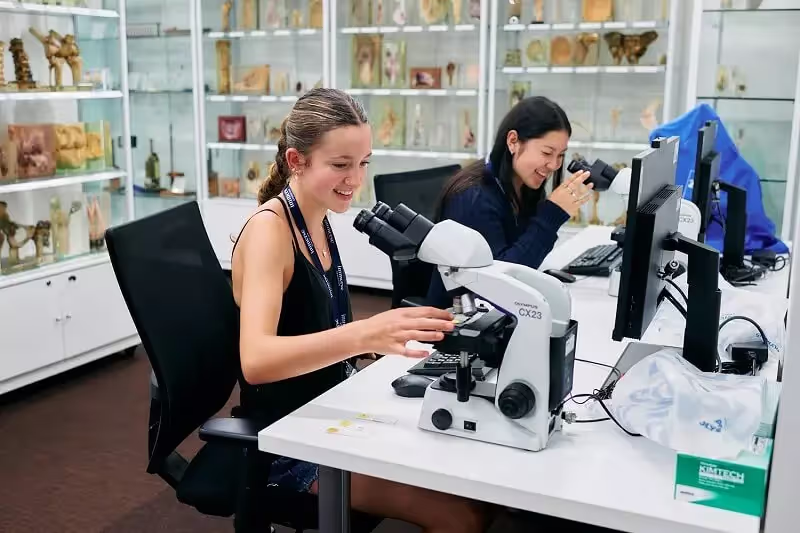
What you're paying for is attention more than a famous address. You get small classes led by working biology researchers, regular one-to-one tutorials and a report from your tutor written about you in particular.
What it asks of you
The residential fee is £7,495 before flights, which makes this a serious family decision. In the fortnight itself you'll have about 40 hours of teaching, your tutor may send reading to finish before you arrive, and you'll need to bring your own laptop.
Who should skip it
Students who want to design and run an experiment of their own, because the Biology syllabus is built around classroom sessions plus one lab visit, and the Personal Project is a presentation drawn from what you've learned in class.
Check the cancellation terms
Immerse keeps the deposit if you cancel, and changing or deferring a booking normally costs you the course fees or at least a £495 deferral fee, so settle your summer plans before you book.
Any student aged 16 to 18 who meets Immerse's requirements can book, and you don't need any prior study of biology. Immerse doesn't pick applicants. Places go first come, first served on a rolling basis, and once a session fills you may be able to join a waiting list.
The requirement most likely to matter is English. Immerse asks for at least B2 (upper-intermediate) on the Common European Framework of Reference for Languages (CEFR), because all teaching and discussion is in English. Tutors do support students who speak English as a second language and explain biological terms as they go. If you have educational, physical or emotional support needs, Immerse asks you to mention them when you enroll so it can check what it can arrange.
You'll be taught by biology researchers. The tutors Immerse names include Filip, a PhD candidate at the Mitochondrial Biology Unit at the University of Cambridge, Hannah, a DPhil candidate in Medical Science at Oxford's John Radcliffe Department of Medicine, and Iris, a postdoctoral fellow researching neurobiology at the MRC Laboratory of Molecular Biology in Cambridge. Classes average seven students and are capped at ten, and you get one-to-one tutorials on top.
The syllabus starts with what counts as life, the molecules of life and cell structure. It then moves through DNA and RNA, genome sequencing in what Immerse calls the -Omics Era, cell respiration and Darwinian evolution to infectious disease and antibiotic resistance, with a session on whether there's life elsewhere in the universe. Immerse describes these modules as indicative, so tutors add their own specialisms and follow the class's interests. A planned lab visit gives you the chance to ask researchers about university study and careers in biomedical science. Outside class, undergraduate mentors look after small groups of students.
Expect a little over three hours of class on a typical weekday, based on Immerse's 2026 sample timetables for Oxford and Cambridge, which may change for 2027. After breakfast, an academic session runs from 9:30 to 11:15. Lunch follows, then two shorter sessions run until 3pm, with a one-to-one tutorial taking the place of one of them on some days.
From 3:30 to 5:30 there's an organized activity, such as a city walking tour, a masterclass, sports or time with your tutor on your project. Dinner is at 6, and evenings from 7:30 to 9 bring guest speakers, quiz nights, a talent show and punting. The first Saturday is a full-day trip to London. The final Friday is for project presentations, graduation and a formal dinner, and you check out by 10am the next morning. Commuters attend from 9am to 5pm and miss dinner and the evening program.
Two weeks cost £7,495 if you live in college or £5,995 if you commute, and the prices are the same in Oxford and Cambridge. The residential fee covers 13 nights in a college with Wi-Fi and laundry, breakfast and dinner, about 40 hours of teaching including one-to-one tuition, course materials, the activity and excursion program, graduation and your tutor's written report. Commuters get the same teaching and project support. Immerse doesn't say consistently whether commuters join the weekend excursions, so ask before you choose that option.
Lunch isn't included for the 16 to 18 group, who buy it near their college or classrooms. Travel to Oxford or Cambridge, airport transfers (an extra fee), spending money and travel insurance, which Immerse strongly advises, are also yours to pay. If you need a visa, check that cost with the official source. Optional add-ons such as the UCAS points qualification and a guaranteed en-suite room cost extra.
Immerse's need-based bursary can cover up to 100% of tuition, but only for students who are eligible to live and study in the UK and attend a non-fee-paying school or receive financial aid at a fee-paying one. Immerse says only a small percentage of applicants succeed. Its annual essay competition also offers full or partial scholarships.
You leave with an Immerse certificate, presented at graduation, and a written evaluation from your tutor, sent after the course. It covers your strengths, areas to explore further and recommended reading, and it often includes feedback on your project presentation. That report is the most useful thing you take away, because it's about your work specifically and gives you concrete material to draw on when you write about biology later.
UCAS points, the tariff UK universities use to compare qualifications, are an optional add-on you choose when you apply. Immerse says the qualification is worth 8 UCAS points and is open to students aged 14 and over, and it offers a US version worth up to 3 college credits. Immerse also quotes up to 16 UCAS points, so confirm the figure before you pay. Immerse states that its programs don't award university credit or university-issued certificates, and how much weight any university gives these points is up to that university. A recommendation letter comes only with the paid Signature package and depends on your attendance and effort.
Immerse's resident summer team and on-site staff supervise each site around the clock, and every staff member passes an Enhanced DBS check (the UK's criminal record check) and completes safeguarding training. Each site has a College Manager responsible for welfare, whose phone number parents get before the course starts. Mentors live in the accommodation alongside students, and boys and girls are housed separately.
Free time is spent in small groups within set boundaries, and residential students can't sign out in the evening. Staff are trained in first aid and deal with minor illness on site, while more serious cases go to the nearest hospital or doctor. Parents can tour the accommodation on arrival day but must leave before the evening Welcome Talk, and they can't stay on site. Immerse is a member of AEGIS (the Association for the Education and Guardianship of International Students), and you can request its safeguarding policy from student.services@immerse.education.

Sean
Talk it through with Sean
“I can help you compare the programs you're considering, think through the practicalities and work out what makes sense for you.”
In person in Toronto, ages 15 to 18, from $6,625.
Deadline: Not announced yet · From $6,625 · 15-18 · Toronto · In-person
In person in Los Angeles, ages 15 to 18, from $8,130.
Deadline: Not announced yet · From $8,130 · 15-18 · Los Angeles · In-person
In person in Oxford, ages 15 to 17, from £3,980.
Deadline: Not announced yet · From £3,980 · 15-17 · Oxford · In-person
Save this program in Succeed to compare it with similar programs, dates, costs and formats in one place.
Compare with other programsimmerse.education · Official page
cdn.prod.website-files.com
my.immerse.education
immerse.education
immerse.education
immerse.education
cdn.prod.website-files.com
immerse.education