
Build a Robot! Mechatronics and Electromechanical Design
Applications open
Two-week robot build in Evanston, ages 15 to 18, from $3,625.
01 Apr 2027 · From $3,625 · 15-18 · Evanston · In-person
This two-week residential summer course from Immerse Education runs in Cambridge, Oxford, London, Singapore, Sydney and Toronto, with classes split by age from 13 to 18. Morning and afternoon classes cover university-style topics such as robotics and path planning, numerical simulation, a rocket model built in MATLAB, fluid mechanics, control systems and machine learning, and you also get one-to-one tutorials. At the end you present a personal project to your tutor and classmates, and your tutor writes you an individual evaluation.
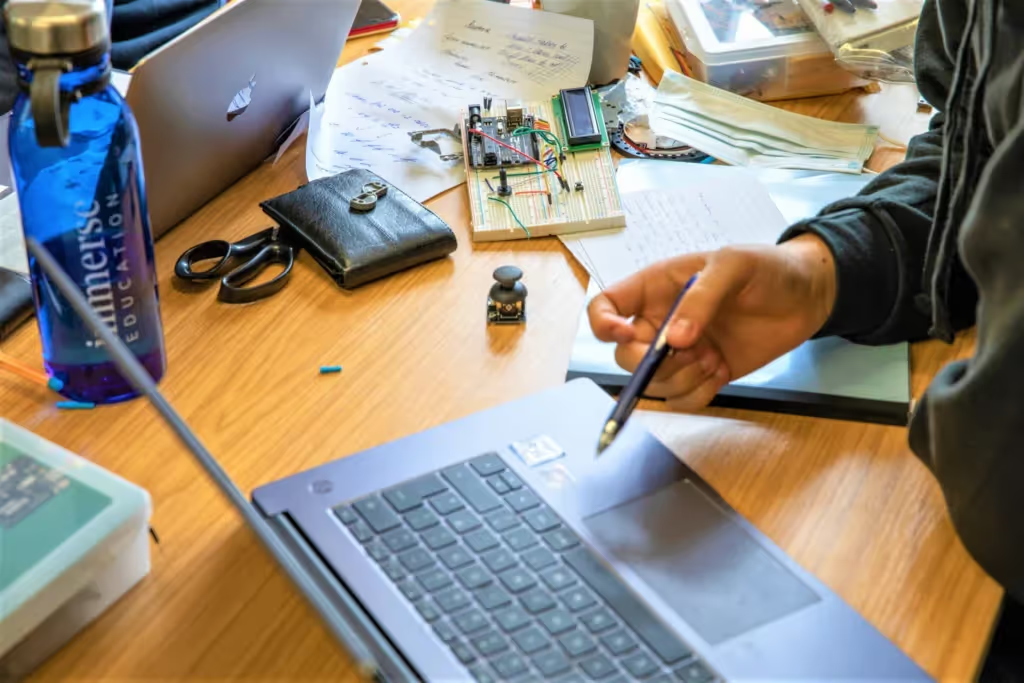
Why it's worth it
The 2027 sample syllabus reads like a real first look at engineering. You model a rocket's flight in MATLAB, plan robot paths with graph search and work through control systems and fluid mechanics, with a one-to-one tutorial each week. Because classes are capped at 10, you'll be doing the thinking out loud.
What it asks of you
You spend two weeks living away from home in one of six cities and get yourself there, and you'll need a laptop and English at B2 level. Immerse says no engineering background is needed, but the first day goes back over vectors, matrices and calculus, so you'll get far more out of it if you're comfortable with school math.
Who should skip it
Students drawn mainly by the Oxford or Cambridge name. You live and study in their colleges, but the teaching, the certificate and the report all come from Immerse, which says it isn't affiliated with any university and awards no university-issued credit.
In the 2027 sample syllabus, each weekday has a morning class and an afternoon class, each on its own topic. Week one moves from linear algebra and equations of motion to robotics, path planning and a rocket simulation in MATLAB. Week two covers dimensional analysis, fluid mechanics, control systems, microchip design, machine learning and sustainable design. Each week also includes a one-to-one tutorial, a masterclass (creativity first, then critical thinking) and a session of personal project supervision.
Outside class you have excursions, social events and a guest speaker evening, although the sample doesn't show the full evening and weekend program. On the final Friday you present your project, then there's the graduation ceremony and a formal dinner, and you check out by 10:00 the next morning. Residential students can't sign out in the evening. Where Immerse offers commuter places, those students attend from 9AM to 5PM and miss evening activities, dinner and weekend trips.
Classes average seven students and are capped at 10, and on top of class time you get one-to-one tutorials with your tutor. The example tutor on the 2027 engineering syllabus is Dr Muhammad Z. He holds a PhD from the University of Cambridge, researches semiconductor layers for next-generation solar cells and teaches physics and engineering at Cambridge through college supervisions. Immerse also names Dr Robail, a postdoctoral researcher in biomedical image analysis at the University of Oxford, and Pramit, a DPhil (PhD) student in Oxford's Department of Engineering Science.
Immerse describes these as example and past tutors, so the tutor for your session may be someone else.
Any student aged 13 to 18 can apply, but your age decides your campus, because Immerse teaches separate age groups and sets the content and pace for each. Ages 13 to 15 study in Cambridge or Oxford, ages 16 to 18 in Cambridge, Oxford or Singapore, and ages 15 to 18 in London, Sydney or Toronto.
You don't need any previous engineering. All teaching is in English, and Immerse asks for at least B2 (upper-intermediate) on the Common European Framework of Reference for Languages. There's no selective application. Places go first come, first served, with a waiting list once a course fills, and Immerse confirms your place by email within 48 hours.
You leave with three things: a certificate from Immerse presented at graduation, a personal engineering project you've presented to your tutor and classmates, and a written evaluation from your tutor covering your progress, what to work on next and suggested reading. Immerse pitches the project and evaluation as material for university applications. It also states that its programs don't award university credits or university-issued certificates.
Students aged 14 and over can pay extra for an accredited qualification. Immerse says it is worth 8 UCAS points (UCAS runs UK university admissions) or up to 3 US college credits, and it requires B2 English. How much weight it carries is up to each university you apply to.
Every staff member passes an enhanced DBS check (the UK criminal record check), or the local equivalent abroad, and completes safeguarding training. A resident team supervises each site around the clock, and mentors from the pastoral team live in the same accommodation as students. Each site has a College Manager responsible for welfare, and parents get that manager's number before the course starts.
Rooms
Girls and boys are housed separately at every campus. In Sydney, students share twin en-suite rooms in a hotel with 24/7 reception.
Free time
Students go out only in small groups, stay within set boundaries and sign out, and residential students can't sign out in the evening.
Medical care
All staff are first-aid trained and deal with minor problems on site. Serious cases go to the nearest hospital or doctor, and parents are contacted as soon as practicable.
Arrival
Parents can join the accommodation tours on arrival day but must leave before the evening Welcome Talk, and shared airport transfers are chaperoned by Immerse staff.
Two-week robot build in Evanston, ages 15 to 18, from $3,625.
01 Apr 2027 · From $3,625 · 15-18 · Evanston · In-person
Two weeks in Parma with Dallara Academy access, ages 15 to 18, from €5,500.
Deadline: Not announced yet · From €5,500 · 15-18 · Parma · In-person
Project-based engineering introduction in Cambridge, ages 14 to 18, from $3,298.
21 Feb 2027 · From $3,298 · 14-18 · Cambridge · In-person
Save this program in Succeed to compare it with similar programs, dates, costs and formats in one place.
Compare with other programsimmerse.education · Official page
cdn.prod.website-files.com
immerse.education
immerse.education
immerse.education
immerse.education
immerse.education
immerse.education