
Creative writing at Wake Forest in Winston-Salem, ages 14 to 18, from $3,500.
Deadline: Not announced yet · From $3,500 · 14-18 · Winston-Salem · In-person
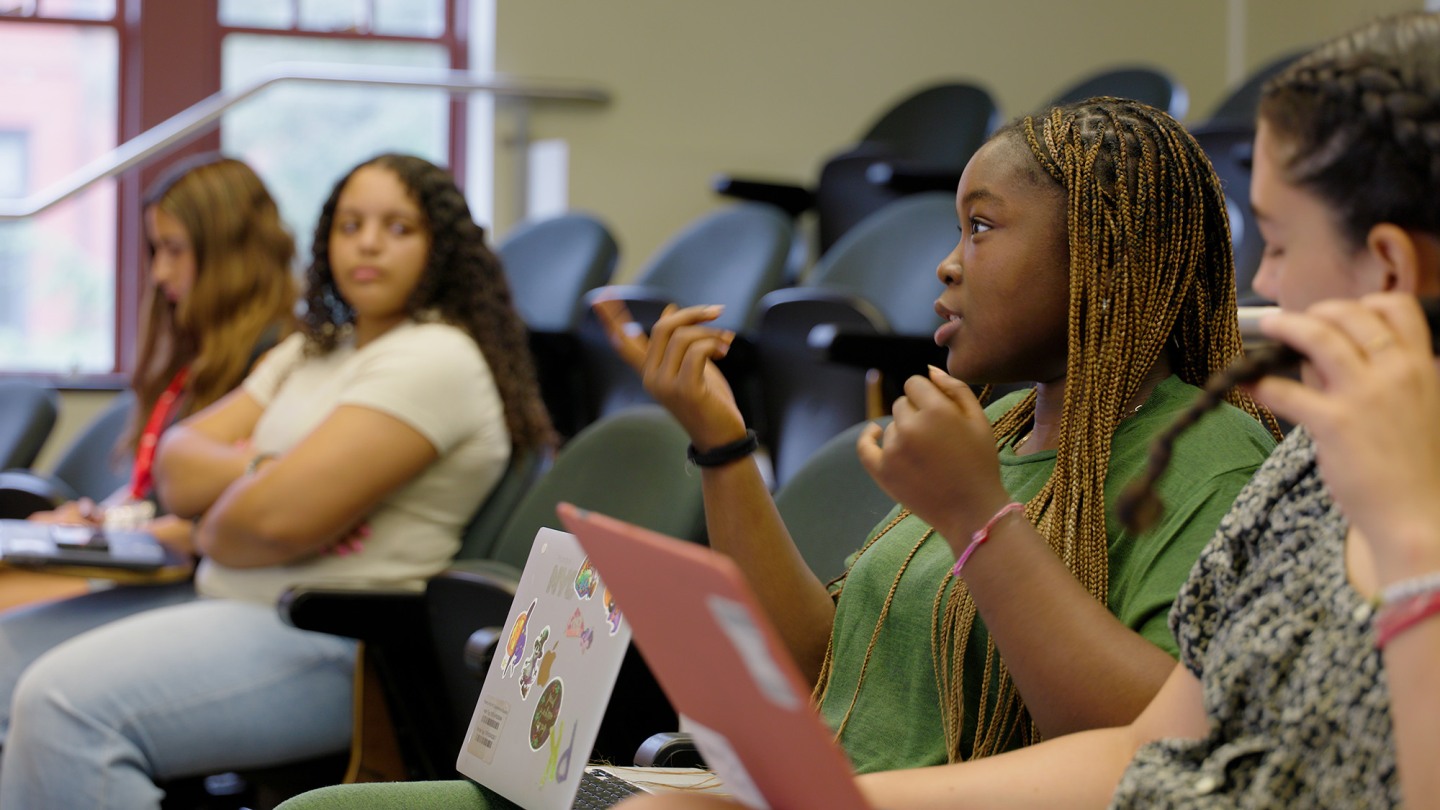
Writing for College Admissions is a one-week, on-campus course in Brown University's Summer@Brown program in Providence. You analyze essay prompts from real applications and admissions essays that worked, then draft a personal statement, workshop it with classmates, get your instructor's feedback and revise it into a polished second draft. Class meets for about three hours each weekday, and you do two to three hours of work outside class each day.
Get the key facts by email
The dates, costs and how to apply, all in one place.
Why it's worth it
You get a concrete result rather than general writing tips: a draft your classmates have workshopped and your instructor has commented on, revised into a second version. While you're enrolled you can also book free sessions with Brown's Writing Center, which helps with college application essays.
What it asks of you
Expect five to six hours a day of class and homework for a week in Providence, at $3,748 with housing or $3,096 commuting in 2026, before the $80 application fee and travel. Attendance is compulsory, so it won't fit around another commitment that week.
Who should skip it
Students who want to grow as writers more broadly, since the course spends its whole week on admissions essays. Writing for Life Institute (run by Wake Forest University), in person with fees from $3,500, is one to compare.
In 2026 the course ran as two one-week sections taught by Choa Choi, each meeting for just under three hours every weekday: an afternoon section from 3:30 to 6:20 p.m. (6 to 10 July) and a morning section from 8:30 to 11:20 a.m. (13 to 17 July). In class you analyzed prompts from real applications and essays that had worked, tried out several possible angles for your own essay, and then drafted it, workshopped it with classmates and revised it after your instructor's comments.
Brown expected two to three hours of work outside class each day and left it to you to decide when to do it. The rest of the day was free for no-cost workshops, including ones on the college application process, as well as social events and outings to places like local beaches. You checked in on the Sunday between 9 a.m. and 1 p.m., and residents had to check out by 9 p.m. on Friday. That was tight for the afternoon section, whose last class ended at 6:20 p.m., although Brown let students ask to stay until 9 a.m. on Saturday if their class schedule or a long journey home made it necessary.
You leave with a polished second draft of a personal statement you could use in your applications, plus several possible angles for other essays and a process for writing them. If you complete the course, Brown sends a digital CeCertificate of Completion in the early fall.
That's the whole record. The course carries no credit and no grade and produces no transcript. Because it lasts one week, it also doesn't come with the instructor's Course Performance Report, which Brown gives only for in-person courses of 10 days or more. Missing class can cost you the certificate.
The course has no prerequisites, so the real bar was admission to Brown Pre-College. In 2026 that meant completing grades 9 to 12 and being 14 to 18 by 14 June 2026. Brown reviewed each application as a whole, looking at academic performance, motivation, interests and English proficiency, and it says plainly that not everyone is admitted. An essay that turns out not to be your own work is grounds for denial.
Essay
A 250- to 500-word response to one of two prompts, about a school subject you can't get enough of or a time you tried something new.
Grades
All your grades from the current and previous school year, in English. An unofficial transcript, report card or screenshot from a school portal showing your full name was fine.
Recommendation
Optional, but Brown strongly suggested one if you'd be under 15 on 14 June 2026 or had any grade of C or below.
English scores
International students whose first language isn't English sent TOEFL iBT or Duolingo English Test results, and Brown says successful applicants generally scored at least 130 on Duolingo or 5.5 on a TOEFL iBT taken from January 2026.
In 2026 a week cost $3,748 if you lived on campus and $3,096 if you commuted. The residential price covered your room, three meals a day and the fitness and pool facilities. Commuters got one meal a day, the same gym access and free local bus travel with a Brown ID. Brown's own breakdown puts the course itself at $2,940 of either total.
On top of that came the $80 application fee, travel to Providence and any required books. International students and U.S. students without health insurance also paid $80 for Brown's limited accident insurance, and paying the balance by card added a 2.95% service fee on U.S. cards or 4.25% on international ones.
Deposit and refunds
The $500 deposit you paid to enroll was refunded only if Brown canceled the course and you withdrew rather than switching to another one. If you withdrew in writing at least a week before your first class, you got back everything else you'd paid apart from the application fee and any card service fee. From then until the day after the first class the refund was 70%, and after that there was none.
Scholarships
Need-based Sibley Scholarships went to U.S. citizens, permanent residents and certain other U.S. residents, first come, first served, until funds ran out, and admitted Providence Public School District students who completed its scholarship form on time got a full scholarship. Brown offered no scholarships to international students for summer 2026 and gives no merit awards.
Residential students lived in Brown residence halls alongside trained Student Life staff, including college-age Resident Assistants, and had to check in face to face every night at 10 p.m. and stay on their floor until 6 a.m. If a student wasn't accounted for at curfew, staff called the parents and then Brown's public safety department. On-call staff were available around the clock, and Brown Health Services saw students on weekdays, with a 24-hour nursing line and emergencies generally taken to Hasbro Children's Hospital in Providence.
Outside class and curfew, students had real freedom. They could travel anywhere in Rhode Island without a parent's permission, while leaving the state needed a parent's form 24 hours ahead. Brown provides no transportation to or from campus, so students should plan to arrive and leave without help. Rooms were singles, doubles or triples with roommates usually within a year of age, and Brown's policy handbook sets out the full rules.

Sean
Talk it through with Sean
“I can help you compare the programs you're considering, think through the practicalities and work out what makes sense for you.”
Creative writing at Wake Forest in Winston-Salem, ages 14 to 18, from $3,500.
Deadline: Not announced yet · From $3,500 · 14-18 · Winston-Salem · In-person
Business writing in Evanston, ages 15 to 18, from $3,625, apply by 1 April 2027.
01 Apr 2027 · From $3,625 · 15-18 · Evanston · In-person
English communication and confidence course in Cambridge, ages 14 to 17, from £3,495.
Deadline: Not announced yet · From £3,495 · 14-17 · Cambridge · In-person
Save this program in Succeed to compare it with similar programs, dates, costs and formats in one place.
Compare with other programscatalog.precollege.brown.edu · Official page
precollege.brown.edu
precollege.brown.edu
precollege.brown.edu
precollege.brown.edu
precollege.brown.edu
precollege.brown.edu
Facts checked against the official page on 10 Nov 2026
Editor: Ben Stacy
Succeed has no commercial relationship with Brown Pre-College Programs.
Spot an error? Report it