
Biology
Deadline: Not announced yet
From £7,000
15-18
Cambridge
In-person
by Penn Arts and Sciences High School Programs
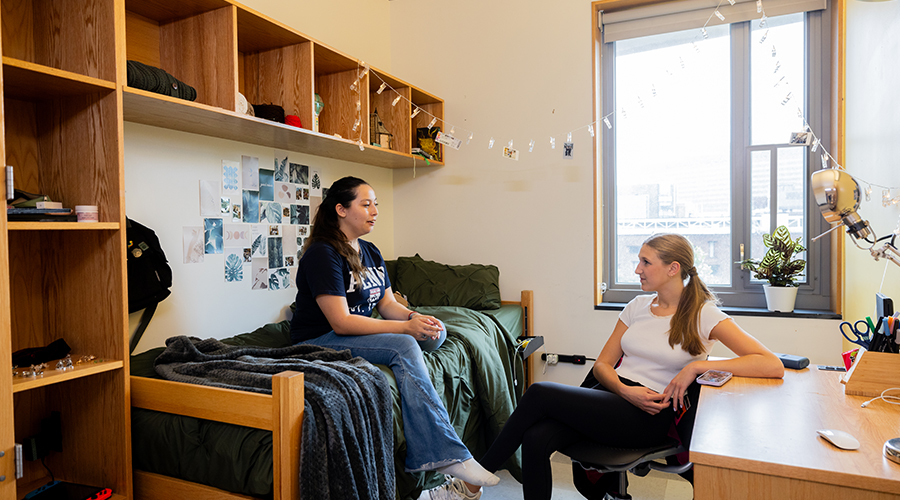
The Pre-College Residential Program lets 10th and 11th graders spend the summer living in University of Pennsylvania residence halls while taking regular undergraduate courses for credit alongside Penn students. You choose one of four course loads, from a single course up to a lab science plus a second course, and you're graded to the same standards as Penn undergraduates. Outside class, residential staff run evening activities and Saturday trips.
 Sean Stevens · Sources
Get the key facts by email
The dates, costs and how to apply, all in one place.
Succeed's assessment
In short
Why it's worth it
These aren't watered-down college classes. You sit in the same summer courses as Penn undergraduates, taught by Penn faculty, staff and visiting scholars and graded to the same standards, so your grade says something real about how ready you are.
What it asks of you
It takes about five and a half weeks on campus, with homework, papers and exams on an undergraduate schedule. Penn doesn't allow residential students to hold a job, do an internship or research, or attend another summer program at the same time, so you can't fit anything else into those weeks.
Who should skip it
Families who'd need help with the bill. Penn offers no scholarships or financial aid for the Pre-College Programs, although you can pay from a 529 college savings plan, and Penn suggests looking for outside funding from educational agencies or scholarship groups.
They're regular Penn undergraduate courses taught by Penn faculty, staff and visiting scholars, and you sit in them alongside Penn's own students. Most meet two to five times a week, Monday to Friday, and set homework, research papers, midterms or finals, and some require textbooks you buy yourself. The 2026 list included Introduction to Biology A, General Physics, Introduction to Micro Economics, World Film History, Medicine in History, Introduction to Philosophy, Introduction to Experimental Psychology and Law and Society.
Once you're admitted, you pick one of the four course loads below. One course unit (c.u.) usually converts to a four-semester-hour course, and international students who need a visa must take at least 1.5 c.u.
Getting the course you want isn't guaranteed. You apply to the program rather than to a course, you can only register after paying the deposit, and courses fill first-come, first-served with no waitlist, which is why Penn makes you choose alternates. You can take a course pass/fail, but you can't audit one.
1 c.u
One college course.
1.5 c.u
Biology 101 or Physics 101 with lab.
2 c.u
Two college courses.
2.5 c.u
Biology or Physics with lab, plus a second course.
Your class hours depend on the courses you take. In 2026, for example, one section of Introduction to Biology A met every weekday from 1:45 to 3:30 p.m. Penn says that outside class, students generally study or work on assignments when they aren't at planned activities, and they can use the residence hall, lounges, dining halls and libraries.
Most evenings have something planned, such as trivia or arts and crafts nights, and ESF Pre-College, which runs residential life for Penn, also lists bowling, dances, talent shows and sports. Saturdays bring trips to places such as New York City, Washington, DC or the Jersey Shore, while Sundays are kept for relaxing and exploring Philadelphia. Meals come through a campus meal plan, and students 15 and older can use the gym.
Penn looks for 10th and 11th graders with at least a 3.5 GPA, writing that shows both technical skill and intellectual depth, strong recommendations and a range of extracurricular interests. Graduating seniors can't apply. Admission is rolling until the program fills, with complete applications reviewed in the order they arrive and decisions taking up to six weeks, and Penn strongly recommends applying early to improve your chances before the program reaches capacity.
The student has to submit the application, not a parent, counselor or agent, and nothing can be added after submission unless the admissions committee asks. For 2026, the application asked for the following.
Essays
Two answers of up to 400 words each, on why you want this program and how two of your extracurricular activities have helped you grow, plus a third on your English background if you're not a native speaker.
Transcript
Your full transcript from the previous school year (2024-2025 for the 2026 cycle), official or unofficial, in English or with an official translation.
One recommendation
From an adult who knows your work, written on their organization's letterhead and naming this program.
English scores, if needed
At least 7 on the IELTS, 130 on the Duolingo English Test or 100 on the older 0 to 120 TOEFL iBT scale. TOEFL iBT now reports scores on a 1 to 6 scale, and Penn says competitive applicants tend to score 5 or above. You may get a waiver if you'll have attended an English-medium school for two years by the time you enroll.
Optional test scores
SAT, PSAT or ACT scores aren't required, but Penn strongly encourages them for this program.
International students
You'll need an F-1 student visa, and Penn suggests applying by February to leave time for it.
For summer 2026 the price depended on your course load: $15,192 for one course, $17,996 for Biology or Physics with lab, $20,800 for two courses and $23,604 for a lab science plus a second course. Penn says its fees can change without notice.
That price covers your room, the meal plan, linens, gym access, activities and trips, supervision and use of Penn's academic facilities. You pay separately for travel, textbooks and class materials, meals off campus, laundry supplies, medical costs and spending money, and official transcripts carry a fee too. The $100 application fee is nonrefundable, although Philadelphia residents at a School District of Philadelphia public or charter high school can have it waived. ESF Pre-College charges $75 each way for an airport pickup or drop-off. Students with a permanent address outside the U.S. also pay ESF a nonrefundable $175 international registration fee, which covers a medical policy and a visa support letter.
A $1,500 nonrefundable deposit holds your place and counts toward the total. Bills typically arrive at the beginning of May and are due by June, and Penn adds a 1.5% penalty on any amount paid late. If you withdraw in writing by 15 May, everything except the deposit is refunded, but nothing is adjusted if you arrive late or leave early.
| Course units (2026) | Program fee | Tuition | General fee | Total |
|---|---|---|---|---|
| 1 | $9,100 | $5,608 | $484 | $15,192 |
| 1.5 | $9,100 | $8,412 | $484 | $17,996 |
| 2 | $9,100 | $11,216 | $484 | $20,800 |
| 2.5 | $9,100 | $14,020 | $484 | $23,604 |
You leave with a University of Pennsylvania transcript for the courses you complete. You can view it through Path@Penn, while official copies come from Penn's Registrar for a fee.
Whether that credit counts toward a degree later is up to the college you eventually attend, and Penn says the same applies to Penn itself. So treat the credit as proof of what you can do rather than a guaranteed head start on your degree.
Penn hands residential life to ESF Pre-College, which hires and supervises the residential staff and lists a staffing ratio of 1:10. The ESF rules are strict. Students leave campus only with staff or an adult aged 18 or over whom parents have authorized, they walk around campus in groups of three or more and sign out and back in through the residential director's office, and the residence halls are separated by gender, by building or by floor. There's a curfew and quiet hours, every student needs a working phone with a U.S. data plan, and some free time may be unsupervised.
After-hours emergency or urgent care is at The Children's Hospital of Philadelphia nearby. Families must submit health, immunization and insurance forms after acceptance, and ESF can remove a student without a refund if those forms are incomplete. Students must be at least 13 to live in the residence halls and are expected to stay from the first day to the last.

Sean
Founder, Succeed
Talk it through with Sean
“I can help you compare the programs you're considering, think through the practicalities and work out what makes sense for you.”
20 minutes · No obligation to enroll
Save this program in Succeed to compare it with similar programs, dates, costs and formats in one place.
Compare with other programshs.sas.upenn.edu · Official page
esfprecollege.com
esfprecollege.com
hs.sas.upenn.edu
hs.sas.upenn.edu
hs.sas.upenn.edu
hs.sas.upenn.edu
hs.sas.upenn.edu
Not ready to decide yet? Keep it for later.