Online AI course, ages 14 to 18, from $4,200, multiple sessions.
Deadline: Not announced yet · From $4,200 · 14-18 · Online · Online
by Stanford Pre-Collegiate Studies
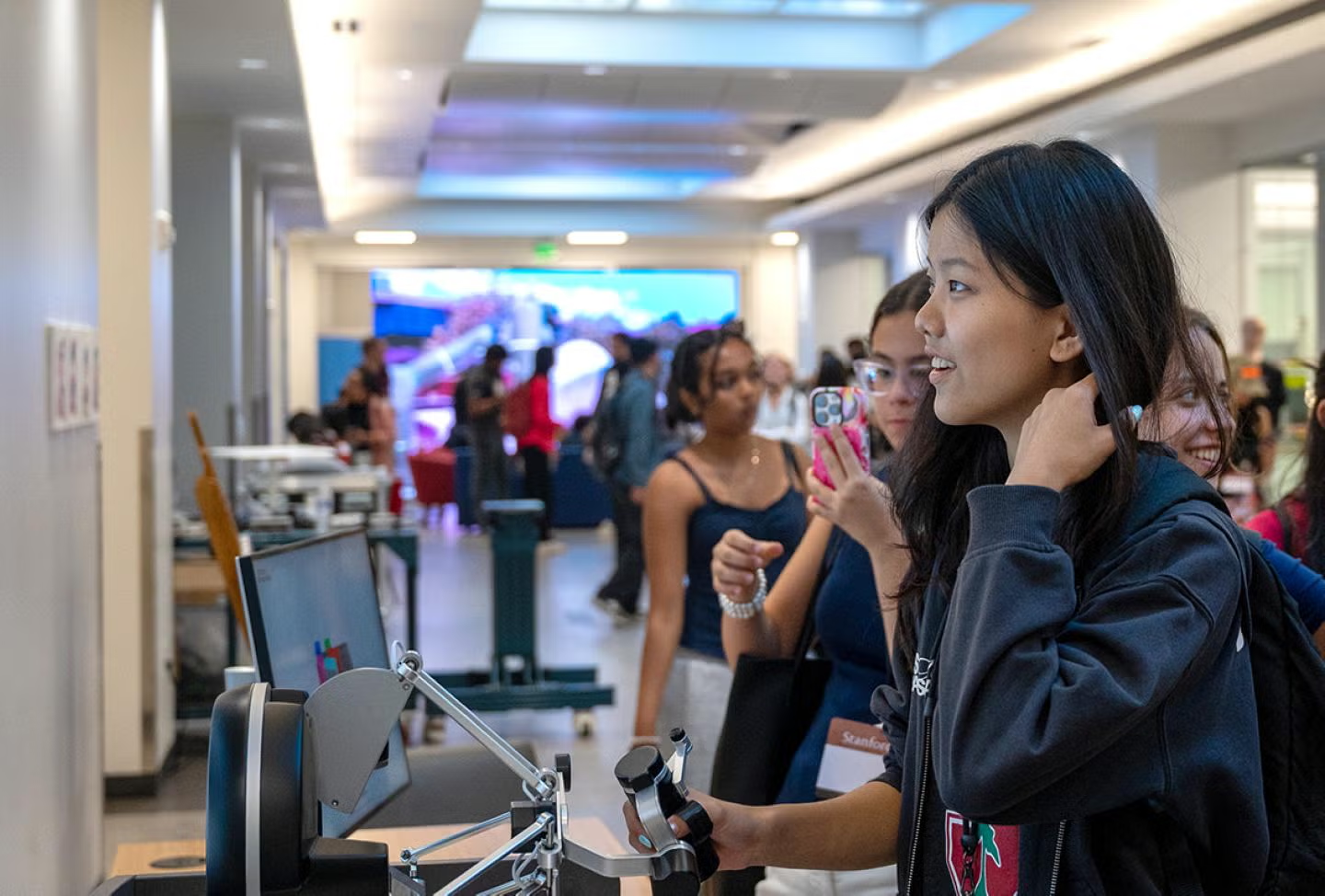
Stanford AI4ALL is a two-week summer program for ninth graders, run by Stanford Pre-Collegiate Studies and the Stanford Institute for Human-Centered Artificial Intelligence, that you can take online or while living on Stanford's campus. Each student joins one of four research groups, Computer Vision, Medical AI, Natural Language Processing or Robotics, and works on a team project about using AI for social good. Faculty lectures, live demos with AI companies and career workshops fill out the two weeks, which end with a final presentation.
 Sean Stevens · Sources
Get the key facts by email
The dates, costs and how to apply, then 2 reminders: 18 Jan (2 weeks before) and 29 Jan (3 days before).
Why it's worth it
It takes ninth graders with no AI or programming background and gives them two weeks of team research led by graduate students and postdocs, plus lectures from Stanford faculty, which is a lot of access for a student that young.
What it asks of you
Both formats expect you at every session, and online students also have daily homework on top of their live classes. The residential option costs $9,800 against $4,120 online, more than twice as much before flights and insurance, although that price covers housing, meals and weekend field trips. Choosing between the formats comes down largely to whether two weeks on campus is worth the difference.
Who should skip it
Students who want academic credit or a transcript grade, because Stanford Pre-Collegiate Studies runs its summer courses for enrichment only and sends a certificate of completion and a written instructor evaluation instead.
Your research group is led by graduate students and postdocs in computer science and AI, while the lectures come from Stanford faculty in computer science, AI and related fields. Juan Carlos Niebles, an adjunct professor of computer science, is one of the named instructors. Stanford Pre-Collegiate Studies runs the program with the Stanford Institute for Human-Centered Artificial Intelligence and works with the Stanford AI Lab and industry professionals, and the two weeks also include live demos with AI companies, guest speaker panels and career workshops.
The research centers on how AI affects society and how it can help with big problems. Past groups have built a machine learning pipeline that uses satellite images to identify poverty-stricken regions in Uganda, a robotic system that sorts objects by what it sees, and a natural language processing (NLP) system that classifies communications during disasters.
Computer Vision
How machines interpret images and video, with uses from facial recognition to reading satellite imagery.
Medical AI
How to build AI systems that analyze biomedical images and help clinicians.
Natural Language Processing
How computers read and process text and speech, including language models, text classification and checking how well a model performs.
Robotics
Building AI-powered robots that sense their surroundings and make decisions.
Online classes are live, Monday to Friday from 9am to 1pm Pacific Time, inside a program day that runs until 2:30pm PT. You have to attend with your camera and microphone on and join in the discussion, so this isn't a course you can catch up on later. Each class sets assignments for the next day, which Stanford Pre-Collegiate Studies expects to take two to three hours a weekday, rising to as much as four hours as the final presentation approaches.
Every session is scheduled on Pacific Time, so if you live elsewhere it's worth checking what those hours mean for you before you apply. You'll need a computer that runs current browsers (a phone isn't recommended), a reliable broadband connection, ideally wired, a webcam, headphones with a microphone and a quiet space where you're comfortable on camera.
Residential weekdays run from breakfast at 8am to lights out at 11pm, with about six hours of lectures, project work and faculty talks between 9am and 4:30pm. The first week leans on guest lectures and the second on the final project. Late afternoons and evenings mix free time with staff-run activities such as sand volleyball, karaoke and trivia nights, a firepit night or a trip to downtown Palo Alto, and every day ends with a house meeting.
| Time (PT) | Activity |
|---|---|
| 8:00am to 9:00am | Breakfast |
| 9:00am to 12:00pm | Program-wide or project-group lecture |
| 12:00pm to 1:30pm | Lunch |
| 1:30pm to 3:00pm | Project-group lecture |
| 3:00pm to 4:30pm | Faculty talk or demonstration |
| 4:30pm to 6:00pm | Free time, study time or co-curricular activities |
| 6:00pm to 7:00pm | Dinner |
| 7:00pm to 9:00pm | Free time or co-curricular activities |
| 9:00pm to 10:00pm | House meeting |
| 10:45pm | Room checks |
| 11:00pm | Lights out |
Weekends have no classes but aren't entirely your own, because the planned field trip to a San Francisco Bay Area attraction and other weekend activities are required for everyone.
Residential students live in Stanford undergraduate halls alongside trained residential staff, who are generally undergraduates and double as academic mentors. Everyone in the residential program has to live on campus, so commuting isn't an option.
Leaving the residence
After the first few days, students may walk the main campus only with a buddy during checkout hours, and must be back by the time staff set or before dark, whichever comes first.
Parent visits
A parent can check a student out for up to three hours between 5pm and 8pm PT when it doesn't clash with program activities, with a request at least 48 hours ahead that staff must approve.
Getting there
Staff meet students at San Francisco International Airport (SFO) baggage claim on arrival day and run buses back on departure day, but early arrivals and late departures can't be accommodated.
Medical care
If staff can't treat an illness or injury on campus, they take the student to Palo Alto Medical Foundation urgent care or the Stanford Health Care pediatric emergency room and contact parents. US-based medical insurance is required without exception, along with proof of MMR vaccination and tuberculosis (TB) clearance.
Rooms
Rooms are assigned by gender on all-gender floors, gender-inclusive options are available, and the halls have no air conditioning.
You need to be in ninth grade when you submit the application, and you don't need any AI or programming experience. There are age limits too: you must be at least 13 by the start of the online session or 14 by the start of the residential one, and under 16 during either session.
You fill in the online form yourself, and a parent or guardian reviews and signs it before it's submitted. Alongside it you'll need unofficial transcripts from every school or program that graded you from fall 2025 through fall 2026, a recommendation from a math or science teacher and the application fee. Your application isn't reviewed until the recommendation arrives, and keeping track of it is your job rather than the office's.
You also rank the four research groups, and Stanford Pre-Collegiate Studies places each admitted student in one of them based on preferences and readiness. It won't move you after admission, so rank them honestly. Every complete application gets a holistic review in a single admissions round, and decisions come out in mid-April 2027 and can't be appealed.
The online program costs $4,120 and the residential program costs $9,800, with a $65 application fee on top of either that can be waived if you qualify. Residential tuition covers a room in a supervised Stanford residence with linens and towels, meals in a Stanford dining hall, course supplies, weekend field trips with transport and admission, and the airport shuttle on arrival and departure days. It doesn't cover flights, the US medical insurance every residential student needs, a laptop or spending money. Students from outside the US should also apply for a B-2 tourist visa, so check its cost and waiting times with the US embassy. Online students supply their own computer and may need to buy course readers or textbooks.
Tuition has to be paid in full, since Stanford Pre-Collegiate Studies offers no installment plan. Application fees and program deposits aren't refunded, except that the deposit comes back when an admitted student who applied for aid isn't awarded enough to attend, and there's no refund for leaving early or for withdrawing after the refund deadline. Stanford Pre-Collegiate Studies doesn't give the deposit amount or the refund deadline in its published material, so ask before you commit.
Stanford Pre-Collegiate Studies offers limited need-based aid, partial or full, to US and international applicants, and applying doesn't affect the admissions decision. You apply through the Ravenna Parents' Financial Statement by 8 February 2027, with a $60 fee that can also be waived, and the tax and income documents are due by 15 February 2027.

Sean
Talk it through with Sean
“I can help you compare the programs you're considering, think through the practicalities and work out what makes sense for you.”
Online AI course, ages 14 to 18, from $4,200, multiple sessions.
Deadline: Not announced yet · From $4,200 · 14-18 · Online · Online
In person in Winston-Salem, ages 14 to 18, from $3,500.
Deadline: Not announced yet · From $3,500 · 14-18 · Winston-Salem · In-person
In person in Cambridge, ages 13 to 18, from £5,995.
Deadline: Not announced yet · From £5,995 · 13-18 · Cambridge · In-person
Save this program in Succeed to compare it with similar programs, dates, costs and formats in one place.
Compare with other programsspcs.stanford.edu · Official page
ai4all.spcs.stanford.edu
ai4all.spcs.stanford.edu
ai4all.spcs.stanford.edu
ai4all.spcs.stanford.edu
ai4all.spcs.stanford.edu
ai4all.spcs.stanford.edu
ai4all.spcs.stanford.edu
Facts checked against the official page on 11 Nov 2026
Editor: Sean Stevens
Succeed has no commercial relationship with Stanford Pre-Collegiate Studies.
Spot an error? Report it