Fundamentals of Engineering High School Course
Applications open
In person in Berkeley, ages 14 to 18, from $2,498, several sessions.
21 Feb 2027 · From $2,498 · 14-18 · Berkeley · In-person
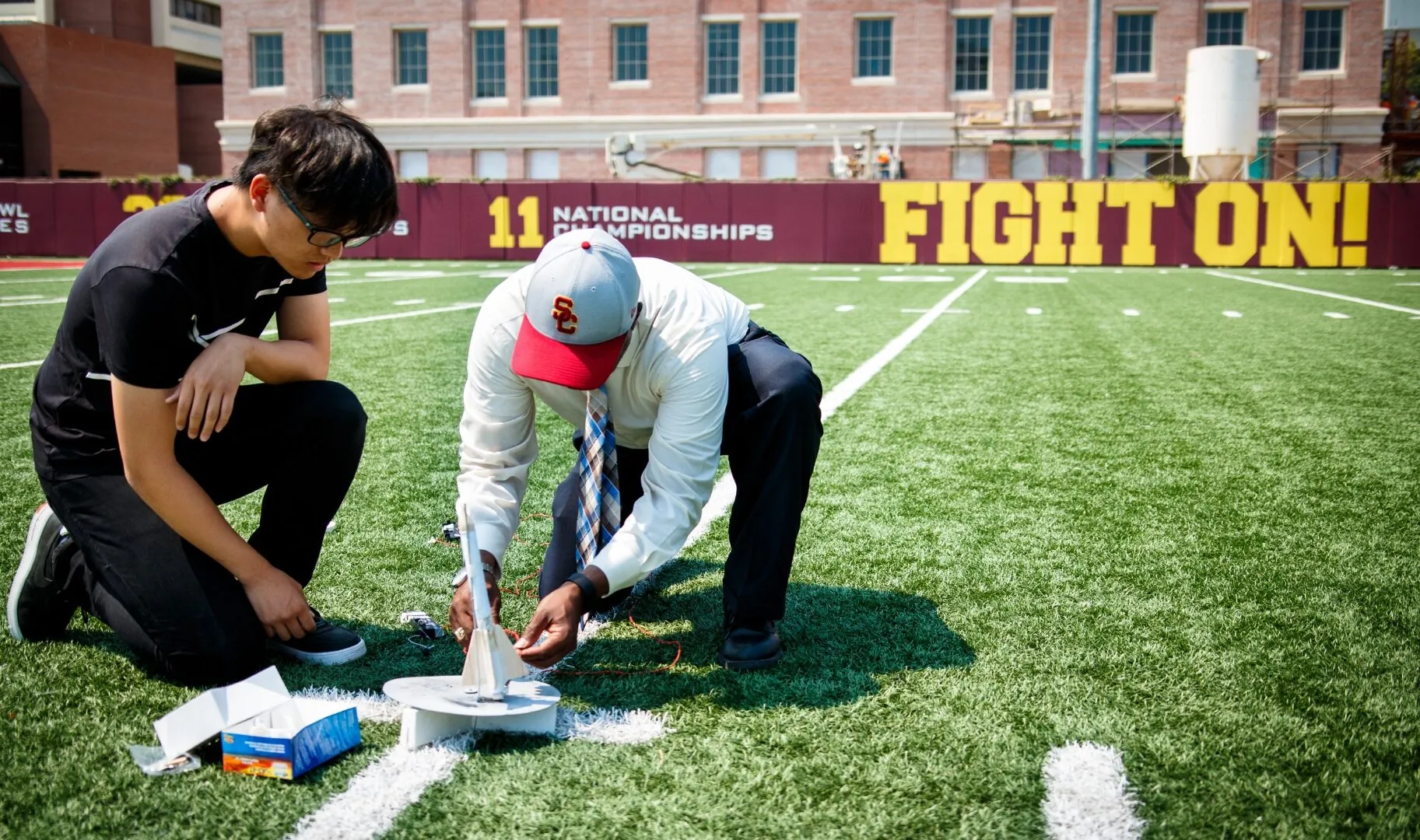
Discover Engineering is a four-week USC course in Los Angeles. Each week you take on a different branch of engineering, building windmills and bridges, a working digital circuit, rockets, drones and AI robots, with field trips around the city. Alongside the builds you write a research paper and learn to present and defend your projects, and finishing the course earns three units of USC elective credit. You can live in the residence halls, or commute if your home is in Los Angeles or Orange County.
 Sean Stevens · Sources
Get the key facts by email
The dates, costs and how to apply, then 2 reminders: 23 Apr (2 weeks before) and 4 May (3 days before).
Why it's worth it
You build something different every week, from bridges and a working digital circuit to rockets and AI robots, which is a practical way to find out which branch of engineering you'd actually want to study. The course also carries three units of USC elective credit.
What it asks of you
Four full weeks in Los Angeles from 21 June to 16 July 2027, with class most of each day, a research paper alongside the builds and no late arrivals or early departures. You'll also need to bring your own laptop.
Who should skip it
Students who'd need financial help to attend, because USC doesn't offer aid or scholarships for its summer programs.
Class runs from 9 a.m. to 3:30 p.m. each day, broken up by lunch or a field trip, and each week takes on a different pair of engineering fields with at least one field trip. Past groups have visited the Hyperion Water Reclamation Plant, and one former participant said students were left to solve problems as a team for long stretches, so expect plenty of group troubleshooting.
| Week | Focus | What you build or do |
|---|---|---|
| 1 | Civil and Environmental Engineering: green energy and structure design | Simulate and build windmills and bridges, plus a guest speaker and a field trip |
| 2 | Biomedical and Electrical Engineering: digital circuit design | Simulate and build a working digital circuit, plus a field trip |
| 3 | Aerospace and Chemical Engineering: rocket design, flight and atmospheric testing | Launch rockets, program drones, and design and fly gliders, plus a field trip |
| 4 | Computer Science and Robotics: programming and AI | Build and program Arduino-based robots, program AI robots and build an AI chatbot, plus field trips |
After class, afternoons are free for studying in the campus libraries or using the gym, and in the evenings residential advisors and program staff run activities such as game nights, ice cream socials and movies on the lawn. Weekends bring day trips to places like beaches, theme parks and sports events. If you live on campus, these organized activities aren't optional, because USC requires residents to attend all of them, weekend trips included, while commuters can choose.
If you successfully complete the course, you get three units of USC university elective credit, along with a research paper on an engineering concept and practice presenting and defending your projects. USC says the units can transfer to other colleges, but each school decides whether to accept them, so it's worth keeping a copy of the syllabus.
The grade goes on a USC transcript. USC is clear that taking part doesn't guarantee admission to USC or any of its schools, and that applying to its undergraduate programs is a separate process. It also mentions the chance of getting a recommendation letter from USC faculty or staff, which is a possibility rather than something the course provides.
You need to have finished at least ninth grade by the time the program starts and be taking a rigorous high school curriculum. For this course in particular, USC expects pre-calculus or trigonometry to be completed before 15 June 2027, and if it won't be, you can still be considered by sending the Pre-Calc/Trig Waiver with your application.
USC doesn't publish an acceptance rate. It says it looks for students with a record of challenging coursework, such as honors and AP (Advanced Placement) classes, and a real interest in their chosen field, and it decides on a rolling basis. You can list up to three courses but enroll in only one, and if Discover Engineering is full you may be placed in your second or third choice, so list it in all three slots if it's the only course you want.
International students, including those already at a U.S. high school, must show English proficiency in one of these ways. They also have to live on campus, since commuting is only for students whose home is in Los Angeles or Orange County.
Test scores
650 on the SAT Evidence-Based Reading and Writing section (or 600 on the old SAT Critical Reading), 27 on ACT English, 7 on IELTS, 68 on PTE or 120 on the Duolingo English Test.
TOEFL iBT
Accepted, with minimum scores that depend on when you took the test, so check USC's current figures.
Waiver
USC's English Language Proficiency Waiver is the alternative to a test score.
Applications go through USC's Summer Programs application portal, and USC won't review yours until every task is complete.
Create an account using your legal name as it appears on your passport or birth certificate, and an email address you check often, because every decision and update comes by email.
Choose up to three courses, and add the Pre-Calc/Trig Waiver if you won't have finished pre-calculus or trigonometry by 15 June 2027.
Write a 300- to 500-word essay on one of the prompts in the portal yourself, since USC can reject materials or withdraw an offer if paid help or copying is involved.
Ask a teacher, counselor or mentor to fill in the online recommendation form, and have a school administrator upload your transcript, with the request sent to their professional school email.
Pay the $85 application fee and click Submit by 12 p.m. Pacific Time on 12 March 2027 if you're an international applicant or 7 May 2027 if you're domestic.
If you're admitted as an international student, upload your passport and financial documents, or your other visa documents, by 29 March 2027, or USC cancels your place.
For domestic students, the four weeks cost $11,946 if you live on campus and $8,371 if you commute. International students pay $12,602, which adds a $370 I-20 administration fee and $286 for required USC health insurance, and anyone needing an F-1 visa also pays U.S. government visa fees, which are worth checking with the official sources.
Both domestic prices include $7,617 tuition, $300 for course materials and academic field trips, a $350 program fee for on-campus social activities and weekend trips, and a $104 health center fee. The residential price adds $3,575 for room and board, which gets you a shared residence hall room and three dining-hall meals a day. Commuters buy their own meals.
Once you're admitted, a $1,000 nonrefundable deposit secures your seat and counts toward the total. The balance is due by 28 May 2027, by transfer from a U.S. bank account or by wire, because USC doesn't take credit or debit cards or offer a payment plan, and anyone not paid in full by then is dropped. If you cancel in writing before 25 June 2027, you get back the tuition you've paid but not the deposit or fees. After that, nothing is refunded.
Application fee
$85, nonrefundable and never waived.
Spending money
USC suggests about $50 to $75 a week for residents.
Health insurance
If you don't send proof of your own health insurance by USC's deadline, you're enrolled in and billed for USC's student health plan.
Commuter extras
Parking permits are bought separately from USC Transportation, and lunch is paid for on the day.
Residential advisors, including the director of USC Summer Programs, live in the residence halls with students and are available at all times, while USC's Department of Public Safety patrols the campus around the clock and residence and dining halls open only with a student ID card.
Residents must be in their hall by 10 p.m. every night, weekends included, with lights out at 11:30 p.m., and breaking curfew means leaving the program. They can't go beyond the program's campus boundaries without approval, can't drive, and can't use public transit or services like Uber, Lyft or Waymo. Rooms are shared, assignments are by gender, and USC doesn't take roommate requests.
A full-time nurse works in the residence halls from 8 a.m. to 5 p.m. each day, a 24-hour USC wellness hotline (213-740-9355) handles after-hours medical questions, and a residential advisor escorts students to the Student Health Center when they need care. USC's Protecting Minors Policy sets out how staff work with under-18s. Every participant also has to meet USC's vaccination requirements, including MMR, Tdap, varicella, meningococcal ACWY, hepatitis B and polio, with records uploaded through CampDoc, although medical and religious exemptions are allowed.

Sean
Talk it through with Sean
“I can help you compare the programs you're considering, think through the practicalities and work out what makes sense for you.”
In person in Berkeley, ages 14 to 18, from $2,498, several sessions.
21 Feb 2027 · From $2,498 · 14-18 · Berkeley · In-person
In person in Cambridge, ages 16 to 19, from £6,550, several sessions.
Deadline: Not announced yet · From £6,550 · 16-19 · Cambridge · In-person
London, ages 15 to 18, from £2,290, with UCL and industry site visits.
Deadline: Not announced yet · From £2,290 · 15-18 · London · In-person
Save this program in Succeed to compare it with similar programs, dates, costs and formats in one place.
Compare with other programsprecollege.usc.edu · Official page
precollege.usc.edu
precollege.usc.edu
precollege.usc.edu
precollege.usc.edu
precollege.usc.edu
precollege.usc.edu
precollege.usc.edu
Facts checked against the official page on 10 Nov 2026
Editor: Sean Stevens
Succeed has no commercial relationship with USC Pre-College.
Spot an error? Report it